Astrology Journal
North Node Conjunct Pluto Transit: Timing and Meaning
North Node conjunct Pluto transit is an exact longitude contact between the selected moving North Node and natal Pluto, interpreted alongside the simultaneous South Node opposition and real-world evidence.
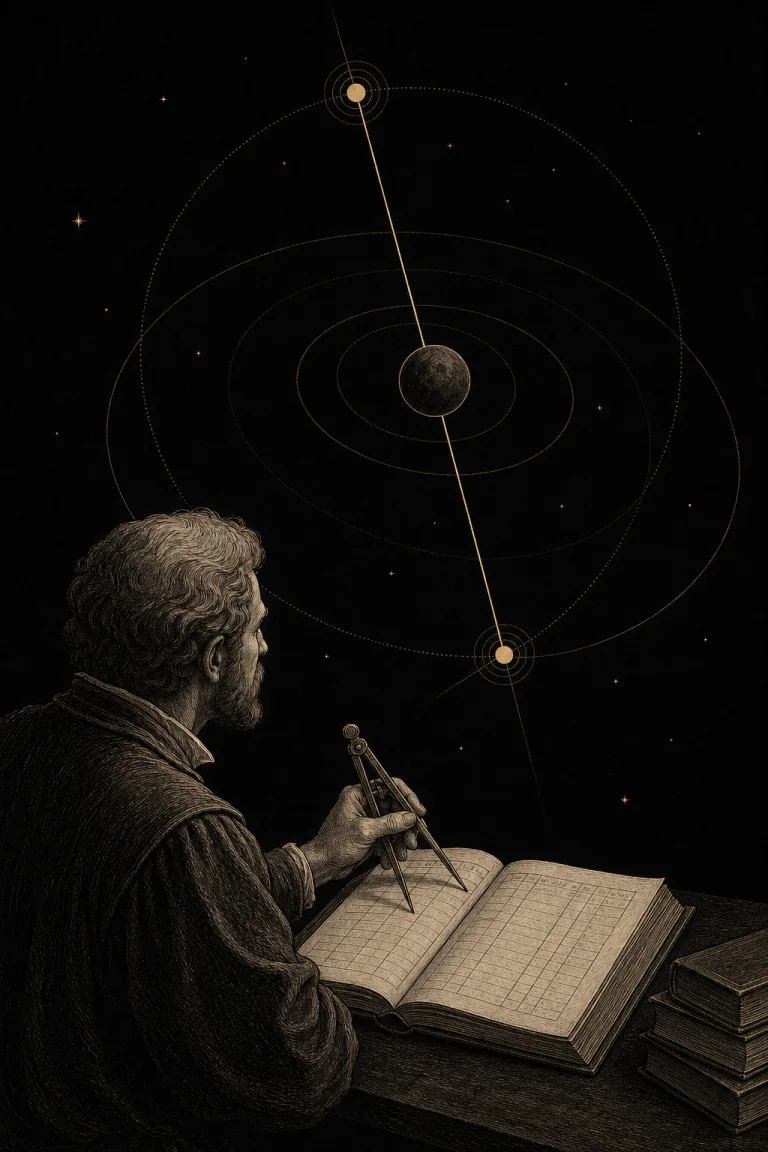
North Node conjunct Pluto transit occurs when the geocentric longitude of the moving North Node reaches the natal longitude of Pluto under one stated node convention. At the same moment, the South Node occupies the opposite longitude. Because the lunar nodes are an axis, the event is not a single isolated point. It is one conjunction and one opposition that must be timed and interpreted together.
Astrologers often associate Pluto with power, pressure, elimination, secrecy, control, inheritance, crisis, and deep change. Those themes can organize reflection, but the contact does not prove fate, trauma, exposure, wealth, coercion, death, or inevitable transformation. Calculate every exact pass first, preserve source uncertainty, and use the symbolism to audit choices, authority, consent, reversibility, and consequences.
Take the next insight with you
Explore personalized Astrology guidance in Veritas, available for iOS and Android.
 Scan with your phone
North Node conjunct Pluto transit at a glance
The exact geometry
Let N(t) be the chosen transiting North Node longitude and Pn the natal Pluto longitude. Solve wrap180(N(t) - Pn) = 0. At every solution, the South Node lies at N(t) + 180 degrees modulo 360, so it simultaneously opposes natal Pluto. This is ordinary circular longitude geometry. The lunar nodes guide explains why both ends of the axis remain part of the same event.
Verify natal Pluto and chart settings
Natal Pluto changes slowly, so birth-time uncertainty usually moves its longitude much less than it moves the Moon, Ascendant, or houses. Still verify the birth date, civil time, time zone, calendar, coordinates, zodiac, and ephemeris. A date-only chart may support the Pluto longitude while leaving houses and angles uncertain. The unknown birth time guide shows how to label those limits instead of hiding them.
Mean node and true node are different models
The mean node smooths short-period oscillation. The true node includes it and can change direction briefly. Either convention can be used consistently, but they do not produce interchangeable timestamps. Label the model in every table, chart, export, and note. If you compare both, run two complete searches and keep two result sets rather than switching settings to select a preferred date.
How to calculate every exact pass
- Freeze the natal target
Record natal Pluto longitude, zodiac, reference frame, ephemeris, birth inputs, and uncertainty.
- Choose the node model
Select mean or true North Node before searching and keep that setting fixed for the entire run.
- Scan a broad window
Sample signed circular longitude difference often enough to detect every crossing and near-zero turn.
- Bracket each root
Preserve intervals where the difference changes sign and inspect close approaches that may touch without a simple sign change.
- Refine and verify
Use a numerical root finder, recompute the final separation, and record the timestamp, direction, model, and tolerance.
- Preserve the axis
Annotate the simultaneous South Node opposition and keep every valid pass in the final interpretation.
Why multiple passes matter
A true-node search may produce several crossings because the node can oscillate around the natal longitude. Even a mean-node workflow should be checked over a sufficient window rather than assumed to have one date. Treat the full series as one transit period with distinct exact contacts. Do not label the first pass a warning, the second a crisis, and the third a resolution unless documented events actually justify that narrative.
Choose and disclose an orb
An orb defines an interpretive window, not the exact event. Choose it before reviewing the life story, disclose it, and distinguish entry, exactitude, and exit. Pluto's slow natal motion does not make a wide nodal orb more accurate. A smaller orb produces a shorter, more reproducible window; a larger orb increases the chance of fitting unrelated events after the fact. See astrology transits for a general timing workflow.
Pluto themes as audit questions
Pluto symbolism can prompt questions about who has decision rights, which resources are concentrated, what is hidden, what pressure is present, what cannot easily be reversed, and which ending has already occurred. Turn each theme into a specific audit. Who owns the asset? Which rule authorizes the action? What evidence supports the concern? What is the exit route? Symbolic intensity is not evidence that an extreme event is unfolding.
Power, pressure, and consent
In relationships or organizations, distinguish legitimate authority, negotiated influence, dependence, persuasion, manipulation, and coercion. Record what was requested, what can be refused, what consequence follows refusal, and who controls information or resources. A chart cannot establish consent or abuse. When pressure is real, use direct communication, written agreements, safeguarding procedures, legal advice, or qualified support rather than relying on transit symbolism.
Work, institutions, and concentrated resources
At work, the transit may be used to review approvals, access, succession, ownership, confidential data, budget control, legacy systems, and shutdown criteria. A useful question is not whether power will arrive, but whether authority matches responsibility and oversight. Record the decision owner, affected people, evidence, appeal path, rollback plan, and review date. Do not predict promotion, dismissal, merger, scandal, or institutional collapse from the contact.
Money, debt, inheritance, and shared assets
Pluto is sometimes linked with shared wealth, debt, taxes, insurance, and inheritance. Treat those as categories to verify, not promised outcomes. Review account ownership, obligations, beneficiaries, fees, deadlines, security, liquidity, and professional advice. The transit cannot reveal an undisclosed account, guarantee an inheritance, select an investment, or replace regulated financial, tax, or legal guidance.
Health and crisis language
Avoid using Pluto as shorthand for death, disease, trauma, detoxification, or guaranteed healing. A transit does not diagnose a condition or establish the cause of symptoms. Use medical services for symptoms, emergency services for immediate danger, and qualified mental health support for distress. Astrology can help structure questions and records, but it must not intensify fear or delay evidence-based care.
Houses are conditional on reliable birth time
If the birth time is reliable, natal Pluto's house may identify the life domain where power, ownership, or endings are being reviewed. The transiting node's house adds another contextual layer. If time is uncertain, do not present house placement as exact. Sign, degree, aspect geometry, and documented circumstances can still support a useful analysis without invented angular precision.
Worked protocol
Suppose natal Pluto is 18 degrees 42 minutes in a stated tropical chart. Run the mean-node search across a broad window, refine every zero of circular difference, and verify the South Node at the opposite longitude. Repeat separately with the true node if comparison is useful. For each pass, log known decisions, authority, pressure, shared resources, exits, and evidence. Review the record after the full series rather than forcing every event into a Pluto story.
Build a power and consequence audit
Use Veritas to record natal Pluto, node model, every exact pass, simultaneous South Node opposition, sources, decision rights, pressure, consent, ownership, reversibility, costs, safeguards, and review dates.
North Node conjunct Pluto compared with Neptune
The North Node conjunct Neptune transit emphasizes source quality, ambiguity, ideals, and porous boundaries. The Pluto contact emphasizes concentrated power, pressure, ownership, secrecy, endings, and consequences. Both require the same node-setting discipline and simultaneous South Node opposition, but they answer different primary questions. Neither proves a soulmate, revelation, crisis, or transformation.
Pluto return is a different calculation
A Pluto return compares transiting Pluto with natal Pluto and operates on a roughly 248-year orbital scale, making it mainly relevant to long-lived national or institutional charts. North Node conjunct natal Pluto compares the moving node with natal Pluto and recurs on the nodal cycle. Do not transfer dates, charts, or interpretations between the two techniques.
Common mistakes and responsible limits
Common mistakes include mixing mean and true node dates, reporting one pass, ignoring the South Node, fitting a wide orb after an event, and using intense language as evidence. North Node conjunct Pluto transit is a symbolic timing technique, not scientific prediction, diagnosis, proof of coercion, financial guidance, or certainty about death, loss, exposure, wealth, or transformation. Visit the <a href="/astrology">Astrology journal hub</a> and aspect guide for related methods.