Astrology Journal
North Node Conjunct Uranus Transit: Timing and Meaning
North Node conjunct Uranus transit is an exact moving-node contact to natal Uranus that requires consistent settings, every pass, and the simultaneous South Node opposition.
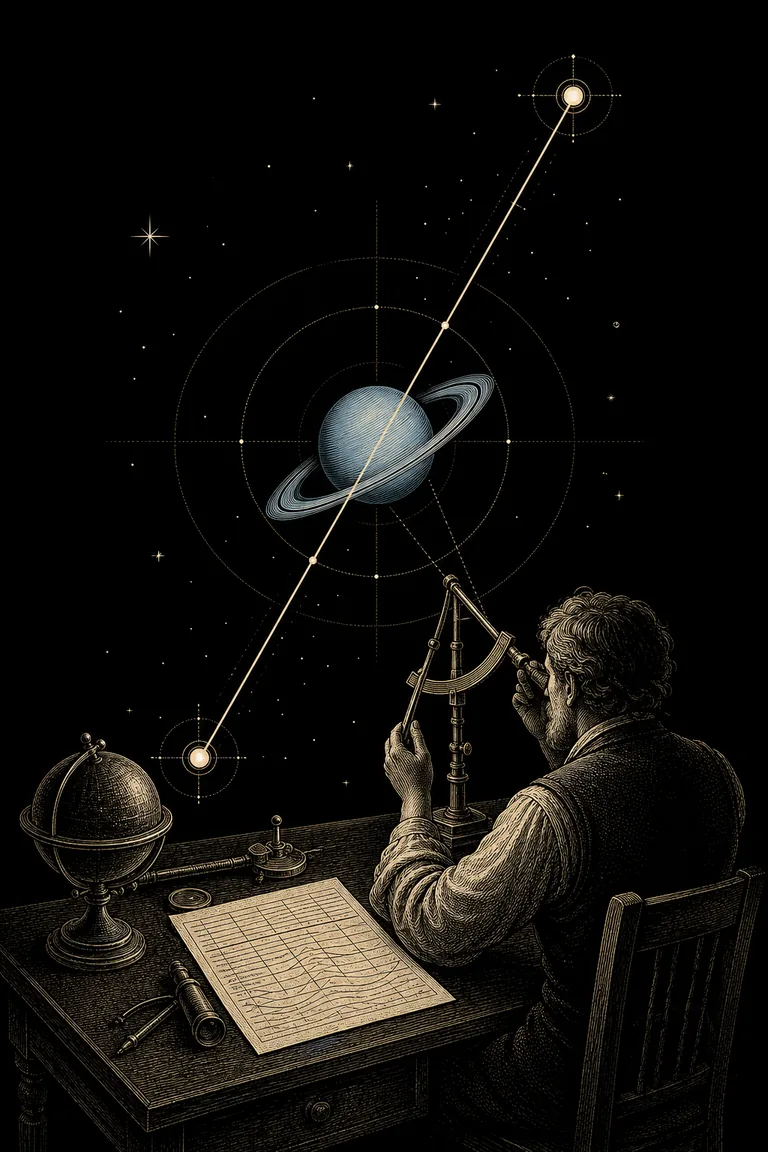
North Node conjunct Uranus transit occurs when the transiting North Node reaches the same zodiacal longitude as natal Uranus. Astrologers may use the contact to review autonomy, experimentation, disruption, technology, groups, rules, nervous excitement, and changes that challenge an established pattern. It does not guarantee a breakthrough, shock, separation, invention, awakening, accident, rebellion, or sudden success.
Calculate the contact before interpreting it. Record natal Uranus's longitude, tropical or sidereal zodiac, mean or true node, ephemeris source, time zone, orb, and every exact crossing. The South Node is simultaneously opposite natal Uranus because the nodes form one axis. That opposition belongs to the same geometry and should not be counted as a separate event.
Take the next insight with you
Explore personalized Astrology guidance in Veritas, available for iOS and Android.
 Scan with your phone
North Node conjunct Uranus transit at a glance
The exact geometry
A conjunction is a zero-degree longitude relation. If natal Uranus is at 18 degrees 42 minutes Aquarius, the exact contact occurs when the selected transiting North Node reaches 18 degrees 42 minutes Aquarius in the same zodiac. The South Node then occupies 18 degrees 42 minutes Leo. The lunar nodes guide explains the axis and why astronomical calculation must remain separate from symbolic claims.
Record data quality and natal Uranus
Save the birth date, recorded time, place, source, time-zone conversion, and calculated Uranus position. Uranus moves slowly, so a modest birth-time error usually changes its longitude less than it changes houses or angles. Uncertain dates, historical time zones, and a Uranus station can still matter. State uncertainty directly. House interpretation needs stronger birth-time confidence than the conjunction by longitude.
Mean node and true node
The mean node is a smoothed mathematical position. The true node includes shorter oscillations and may briefly reverse direction. Their exact dates can differ, and the true node may cross the same Uranus longitude more than once. Neither series is scientifically established as the correct symbolic choice. Select one in advance, label it, and calculate the other as a separate model if comparison is useful.
Calculate circular distance
Convert both positions to longitudes from 0 to 360 degrees, subtract, take the absolute value, and use the shorter distance around the circle. Natal Uranus at 318 degrees 42 minutes and North Node at 318 degrees 08 minutes are 0 degrees 34 minutes apart. Applying or separating status depends on the node's actual motion in the selected ephemeris, not on its usual retrograde direction.
Illustrative longitude check
Natal Uranus: 318 degrees 42 minutes
Transiting North Node: 318 degrees 08 minutes
Shorter circular distance: 0 degrees 34 minutes
Transiting South Node: 138 degrees 08 minutes
Find every exact pass
Search a broad interval that includes orb entry, every zero crossing, and final exit. True-node oscillation can produce several exact contacts in a compact period. Rounding to whole degrees can merge crossings or invent one. Inspect the signed longitude difference before and after each candidate, preserve timestamps at adequate precision, and do not select only the pass nearest a memorable disruption.
Choose the orb before reviewing events
No scientifically validated orb exists for this transit. Choose a narrow observational orb before opening calendars, messages, health records, release notes, or relationship histories. Keep it fixed and record why. A broad window contains more software changes, travel interruptions, arguments, surprises, and ordinary novelty, making a Uranus story easy to assemble after the fact.
Uranus topics without automatic disruption
Astrologers associate Uranus with autonomy, experimentation, reform, interruption, invention, technology, networks, unconventional choices, and sudden changes of state. Each topic has several expressions. Innovation can solve a real problem or create avoidable instability. Independence can protect agency or evade responsibility. A broken pattern can reveal a better option or simply break something useful. Evidence must decide which description fits.
Experiments need boundaries
Use the transit as a prompt to define a reversible experiment rather than to force a dramatic change. Name the problem, hypothesis, smallest test, people affected, consent, safety constraint, budget, rollback condition, owner, and review date. Novelty is not evidence of value. Astrology cannot authorize risky driving, unsafe electrical work, medication changes, security bypasses, abrupt financial bets, or contact that violates a boundary.
Technology, systems, and networks
For technology, separate feature ideas from reliability, privacy, accessibility, security, support, and maintenance. For groups, distinguish invitation, membership, decision rights, shared standards, and the ability to leave. A transit cannot prove that a platform, community, tool, or unconventional method is trustworthy. Use documentation, backups, staged tests, professional review, and informed consent where failures could affect other people.
Autonomy and responsibility
Autonomy means meaningful choice within real constraints, not freedom from consequences. Ask which rule is being challenged, who created it, whom it protects, and whether a safer alternative exists. Some rules are arbitrary; others encode hard-earned safety or fairness. Uranus symbolism does not make every refusal brave or every institution oppressive. Preserve contracts, duties, dependencies, and the rights of people who did not choose the experiment.
Nervous excitement, stress, and safety
Excitement, disrupted sleep, racing thoughts, fear, or agitation can have many causes. Astrology cannot diagnose a nervous-system condition, mania, anxiety, or imminent danger. Track sleep, substances, workload, medication, stressors, and concrete hazards through appropriate care. If behavior becomes unsafe or functioning changes sharply, seek qualified help rather than treating the transit as an awakening that must be followed.
House, sign, and natal aspects
Uranus's sign may qualify style, the natal house may locate a life area, and natal aspects may describe relationships already present in the chart. Keep these layers separate. The Uranus sign guide and aspects guide support that work. House claims depend on birth time and house system, while no placement proves genius, instability, rebellion, or technological talent.
A worked observation example
Suppose the contact overlaps a proposed change to a team's scheduling system. Before orb entry, record the existing failure rate, staff needs, privacy constraints, support burden, and decision owner. During the window, test one reversible change with a small group and log exceptions. After final exit, compare missed shifts, support tickets, consent concerns, and rollback costs. The transit did not cause the proposal or prove that disruption was beneficial.
A three-phase observation protocol
- Before entry
Record current rules, autonomy constraints, systems, technology, group roles, stress load, and proposed experiments.
- During the window
Log exact passes, dated changes, affected people, consent, outcomes, failures, counterexamples, and rollback decisions.
- After final exit
Compare results with baseline data and identify what improved, what destabilized, and what should be restored.
Retrospective review and confirmation bias
For a past transit, calculate dates before searching for shocks or breakthroughs. Define supporting and contradicting observations first. Include ordinary days inside the orb and comparable periods outside it. Uranus language can fit software updates, travel delays, new devices, changing friendships, protests, surprise messages, and routine plan changes. Without a prospective definition, memorable novelty will dominate recall.
This is not an Uranus return
A Uranus return occurs when transiting Uranus returns to natal Uranus, a cycle longer than a typical human lifespan. This article concerns a moving lunar node reaching natal Uranus. The moving bodies, speed, cycle, and repeated-pass behavior are different. Similar language about change or autonomy does not make the calculations interchangeable.
How this differs from the Saturn contact
The Saturn contact owns duty, limits, standards, authority, maintenance, time, and durable obligations. This Uranus contact owns autonomy, experiments, networks, technology, interruption, and rule change. A project may involve both structure and innovation, but each planetary longitude requires its own dates, orb, evidence, counterexamples, and review.
Build an auditable Uranus transit record
Use Veritas to save natal Uranus, data quality, zodiac, node model, ephemeris, orb, every pass, South Node opposition, proposed change, hypothesis, consent, safety limits, baseline, failures, rollback condition, and review date.
Common mistakes and responsible limits
Common mistakes include rounding Uranus, mixing node models, dropping repeated passes, choosing an orb after a surprise, counting the South Node opposition twice, and treating disruption as proof of growth. Astrology is a symbolic practice, not scientific forecasting, diagnosis, engineering review, cybersecurity guidance, or safety assessment. It cannot replace evidence, backups, qualified professionals, informed consent, or emergency help. Review the transits guide, preserve house limits with the uncertain birth time guide, and browse the <a href="/astrology">Astrology journal hub</a>.