
Tarot Journal
Many Sevens in a Tarot Reading: What It Means
Many Sevens in a Tarot reading usually emphasize several tests of judgment, persistence, strategy, or private assessment. Count them against the whole spread, keep each suit and position distinct, and ask what evidence would justify the next move.
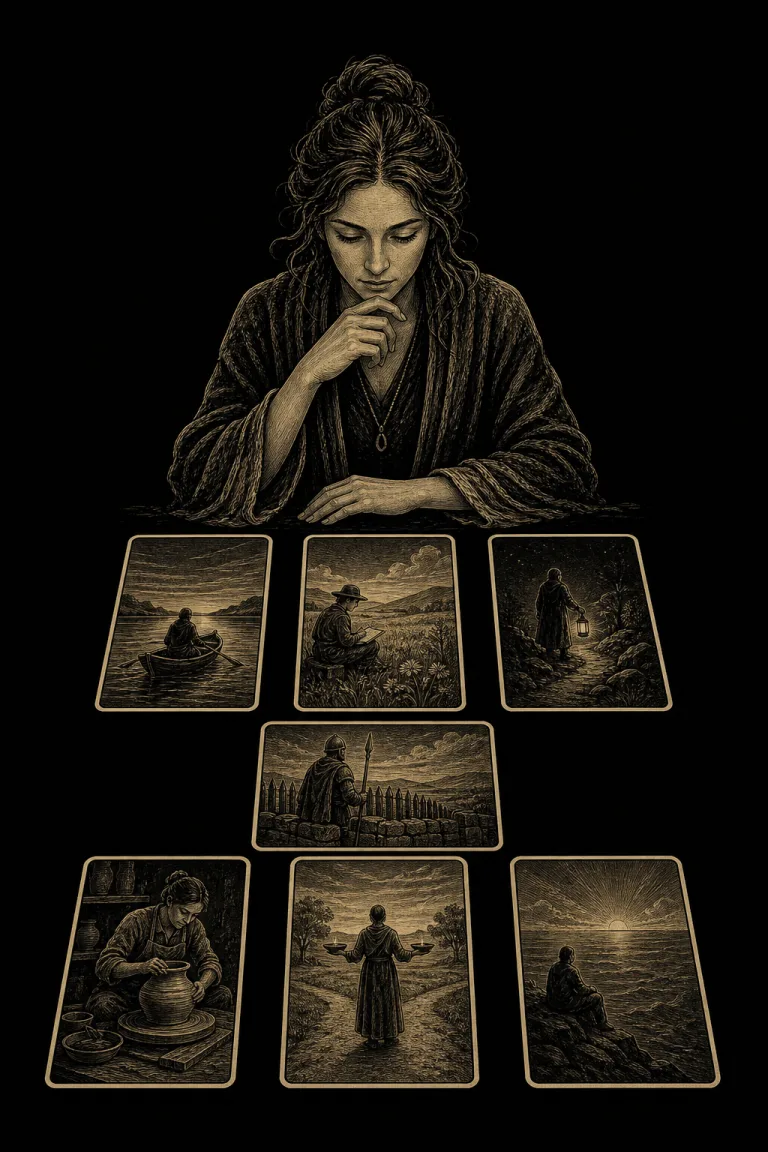
Many Sevens in a Tarot reading do not automatically mean luck, deception, spiritual mastery, or a coming victory. They show that rank Seven repeats, so several cards may be testing how you assess options, defend a position, investigate uncertainty, review progress, or act with incomplete information. The useful question is "What is being tested, and what would count as enough evidence?"
Begin with the Seven count and total cards. Two Sevens in a three-card spread carry more structural weight than two in a twelve-card spread. Preserve suit, artwork, position, orientation, neighbors, the original question, and the planned draw rule. Repetition focuses attention. It does not prove hidden motives, danger, success, betrayal, timing, or a supernatural message.
Take the next insight with you
Explore personalized Tarot guidance in Veritas, available for iOS and Android.
 Scan with your phone
Many Sevens meaning at a glance
Start with the Seven count and denominator
Write the pattern as a fraction: two Sevens out of three cards, three out of eight, or four out of fifteen. State whether all cards came from one planned spread and whether clarifiers were added. A denominator prevents an eye-catching rank from taking over the reading. The card-count guide explains how to preserve the original sample.
Seven suggests assessment, not a single verdict
Seven often appears after the attempted rebalancing of Six, but its work varies by suit. It may ask for strategic positioning, honest evaluation, careful research, or choosing among emotionally charged possibilities. Assessment can confirm a plan, expose a weak assumption, or show that more information is unavailable. Rank alone cannot tell you which conclusion is correct.
Seven of Wands: defend a defined position
The Seven of Wands can depict pressure, a defended boundary, competition, advocacy, or holding ground after gaining visibility. Ask what the position is, who challenges it, what authority supports it, what maintaining it costs, and when withdrawal is sensible. The card does not prove that every critic is hostile, that the reader is right, or that persistence will win.
Seven of Cups: compare real options
The Seven of Cups can focus on multiple possibilities, projection, desire, distraction, or unclear selection criteria. List only options that actually exist, then compare cost, reversibility, evidence, constraints, and who is affected. Imagination can generate alternatives, but an attractive image is not an offer. The card cannot reveal a hidden soulmate, guaranteed opportunity, or secret choice made by someone else.
Seven of Swords: audit information and access
The Seven of Swords can raise questions about strategy, incomplete disclosure, privacy, independent action, avoidance, or handling information outside the main group. Do not jump from ambiguity to accusation. Check authorization, custody, source reliability, missing records, incentives, and ordinary explanations. The card never permits surveillance, account access, entrapment, or public allegations.
Seven of Pentacles: review progress and opportunity cost
The Seven of Pentacles can describe an interim review of work, time, money, maintenance, or expected yield. Compare the original goal with actual inputs and outcomes. Ask what can still change, what continuing costs, and what stopping would preserve. It does not guarantee harvest, profit, promotion, fertility, repayment, or a precise waiting period.
Position determines the kind of test
A Seven in the background may show a prior choice or unresolved assessment. In the present it can identify an active decision point. In advice it should become a bounded action such as verifying a source, comparing two real options, setting a boundary, or reviewing progress. In an outcome it describes a possible test if current conditions continue, not a fixed result.
Several Sevens may share one decision system
Test for a concrete connection before combining cards. Seven of Cups with Seven of Pentacles might connect option selection to resource limits. Seven of Wands with Seven of Swords might connect a public boundary to private information handling. If the positions concern unrelated domains, keep them separate. A shared rank does not prove a coordinated threat or one hidden cause.
Non-Sevens are counterevidence, not background noise
A Six may show the balance being tested, an Eight may show implementation, a court card may identify a role, and a Major Arcana card may widen the frame. Read every card. A difficult Seven cannot erase practical support, while a reassuring neighbor cannot cancel documented risk. The Minor Arcana pattern guide provides a wider baseline.
Reversed Sevens need a declared convention
If you read reversals, choose the rule before interpretation: blocked expression, delay, excess, internalized experience, lower intensity, or attention to a different image feature. A reversed Seven is not automatically surrender, confession, exposure, certainty, or a failed test. Compare it with position, neighbors, and records. The reversal guide supports consistency.
A seven-step method for a Seven-heavy spread
- Record the pattern
Write the Seven count, denominator, original question, positions, draw rule, and reversal method.
- Separate each test
Name the specific boundary, option set, information question, or progress review shown by each card.
- Define criteria
State what evidence would support, weaken, or end each interpretation before seeking more information.
- Check authority
Identify who owns the decision, data, resource, boundary, and consequences, including consent and appeal.
- Compare alternatives
Include ordinary explanations, non-Sevens, direct records, constraints, and the cost of delay or action.
- Choose one test
Run one reversible comparison, verification, boundary, or progress review within your authority.
- Set a stopping rule
Name the deadline, evidence threshold, review date, and condition for stopping further draws or inquiry.
Worked example: choosing a work proposal
A five-card work spread contains Seven of Cups in options, Seven of Pentacles in resources, and Justice in advice. The reader records two Sevens out of five, lists only documented offers, compares pay, workload, timing, exit terms, and opportunity cost, then requests one missing contract detail. The cards do not prove which employer is honest or which choice will succeed.
Worked example: privacy in a relationship
A relationship spread shows Seven of Swords in the present, Seven of Wands in advice, and Two of Cups as context. Instead of accusing a partner, the reader identifies the exact information concern, protects their own account, asks one direct question, and states a boundary. They do not search a device or treat silence as proof. Consent and observable behavior remain primary.
Do not keep drawing until uncertainty disappears
Sevens can tempt repeated investigation. Extra clarifiers change the denominator and may reward answer shopping. Set the draw rule before seeing the cards. If one term truly needs clarification, define it, draw once, and stop. Preserve the full sequence. Cards cannot create missing evidence or authorize access to information you do not have a right to inspect.
Compare many Sevens with many Sixes
Many Sixes owns attempted rebalancing through transition, recognition, memory, exchange, or repair. Many Sevens owns the assessments that follow: defend, compare, investigate, and review. A spread containing both may show a proposed balance being tested, but it cannot establish that the test is fair, the evidence complete, or the outcome certain.
Turn the pattern into one bounded assessment
Choose the smallest legitimate test: compare two written offers, verify one source, review one milestone, state one boundary, or identify one missing approval. Decide in advance what result would support action, pause, escalation, or withdrawal. A Seven-heavy spread can structure attention, but records, consent, professional guidance, and observable consequences determine the real decision.
Save each Seven as a separate assessment
Use Veritas to record the Seven count and denominator, suit, position, image evidence, exact test, authority, options, counterevidence, one bounded action, stopping rule, and review date.
A practical journal prompt
Complete: "This spread contains __ Sevens out of __ cards. The first test concerns __, the second concerns __, and they share or do not share a decision system because __. My evidence threshold is __. The strongest alternative explanation is __. One action within my authority is __, and I will stop or review when __."
Responsible limits
Many Sevens in a Tarot reading are a symbolic pattern, not scientific evidence of luck, deception, betrayal, victory, danger, profit, fertility, diagnosis, guilt, consent, legal rights, safety, or future events. Do not use cards to accuse, surveil, gamble, invest, diagnose, or override another person. Visit the <a href="/tarot">Tarot journal hub</a> and use direct records, communication, qualified guidance, privacy, and ordinary safety checks.