Tarot Journal
Many Sixes in a Tarot Reading: What It Means
Many Sixes in a Tarot reading usually emphasize several attempts to restore proportion, move forward, exchange support, receive recognition, or integrate what came before. Count them, keep their suits and positions separate, and test what balance actually requires.
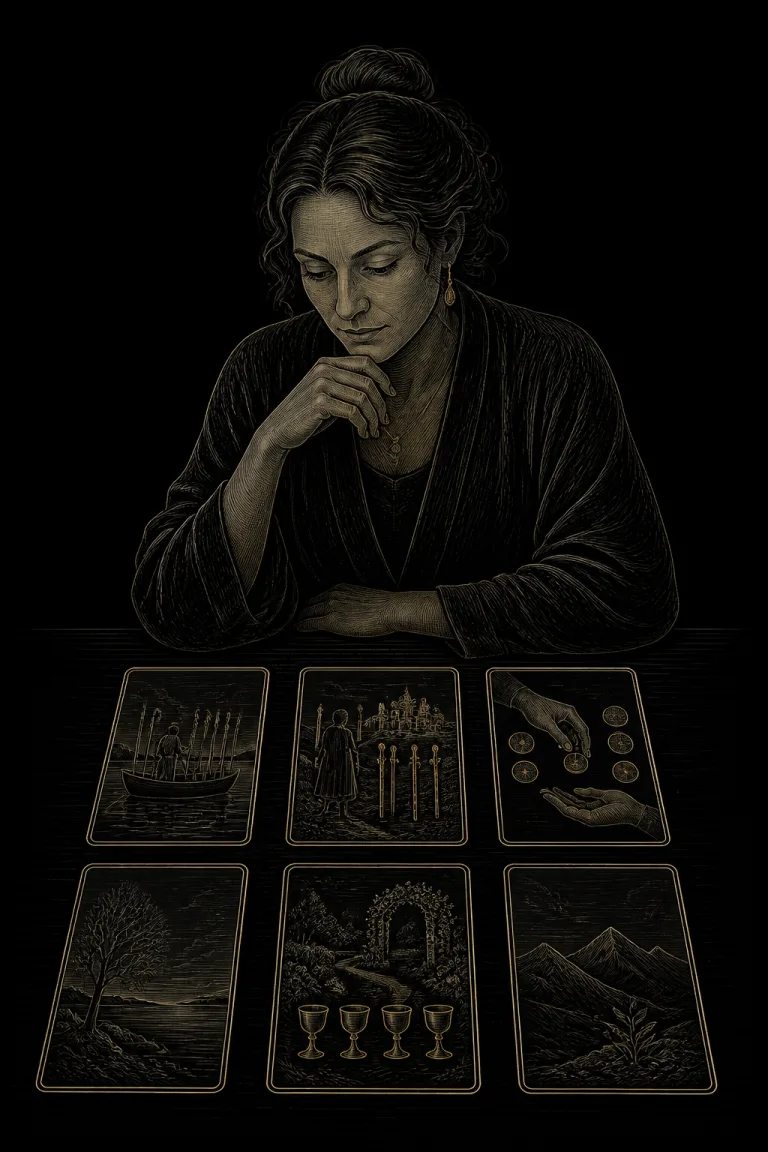
Many Sixes in a Tarot reading do not automatically promise harmony or success. They show that rank Six repeats across the spread, so several cards may be describing recovery after strain, a crossing between conditions, a visible result, memory, reciprocity, or practical problem-solving. The useful question is not "Will everything work out?" but "What is being rebalanced, by whom, and on what terms?"
Start with the number of Sixes and the total number of cards. Two Sixes in a three-card spread carry more structural weight than two in a twelve-card spread. Then preserve suit, image, position, orientation, neighboring cards, and the original question. Repetition raises attention. It does not establish fairness, permanence, consent, repayment, victory, reconciliation, or a future event.
Take the next insight with you
Explore personalized Tarot guidance in Veritas, available for iOS and Android.
 Scan with your phone
Many Sixes meaning at a glance
Start with the Six count and denominator
Write the pattern as a fraction before interpreting it: two Sixes out of three cards, three out of nine, or four out of fifteen. State whether all cards came from one planned draw and whether clarifiers were counted. The denominator prevents a visually memorable rank from becoming the whole reading. The card-count guide helps preserve the original sample and question.
Six suggests rebalancing, not automatic resolution
Six often follows the disruption associated with Five, but that does not mean every problem is solved. Rebalancing can involve transition, negotiation, distribution, public response, memory, repair, or accepting a workable limit. It may be partial, temporary, unequal, costly, or still in progress. Rank alone cannot establish who benefits, whether terms are fair, or whether the new balance can last.
Six of Wands: recognition and its conditions
The Six of Wands can show visible progress, acknowledgment, leadership, a milestone, or support gathered around an effort. Ask what was achieved, who contributed, who defines success, and what happens after attention moves on. It does not guarantee promotion, popularity, victory, fame, or universal approval. In advice it may request clear credit and next responsibilities rather than celebration alone.
Six of Cups: memory, return, and asymmetry
The Six of Cups can focus on memory, familiarity, care, a return to an earlier place or practice, or an exchange shaped by unequal age, experience, or power. Nostalgia is evidence about present feeling, not proof that the past was safe or accurate. The card cannot promise reunion, identify a soulmate, establish childhood facts, or override another person's boundaries.
Six of Swords: a managed crossing
The Six of Swords can describe movement away from strain, carrying unresolved information, accepting help, or navigating a transition with limited options. Ask who is moving, what is carried, what remains behind, who controls the route, and what makes arrival safer. It does not prove escape, travel, recovery, separation, migration approval, or freedom from consequences.
Six of Pentacles: terms of exchange
The Six of Pentacles can raise questions about giving, receiving, distribution, eligibility, debt, charity, wages, access, or dependency. Identify the resource, amount, decision-maker, criteria, duration, conditions, privacy, and appeal route. A generous-looking image does not prove fairness or good intent. The card cannot replace contracts, budgets, benefits rules, professional advice, or direct consent.
Position tells you what kind of balance is being tested
A Six in the background may describe an earlier transition or exchange. In the present it may show active adjustment. In advice it should become a bounded action such as documenting terms, planning a route, crediting contributors, or checking whether support is reciprocal. In an outcome it shows a possible condition if current choices continue, not a guaranteed final state.
Several Sixes may share a system or remain separate
First test whether the cards concern one concrete system. Six of Wands with Six of Pentacles might connect recognition to compensation. Six of Cups with Six of Swords might connect memory to a difficult move. If positions concern unrelated domains, keep them separate. A shared rank does not prove one hidden cause, one person behind every event, or a single solution.
Use suits to identify the resource being rebalanced
Wands can emphasize effort and public response, Cups relationship and memory, Swords information and transition, and Pentacles material exchange and maintenance. These are interpretive conventions, not facts. Compare the actual artwork and guidebook. The element-imbalance guide owns the different question of spread-wide suit distribution.
Non-Six cards can challenge the apparent repair
A Five may show unresolved strain, a Seven may test the next threshold, a court card may identify a role, and a Major Arcana card may widen the frame. Read these as evidence rather than footnotes. A reassuring Six cannot cancel danger or debt, while a difficult neighbor does not erase genuine support. The Minor Arcana pattern guide provides a wider baseline.
Reversed Sixes require a declared method
If you use reversals, decide in advance whether reversal means blocked expression, delay, excess, internalized experience, reduced intensity, or a different image emphasis. A reversed Six is not automatically failure, ingratitude, private success, or a cancelled return. Compare it with position, neighbors, and real terms. The reversal guide supports a consistent method.
A six-step method for a Six-heavy spread
- Record the pattern
Write the Six count, total cards, original question, positions, draw rule, and reversal method.
- Name each process
Describe the exact transition, recognition, memory, or exchange shown without combining cards too early.
- Identify the resource
State what moves between people or conditions: effort, attention, care, information, money, time, access, or safety.
- Inspect the terms
Check authority, consent, contribution, distribution, cost, duration, exit, appeal, and who is missing.
- Read counterweights
Include every non-Six, direct record, alternative explanation, available support, and material constraint.
- Choose one test
Define one proportionate action, owner, success measure, stop condition, and review date.
Worked example: recognition at work
A six-card work spread contains the Six of Wands in the present, Six of Pentacles in advice, and Three of Pentacles in the background. The reader records two Sixes out of six. They separate public acknowledgment from compensation, document contributors, compare role expectations and pay criteria, and request one review. The cards do not prove promotion, fair treatment, or another person's intent.
Worked example: a relationship transition
A relationship spread shows Six of Cups in history, Six of Swords in the present, and Justice in advice. The reader distinguishes shared memory from the practical terms of moving forward. They verify housing, money, belongings, communication, and consent. The cards do not establish reconciliation, separation, fidelity, legal rights, or what the other person privately feels.
Do not keep drawing to secure a happy ending
Repeated clarifiers change the denominator and encourage answer shopping. Decide the draw rule before seeing the cards. If one defined term needs clarification, state it and draw once, then stop. Keep the complete sequence. Pulling until a comforting Six appears does not strengthen the reading; it hides uncertainty and makes the pattern impossible to evaluate.
Compare many Sixes with many Fives
Many Fives owns disruption, conflict, loss, constraint, and adaptation. Many Sixes owns the attempted rebalancing that follows: crossing, recognition, memory, distribution, or repair. A spread containing both can show what changed and how people are responding, but it does not prove that the response is complete, equal, ethical, or permanent.
Turn rebalancing into one measurable action
Choose the smallest action that can test the proposed balance: write one credit list, compare one distribution rule, map one safe transition, clarify one return condition, or set one reciprocal support agreement. State what evidence would count as improvement and what would require revision or withdrawal. Symbolic balance is a hypothesis; observed terms and outcomes determine what happens next.
Save each Six as a separate rebalancing process
Use Veritas to record the Six count and denominator, suit, position, image evidence, affected resource, terms, consent, non-Six counterweights, one action, stop condition, and review date.
A practical journal prompt
Complete: "This spread contains __ Sixes out of __ cards. The first rebalancing process is __, the second is __, and they share or do not share a system because __. The resource and terms are __. The strongest counterevidence is __. One measurable action within my authority is __, and I will review it when __."
Responsible limits
Many Sixes in a Tarot reading are a symbolic pattern, not scientific evidence of harmony, victory, repayment, reunion, travel, healing, fairness, charity, promotion, legal rights, health, safety, or future events. Do not use cards to diagnose, accuse, invest, gamble, cancel obligations, or override consent. Visit the <a href="/tarot">Tarot journal hub</a> and use direct records, communication, qualified guidance, and ordinary safety checks.