Tarot Journal
Tarot Border Symbolism: An Evidence-First Guide
Tarot border symbolism becomes useful when you treat the printed frame as evidence: note what it contains, interrupts, reveals, or allows to cross before assigning meaning.
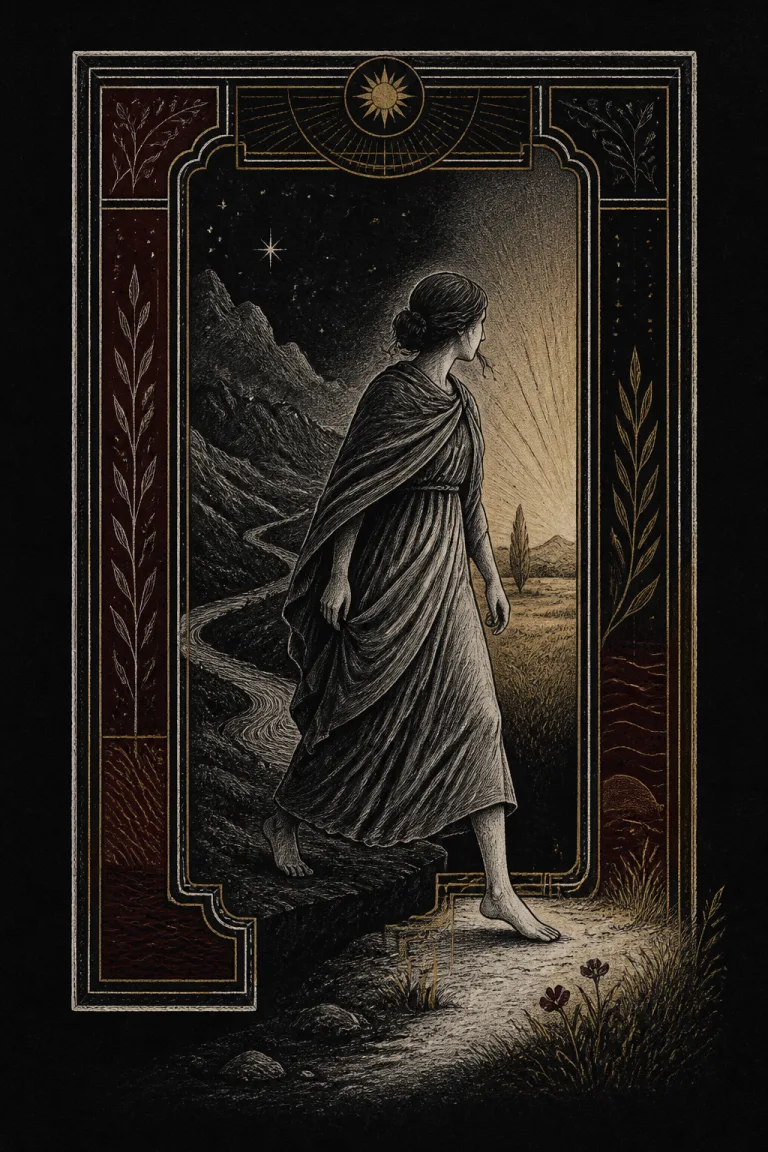
A Tarot card border can separate the pictured world from the table, create a margin around a scene, repeat the deck's visual identity, or become part of the illustration itself. Some borders are closed and ornamental. Others open around a path, hand, tool, cloud, or beam of light. Borderless decks remove most of that division. None of these choices carries one universal meaning.
Start with the physical edition. Record the outer edge, inner frame, margin width, openings, overlaps, crop, and any element that crosses the boundary. Compare several cards before deciding that one feature is exceptional. A broken frame can suggest access or interruption in context, but it cannot prove escape, protection, fate, or a future event.
Take the next insight with you
Explore personalized Tarot guidance in Veritas, available for iOS and Android.
 Scan with your phone
Tarot border symbolism at a glance
What counts as a Tarot card border
The physical card edge is not always the illustrated border. A card may have a blank margin, one printed rule, several nested frames, corner ornaments, a title panel, or an image that runs to the cut edge. Name each layer separately. Use the Tarot card symbolism guide to inventory the scene before deciding whether the boundary actively affects it.
Margins create distance without explaining it
A wide margin can make a scene feel contained, archival, remote, or formally presented. A narrow margin can enlarge the picture and bring figures closer to the physical edge. Those are visual effects, not fixed messages. Check whether the width is standard across the deck, whether a title panel changes the balance, and whether the reproduction has been cropped.
Openings, gaps, and interrupted frames
A gap may align with a road, doorway, stream, gaze, or ray of light. It can provide a visible route between the image and its surrounding space. It may also be decorative or caused by wear. Ask what creates the opening, whether it is usable inside the scene, and whether the same device appears elsewhere. Shape analysis covers the form of the gap; border analysis covers its location at the picture boundary.
When an element crosses the border
A hand, foot, weapon, plant, garment, cloud, or animal may overlap the frame. Describe the direction and degree of crossing. Is the object emerging, leaving, reaching, resting on the edge, or simply printed above an ornament? The movement guide owns depicted route and pace. A crossing creates emphasis and contact, but it does not guarantee action in real life.
Nested borders and internal panels
Several frames can separate title, emblem, foreground, and distant scene. This may create hierarchy, sequence, protection, display, or historical styling. Trace which layer belongs to the deck template and which changes card by card. An internal window is part of the depicted space; the printed border is part of the image's presentation.
A six-pass border reading method
- Identify the edition
Save deck name, publisher, year, printing, digital source, and whether the image has been cropped.
- Map every boundary
List card edge, margin, printed rules, title panels, openings, interruptions, and internal frames.
- Record contact
Note each object or figure that touches, overlaps, crosses, or remains separated from a boundary.
- Compare the deck
Check at least five neighboring cards for standard borders, recurring openings, and ordinary ornament.
- State the scene function
Explain what the border contains, separates, emphasizes, reveals, blocks, or connects.
- Test an alternative
Consider printing, crop, decoration, and composition before choosing a symbolic interpretation.
Worked example: a path breaks the lower frame
Imagine a road that continues through a gap in the bottom border. The visible evidence is continuity between foreground and card edge. One interpretation may emphasize an accessible route; another may see the path as inviting the reader into the scene. Neither reading predicts travel or departure. Check whether every road in the deck uses the same device.
Worked example: a figure remains inside two frames
A seated figure enclosed by an architectural arch and a printed border has two different boundaries. The arch belongs to the depicted place, while the outer frame belongs to presentation. The scene may emphasize layered distance or formal display. Calling it imprisonment would require additional evidence such as barriers, posture, access, and context.
Borderless decks and full-bleed art
A borderless deck lets color and scenery reach the cut edge, but it does not automatically mean freedom or openness. Full-bleed printing can increase immersion, enlarge details, and make adjacent cards appear visually continuous. Compare cards in a spread, while remembering that coincidental alignments and trimming differences are common.
Compare the frame before the meaning
Use Veritas to record edition, border layers, margin, openings, crossings, crop, deck comparison, two possible functions, and the evidence that would change your reading.
Borders, shapes, and composition are different levels
The shape guide examines bounded forms anywhere in the artwork. The composition guide maps the whole frame, focal path, balance, depth, and negative space. Border symbolism stays at the image edge and asks how that edge participates in the scene. Keeping these levels separate reduces overinterpretation.
Reversals, scans, and damaged cards
Reversal changes orientation, not the printed border's identity. A lower opening becomes upper, but its scene role must still be checked. Scans may add black bars or remove margins. Rounded corners, worn edges, foil, and misregistration can also create false interruptions. Compare a reliable image or another copy before treating damage as symbolism.
Common mistakes and responsible limits
Common mistakes include reading standard decoration as card-specific evidence, confusing a doorway with the printed frame, ignoring crop differences, treating every crossing as escape, and assuming borderless art is spiritually superior. Tarot is a reflective practice, not scientific prediction or surveillance. Borders cannot replace consent, direct communication, medical care, legal advice, financial evidence, or safety planning. Visit the <a href="/tarot">Tarot journal hub</a> for related methods.