Tarot Journal
Tarot Shape Symbolism: An Evidence-First Guide
Tarot shape symbolism becomes useful when you describe a form's boundary, openness, repetition, fit, and scene function before attaching a symbolic meaning.
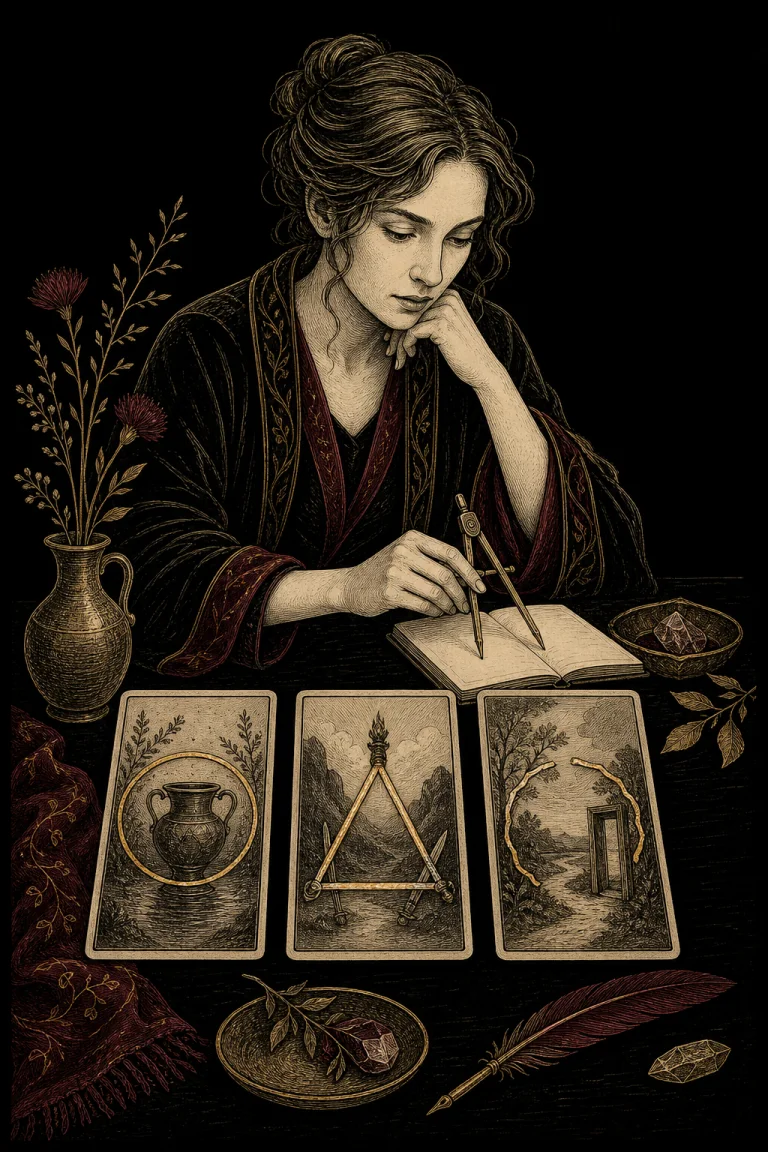
Shapes appear everywhere in Tarot art: a circular halo, triangular roof, rectangular doorway, arch, shield, cloud, pool, or empty gap between figures. Some forms are deliberately geometric, while others emerge from bodies, objects, landscape, or negative space. A visible shape is evidence, but it does not carry one automatic message across every deck.
Begin by locating the boundary and asking what creates it. Is the form closed or open, regular or irregular, repeated or isolated, stable or distorted? Then identify what it contains, supports, separates, exposes, or makes possible in the scene. Compare the same artist's visual grammar before using symbolic language. A circle does not guarantee completion, and a triangle does not automatically indicate conflict or spiritual ascent.
Take the next insight with you
Explore personalized Tarot guidance in Veritas, available for iOS and Android.
 Scan with your phone
Tarot shape symbolism at a glance
What counts as a shape in Tarot art
A shape is an area recognized through a boundary. The boundary may be literal, such as the edge of a coin, window, shield, or pool. It may also be implied by aligned figures, clustered stars, or the empty area between two objects. First list the visible parts with the Tarot card symbolism guide. Then decide whether the boundary is clear enough to analyze as a form rather than an accidental arrangement.
Closed and open forms ask different practical questions
A closed form has a continuous or nearly continuous boundary. It may contain, protect, isolate, organize, or simply describe an object accurately. An open form has a gap through which attention, movement, light, or another object can pass. Openness is not always freedom, and closure is not always restriction. Check whether the opening is usable, whether the enclosure is occupied, and what the scene requires.
Circles, rings, and rounded enclosures
Circles can organize attention around a center, repeat a natural object such as the Sun or a coin, show rotation, create containment, or mark a boundary without corners. Before calling a circle wholeness, eternity, or protection, identify its source. A wheel turns, a halo frames, a coin represents a material object, and a ring may bind or connect. Similar outlines can perform different narrative jobs.
Triangles and three-point structures
Three points can create a stable base and apex, a directional wedge, a roof, a mountain, a group relationship, or a gap between objects. Orientation matters only in relation to the pictured structure. An inverted triangle is not automatically negative, and an upward point is not always growth. Ask what bears weight, what occupies the apex, and whether the sides are actual edges or an implied grouping.
Squares, rectangles, grids, and frames
Four-sided forms often come from built space: doors, windows, tables, books, fields, walls, and card borders. They can make measurement, access, division, support, or containment visible. Their meaning comes from use and condition. A rectangular doorway may offer entry, remain locked, or frame a distant scene. The object guide owns the item's function; shape analysis explains how its form organizes that function.
Organic and irregular shapes
Bodies, clouds, flames, foliage, water, fabric, and damaged objects rarely follow perfect geometry. Their irregular boundaries can show adaptation, growth, erosion, motion, softness, or ordinary natural variation. Avoid treating regular as good and irregular as bad. Describe what caused the form and whether it helps or hinders the scene before introducing metaphor.
Negative shapes and the space between things
The gap between two figures may form a narrow wedge, open corridor, oval, or jagged division. This negative shape can reveal distance, access, crowding, or a visual route even though no object fills it. The composition guide addresses the whole frame. Shape analysis stays with one bounded empty area and tests whether it has a clear scene function.
Repetition, nesting, overlap, and fit
Repeated circles, arches, tiles, shields, or windows can group details and create rhythm. Nested forms may reinforce a center or show layers of access. Overlap can create depth, contact, concealment, or obstruction. A form that fits its container communicates something different from one visibly compressed or spilling out. Compare repetitions with the deck template so printing conventions are not mistaken for card-specific emphasis.
A six-pass shape reading method
- Locate the boundary
Name the lines, object edges, contours, clusters, or empty spaces that make the form visible.
- Describe the structure
Record openness, closure, regularity, corners, curvature, symmetry, distortion, overlap, nesting, and repetition.
- Identify the source
Decide whether the form belongs to an object, body, building, landscape, light effect, border, or implied grouping.
- State the scene function
Explain what it contains, frames, supports, divides, exposes, directs, protects, blocks, or allows.
- Compare the deck
Check the artist's normal geometry, borders, perspective, suit motifs, card templates, and reproduction quality.
- Test two interpretations
Choose between plausible meanings only after checking card title, guidebook, question, position, and neighboring cards.
Worked example: a circle around a vessel
Imagine a vessel placed inside a clear ring. The ring may protect the vessel, designate its working area, isolate it, or simply echo the vessel's rounded body. Check whether the ring is open, who can reach across it, and whether similar rings appear elsewhere. Containment is observable; emotional safety or promised completion is an interpretation that needs additional context.
Worked example: three objects form a triangle
Suppose two tools rest on a table while a lamp sits above them, producing an implied triangle. The arrangement can stabilize the group and direct attention to the lamp. It may suggest coordinated resources, hierarchy, or simple balanced design. Check scale, ownership, and actual use. The scale guide helps when one point is unusually dominant.
Worked example: an irregular form with an opening
A broken wall, bent branches, and a doorway may combine into an irregular enclosure with one gap. Trace which material creates each edge and whether the gap is passable. One reading may emphasize damaged protection; another may focus on a practical exit. The visible opening does not guarantee that a person will leave, enter, or choose either option.
Shapes across a multi-card spread
Separate cards can echo circles, triangles, arches, or gaps. Record the repetition and ask whether the spread positions support a relationship. Random dealing, crop differences, and common deck motifs can produce striking matches. Use repeated shapes as a comparison prompt, not proof of a hidden code that overrides card meanings or the reader's question.
Save the form before the story
Use Veritas to record the boundary, openness, regularity, source, scene function, deck comparison, two possible meanings, chosen interpretation, and evidence that could change it.
Lines, shapes, and composition are related but distinct
The line guide examines stroke quality, endpoints, breaks, and intersections. Shape begins when boundaries define an area. Composition explains how every element is arranged across the complete frame. Keeping these levels separate prevents one diagonal, circle, or empty patch from carrying more interpretive weight than the whole card supports.
Reversals, deck lineage, and accessibility
Reversal changes orientation but not the physical identity of every form. Borders, crops, foil, worn printing, and small screens can alter boundaries. Marseille pip cards, Rider-Waite-Smith scenes, Thoth-derived geometry, collage decks, and minimalist art use shape differently. Compare editions with the deck lineage guide. For nonvisual practice, use neutral descriptions that name boundary, openness, and function rather than vague geometric energy.
Common mistakes
Common errors include using a universal sacred-geometry dictionary, treating every circle as completion, assuming triangles mean conflict, equating regularity with virtue, ignoring negative space, counting accidental overlaps, and confusing a familiar object with an abstract symbol. Another mistake is analyzing low-resolution artwork without checking whether a boundary is actually present in the edition.
Limits and responsible use
Tarot is a reflective practice, not scientific prediction, diagnosis, surveillance, or proof of supernatural causation. Shape cannot establish another person's intentions or replace direct communication, consent, medical care, legal advice, financial evidence, or safety planning. Visit the <a href="/tarot">Tarot journal hub</a> for related methods and keep every conclusion proportional to the visible evidence.