Tarot Journal
Tarot Movement Symbolism: An Evidence-First Guide
Tarot movement symbolism becomes useful when you identify what changes position, trace the pictured route and effort, and avoid turning visual direction into a fixed timeline or prediction.
Movement in a Tarot image can be direct, prepared, interrupted, completed, or only implied. A person may walk, a horse may charge, a boat may cross water, a wheel may turn, or loose objects may travel through the air. These cues help describe action inside the scene, but they do not automatically predict travel, progress, delay, departure, or the speed of a real event.
A grounded reading separates visible motion from assumptions about where life is going. Identify the actor or object, starting point, route, destination, pace, effort, and obstacles. Then compare at least two functions using the card title, deck convention, landscape, posture, gesture, gaze, spread position, and question. Left and right are image directions until a specific layout or artist gives them a documented temporal role.
Take the next insight with you
Explore personalized Tarot guidance in Veritas, available for iOS and Android.
 Scan with your phone
Tarot movement symbolism at a glance
Begin with a motion inventory
List only what the image supports. Bent knees, lifted feet, displaced fabric, wakes, dust, angled rain, repeated limbs, wheel blur, or objects suspended along a trajectory may indicate movement. A standing figure who faces a path may be considering movement without taking it. A cloak that flows in a decorative pattern may not prove wind or speed. Mark uncertain motion as implied rather than observed.
Movement is not the same as posture or gesture
Posture describes how a body is supported and oriented at a moment. Gesture describes an action of a hand, arm, head, or object. Movement describes change of position through a scene or a visible trajectory. A figure can lean forward without walking, point without following the direction, or sit inside a moving vehicle. Use the posture guide and gesture guide to avoid counting one cue as three separate confirmations.
Identify actor, path, and destination
Ask who or what moves, where it begins, which route is available, and whether a destination appears inside or beyond the frame. A route can be open, narrow, curved, flooded, steep, crowded, or interrupted. The mover may choose the route, be carried by another force, or have no visible control. These distinctions are stronger than a generic label such as forward motion.
Direction without a universal timeline
Many readers associate the right side with the future and the left with the past, but that convention is not universal. Artwork may be mirrored, languages have different reading directions, and a spread can assign time through card positions rather than picture orientation. First describe left, right, toward, away, upward, downward, inward, outward, or across. Add a time meaning only if the deck, layout, and question support it consistently.
Pace, effort, and control
Pace is suggested by stride, balance, wake, dust, spacing, repetition, and the response of clothing or terrain. Effort may appear through bracing, pulling, climbing, steering, or carrying. Control depends on reins, rudders, footing, visibility, and available choices. A fast-looking image can still depict uncontrolled motion, while a slow step can be deliberate and sustainable. Neither gives a reliable calendar duration.
Human, animal, vehicle, and object motion
Human movement can show chosen action or response. Animal movement may introduce instinct, training, resistance, or a separate agency, depending on the scene. Vehicles shift attention toward transport, steering, passengers, and shared control. Flying rods, falling objects, flowing water, and turning wheels have trajectories without human intention. Do not assign a motive to every moving element.
Environmental motion
Waves, smoke, clouds, rain, and bending plants can reveal movement around a still figure. That may establish conditions the figure must navigate rather than an action the figure chooses. Compare environmental motion with the weather guide and the route described by the landscape guide. One gust or wave cannot establish inevitable external change.
A six-pass movement method
- Verify the mover
Name each person, animal, vehicle, object, or environmental element that visibly changes position or carries motion cues.
- Map start and route
Locate the apparent starting point, available path, boundaries, obstacles, and destination inside or beyond the frame.
- Classify the phase
Decide whether movement is completed, underway, prepared, interrupted, blocked, externally carried, or only implied.
- Estimate pace and control
Use several agreeing cues and separate speed from effort, stability, and the mover's degree of control.
- Offer two functions
Write at least two interpretations that fit the same evidence and state what detail would favor either one.
- State the boundary
Keep the conclusion inside the pictured scene and do not convert direction or speed into a guaranteed event or date.
Worked example: a walker on a winding path
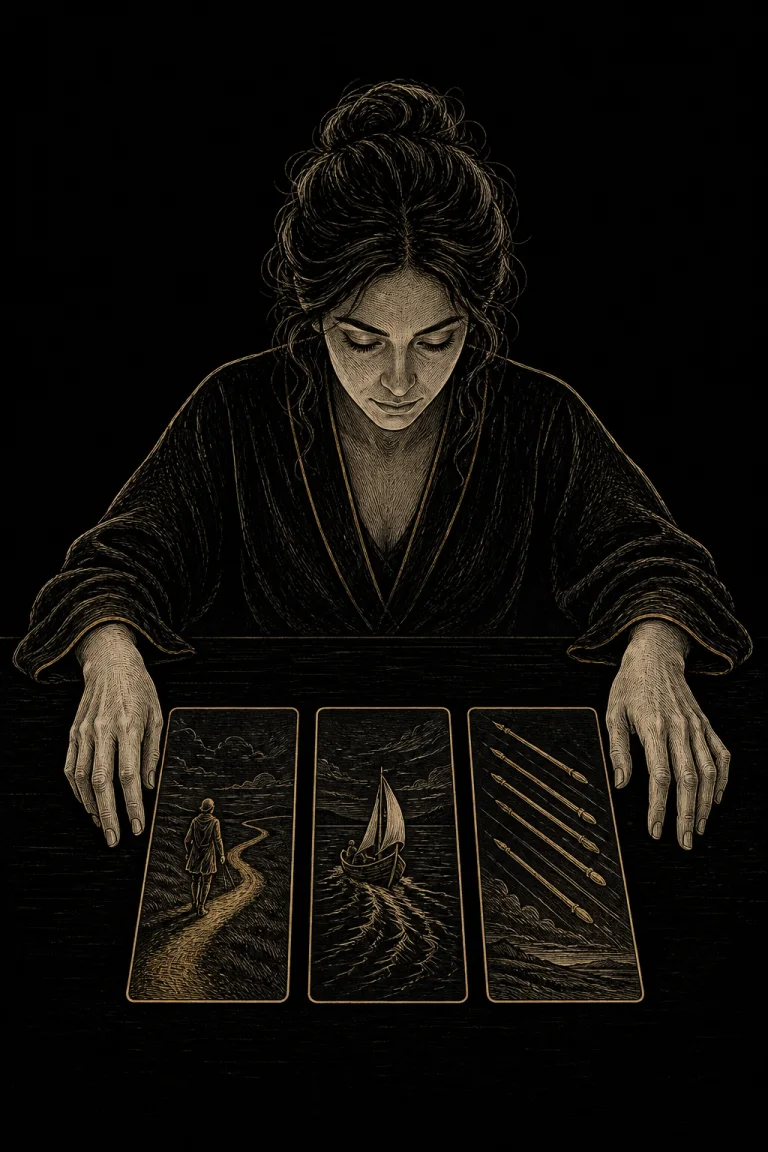
A figure is shown mid-step on a path that curves behind a hill. The lifted foot and changed position support movement underway. One function is continuing despite incomplete visibility. Another is a compositional device that guides the viewer deeper into the image. Check footing, carried objects, weather, and whether the figure looks toward the bend. The scene does not prove a move, trip, or hidden obstacle in real life.
Worked example: a boat crossing water
A wake behind a boat and ripples at the bow show actual displacement. Now ask who steers, who travels, what shore is visible, and whether water conditions help or resist the crossing. The movement might frame transition, transport, separation, or ordinary travel within the artwork. It does not specify that someone will leave, return, reconcile, or arrive by a certain date.
Worked example: rods in flight
Several parallel rods cross open air at a similar angle. Their spacing and alignment support a shared trajectory, but the image may not reveal sender, destination, or control. One function is coordinated motion already underway. Another is visual compression that makes separate actions appear simultaneous. The missing start and endpoint should lower confidence about cause and outcome.
Movement across a spread
In multiple cards, compare routes and directions only after respecting the assigned spread positions. Figures may face one another, move apart, continue in parallel, or encounter a boundary. The card combination method helps test whether the sequence genuinely forms one visual path. Cards from different decks, rotations, or decorative layouts may not share a common coordinate system.
Reversals and rotated layouts
A reversed card changes image orientation but does not physically animate the scene. Decide before reading whether reversal alters, internalizes, blocks, or simply qualifies the upright theme. Do not automatically turn rising into falling or rightward into backward. If a digital interface rotates or crops art, verify the original orientation before drawing a directional conclusion.
Gaze can confirm or contradict motion
A mover may look toward the route, back at the starting point, down at the ground, or outside the frame. That relation can show available attention without proving intention. A body moving one way while the head looks another creates a real visual tension worth describing. Use the gaze guide to separate line of sight from imagined thoughts.
Deck comparison and accessibility
The same card title may be active in one deck and nearly static in another. Compare the actual artwork before importing a familiar trajectory. Small screens, cropping, foil glare, and low contrast can erase wakes, feet, or motion lines. Accurate alt text or a guidebook description can preserve the important relation. The broader symbolism guide helps rank evidence that survives reproduction.
Keep a movement evidence record
Use Veritas to save the card and deck, mover, start, route, destination, motion phase, pace cues, control, obstacles, two competing functions, contradictions, spread position, confidence, and what later review changed.
A focused journal exercise
Choose three cards from one deck: one with human movement, one with a vehicle or animal, and one with moving objects or weather. Describe each scene without using progress, delay, past, or future. Then write two possible functions and one missing fact. Revisit the notes after reading the guidebook. A Tarot journal shows whether your directional rules stay consistent.
Common mistakes
Common errors include treating every rightward figure as the future, confusing facing with movement, assuming speed from one flowing garment, ignoring who controls a vehicle, assigning intention to weather or objects, reading a curved path as delay, and predicting literal travel. Another mistake is counting stride, posture, gaze, and direction as independent evidence when all arise from one drawn pose.
Limits and responsible use
Tarot movement symbolism is an interpretive visual method, not tracking, forecasting, diagnosis, or proof of another person's plans. It cannot establish travel safety, physical capacity, accident risk, legal status, relationship departure, financial progress, or a completion date. Use direct evidence and qualified guidance for consequential decisions, and keep card motion inside the scale of a reflective prompt.