Tarot Journal
Tarot Composition Symbolism: An Evidence-First Guide
Tarot composition symbolism becomes readable when you map the frame, focal point, groups, empty areas, depth, and visual path before deciding what the arrangement might contribute to the card.
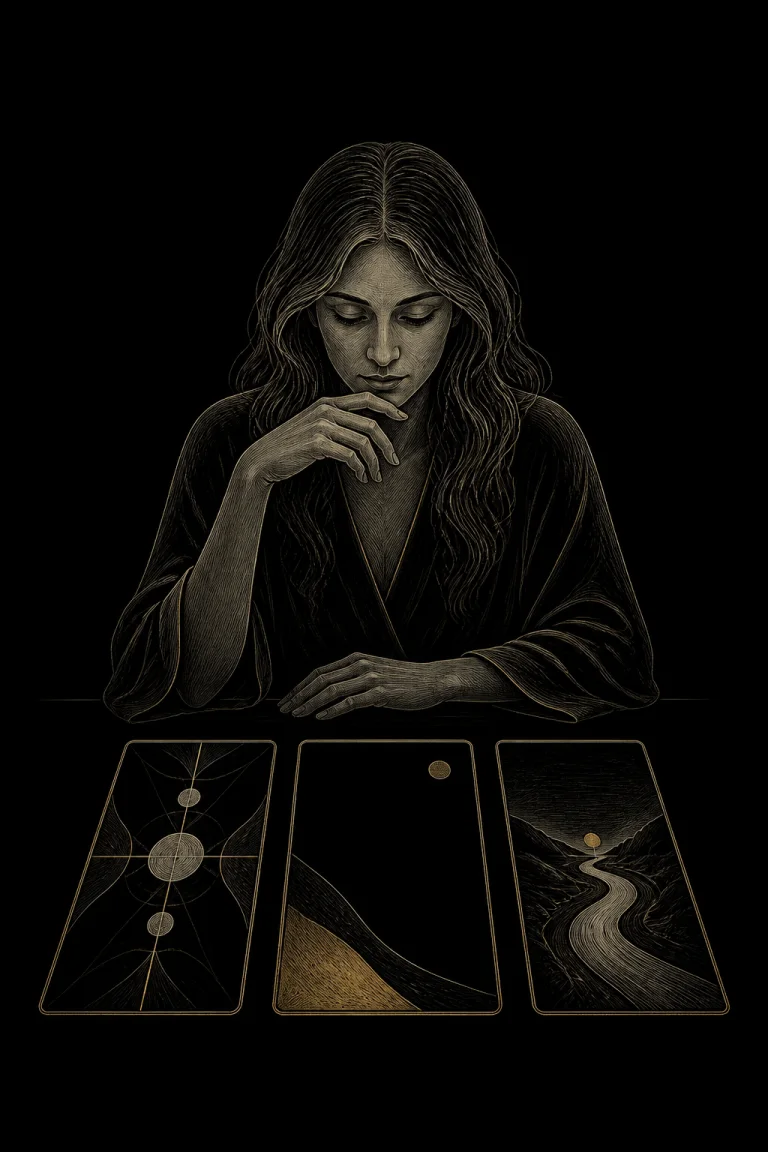
Composition is the arrangement of visual elements inside a Tarot card. It includes what occupies the center or edge, which forms are grouped or separated, where space remains open, how depth is constructed, and how contrast leads the eye through the image. Composition connects individual details into one designed whole, but it does not impose a universal meaning on every deck.
Begin by describing the complete frame before naming symbols. Record the first focal point, the route your eye follows, the strongest groupings, and any area that interrupts that route. Then propose at least two scene-based explanations and test them against the deck, card title, guidebook, spread position, question, and neighboring cards. Placement can organize reflection, but it cannot reveal a person's thoughts or prove that an event will happen next.
Take the next insight with you
Explore personalized Tarot guidance in Veritas, available for iOS and Android.
 Scan with your phone
Tarot composition at a glance
Composition is more than a list of symbols
A symbol inventory tells you that a card contains a figure, cup, doorway, hill, and bird. Composition asks how those elements relate: whether the cup blocks the doorway, the hill isolates the figure, or the bird creates a diagonal toward the open route. The Tarot card symbolism guide helps identify details and sources. This method owns the arrangement that makes those details operate together.
Start with the frame and crop
The card edge determines what the viewer can see. A close crop can make a face dominant, while a wide view can place the same face inside architecture or landscape. Note cut-off objects, partial bodies, margins, borders, windows, and frames within frames. Do not assume a cropped object is intentionally hidden until you compare the full edition, printing, and digital file. A phone thumbnail may remove evidence that the physical card preserves.
Find the focal point without declaring it most important
The eye may land first on the brightest contrast, sharpest edge, isolated shape, face, hand, or largest form. That is a focal point, not automatic proof of narrative importance. Record why it attracts attention. Then see whether the card title, guidebook, and repeated deck conventions support that emphasis. The light and shadow guide can help distinguish actual illumination from contrast created by printing or screen glare.
Axes, balance, and asymmetry
A centered figure can create formal balance, while unequal visual weight can make the image feel unsettled or directional. Weight may come from size, darkness, detail, color, density, or isolation, not only physical mass. Describe the arrangement before using words such as stable or tense. Symmetry may support ritual order in one deck and artificial constraint in another. Asymmetry may create motion, emphasis, or simply accommodate the card title.
Negative space is still designed space
An open sky, blank wall, dark gap, clear tabletop, or unoccupied side of the card can separate groups and give the eye room to pause. Empty space does not automatically mean loneliness, loss, possibility, or the unknown. Ask what it separates, frames, exposes, or makes reachable. Compare it with other cards from the same deck because minimal art may use open space as a default style rather than a special symbol.
Foreground, middle ground, and background
Depth layers help distinguish what appears close from what appears distant. Overlap, relative size, horizon, atmospheric detail, and converging lines can create that depth. Nearness does not always equal priority, and distance does not always mean the future. A background tower may organize the route even if it is small. Use the scale and proportion guide to separate depth cues from deliberate size distortion.
Grouping, overlap, and separation
Elements placed close together are often perceived as a group, especially when they share color, shape, direction, or a boundary. Overlap can establish depth or show that one form interrupts another. A gap can distinguish roles, create a threshold, or leave a route open. Test the grouping against actual contact and function. Two figures on the same side of a line are not necessarily allies, and separated figures are not necessarily in conflict.
Trace the viewing path
After finding the focal point, notice where your eye goes second and third. A gaze, pointing hand, road, beam, repeated color, or diagonal edge may create the route. Distinguish the viewer's eye movement from motion pictured inside the scene. The gaze guide owns looking direction, while the movement guide owns depicted change of position, pace, and control.
A seven-pass composition method
- Outline the frame
Record card shape, border, crop, inner frames, margins, and any element cut by an edge.
- Mark the first focus
Name where your eye lands and the visible contrast, isolation, detail, face, line, or scale cue that caused it.
- Map groups and gaps
Circle clustered elements and describe the space, boundary, or overlap between them.
- Separate depth layers
List foreground, middle-ground, and background elements and the cues that establish their apparent distance.
- Trace the eye route
Follow attention through two or three stops without confusing that route with chronology or literal motion.
- Offer two functions
Write two plausible ways the arrangement organizes attention, access, relationship, or contrast.
- Test and limit
Compare deck convention, card title, spread, neighbors, and guidebook, then remove mind reading and prediction.
Worked example: a centered figure and paired columns
A seated figure occupies the center between two vertical columns. One reading is formal mediation because the figure visually links two balanced sides. Another is constraint because the same columns narrow the available space. Check posture, exits, objects held, and whether the columns repeat throughout the deck. Centering alone does not prove authority, harmony, or indecision.
Worked example: one figure beside a large open field
A figure stands near the left edge while most of the card is open terrain. The space may expose a possible route, make the figure appear small, or direct attention to weather and distance. It may also be the artist's standard landscape style. Do not label the left edge as the past or the open side as the future without a declared deck-specific system and supporting evidence.
Worked example: a diagonal from hand to doorway
A raised hand, tool, and bright doorway align along a diagonal. The eye can follow that path even if nobody in the image is moving. One function is to connect an available action with an exit. Another is to contrast the held tool with the unoccupied threshold. Check gaze, contact, barriers, and spread question before calling the path a decision or departure.
Composition across a multi-card spread
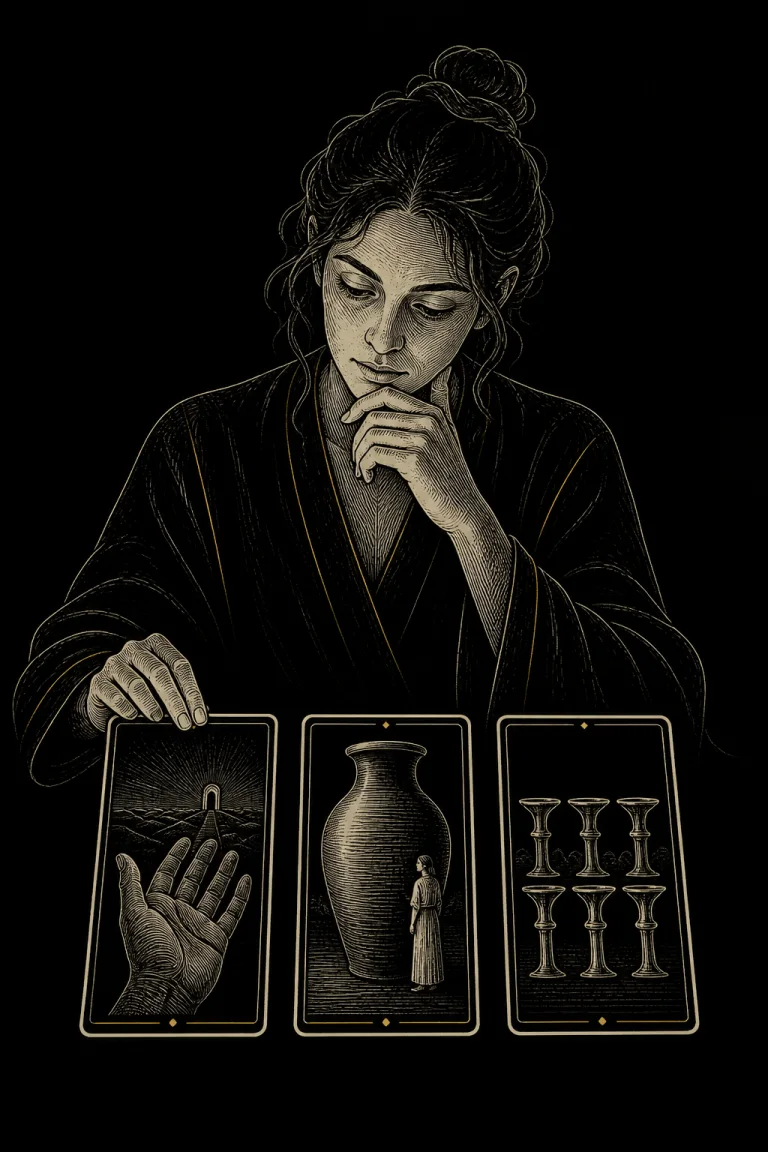
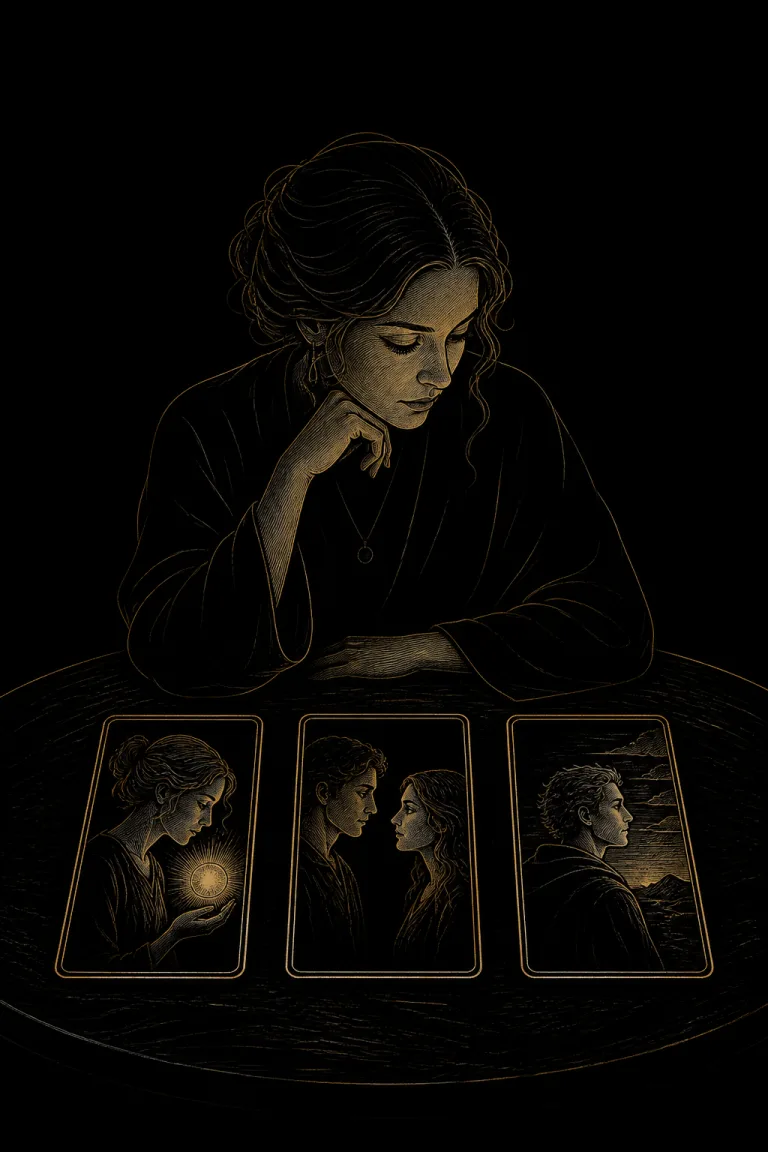
Cards placed together create a second composition. Figures may appear to face across a gap, repeated lines may continue, and dark or dense areas may cluster on one side. First read each card in its own frame, then describe the cross-card pattern. Use the card combination method to connect repeated functions through spread positions without turning accidental alignment into certainty.
Reversals change orientation, not the original design
A reversed card moves top to bottom and changes the viewer's path, but it does not prove that every compositional function becomes opposite. Decide whether your reversal method reads orientation, blocked function, altered emphasis, or no separate meaning. Round cards, borderless decks, mirrored backs, and digital auto-rotation can further complicate orientation. State the method instead of improvising a rule after seeing the spread.
Deck tradition and edition matter
A Marseille pip card, a Rider-Waite-Smith scene, and a contemporary collage can organize attention differently. Compare repeated templates, borders, suit geometry, and artist notes inside the same edition. The Rider-Waite versus Marseille guide explains why imagery systems should not be treated as interchangeable. A composition rule learned from one deck is a hypothesis in another.
Accessibility and shared observation
Low vision, color perception, screen size, and image quality change which focal points are available. Useful alt text names placement and relationships before conclusions: a figure sits centrally between two columns while a doorway remains visible behind. If a viewing path depends on subtle color, offer a second cue such as line or overlap. Shared description makes the evidence reviewable instead of treating one person's first glance as universal.
Save the whole visual map
Use Veritas to record the deck and edition, frame, crop, first focus, groups, gaps, depth layers, viewing path, two competing functions, spread evidence, contradictions, and what later review changed.
A focused composition exercise
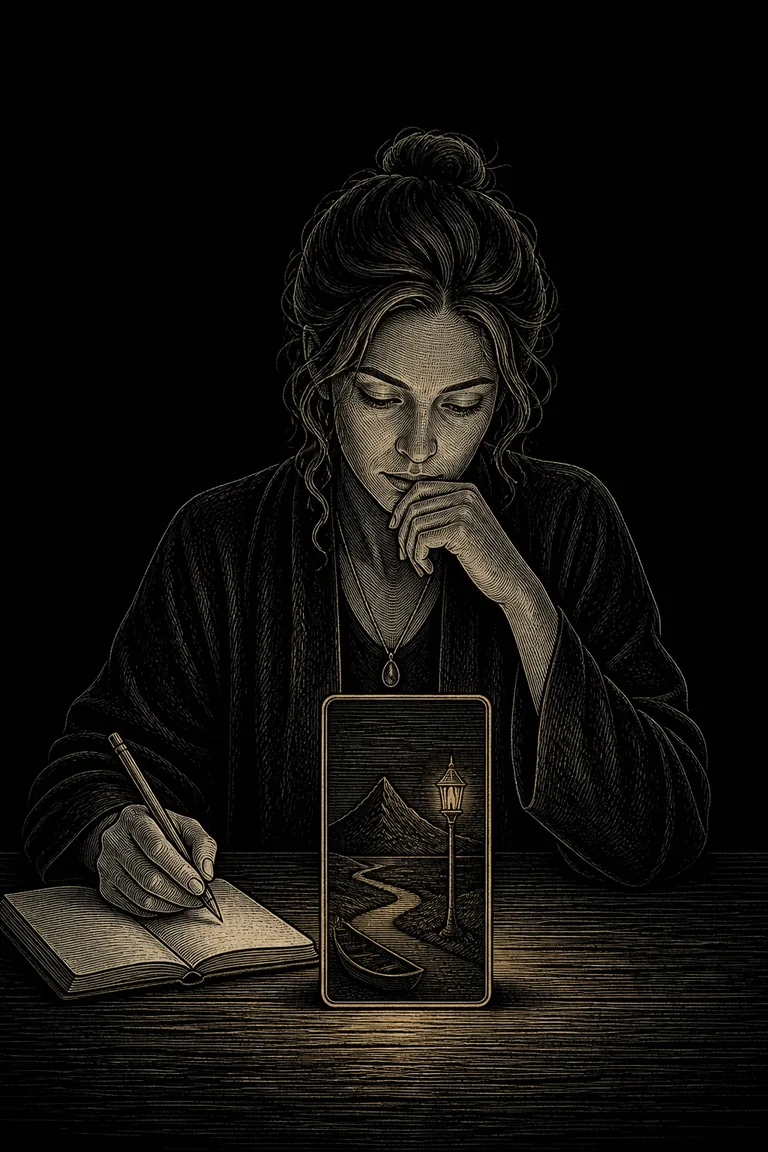
Choose three cards from one deck: one balanced around a center, one strongly asymmetric, and one with obvious depth. Photograph or sketch only the major masses and empty areas, without card names. Trace the eye route, write two possible functions, then restore the titles and guidebook. A Tarot journal helps reveal whether your compositional readings remain consistent or change to fit the question.
Common mistakes
Common errors include treating center as good, edges as exclusion, left as past, right as future, top as spiritual, and bottom as material without deck evidence. Other mistakes are confusing focal point with importance, ignoring crop and edition, reading negative space as absence, treating viewer eye movement as literal chronology, and counting every cross-card alignment as intentional.
Limits and responsible use
Tarot composition symbolism is a visual reflection method, not a validated way to detect intentions, diagnose relationships, establish truth, or forecast events. An isolated figure does not prove loneliness, a balanced design does not promise stability, and an open path does not guarantee opportunity. Use the <a href="/tarot">Tarot journal hub</a> for reflective learning, and make consequential decisions through current evidence, consent, direct communication, and qualified guidance.