Astrology Journal
North Node Conjunct Icarus Transit: Timing and Meaning
North Node conjunct Icarus transit can frame a controlled exposure review when asteroid 1566, calculation settings, every exact pass, the full nodal axis, hard limits, and recovery margin are documented.
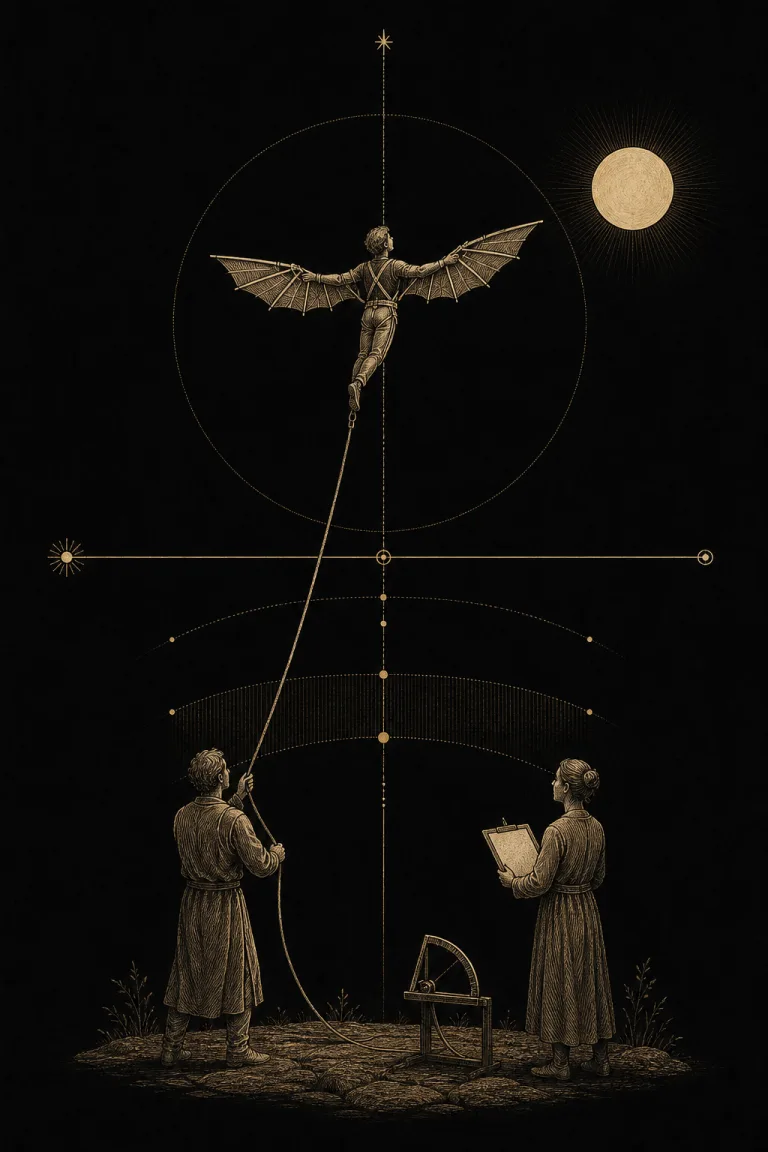
North Node conjunct Icarus transit occurs when the transiting North Node reaches the natal longitude of physical asteroid 1566 Icarus. Astrologers may use the contact as a narrow prompt to review ambition, ascent, exposure, warning signals, operating limits, and the capacity to return safely from an experiment. It does not prove a destined leap, public success, accident, fall, burnout, punishment, protection, recklessness, or permission to accept avoidable danger.
Begin with reproducible timing and a written risk boundary. Confirm asteroid 1566 in the natal chart, choose mean or true node, choose tropical or sidereal zodiac, state the ephemeris and orb, save every exact pass, and preserve the simultaneous South Node opposition. Before reading events, define one objective, the maximum exposure, an early warning, the person authorized to pause the attempt, and the money, time, support, or reputation reserved for recovery.
Take the next insight with you
Explore personalized Astrology guidance in Veritas, available for iOS and Android.
 Scan with your phone
North Node conjunct Icarus transit at a glance
Verify the physical asteroid first
NASA/JPL identifies 1566 Icarus, designation 1949 MA, as a near-Earth asteroid in the Apollo orbit class. Enter 1566 explicitly in chart software and confirm the object name and natal longitude. Save the software version and data source. The natal Icarus guide owns broader sign, house, aspect, synastry, and myth-based interpretation. Astronomical facts identify the object but do not establish astrological causation or predict an event.
Freeze node and zodiac settings
Mean and true lunar nodes can produce different exact dates. Tropical and sidereal zodiacs use different reference frames. Record one node model, one zodiac, ephemeris source, timezone, natal birth-data source, and narrow orb before reviewing events. If you compare configurations, preserve each output as a separate model. Do not select the setting that creates the most dramatic story after the outcome is known.
Record every exact pass
The node's motion can produce more than one exact contact within a wider interval. Export every date and time when the chosen North Node reaches natal Icarus and keep applying and separating phases under the same orb. Record quiet passes and failed expectations. The transit guide helps distinguish an exact contact from a broad narrative window. A memorable event does not justify erasing the rest of the timing record.
Preserve the South Node opposition
A conjunction to one lunar node necessarily places the other node opposite the same natal point. The South Node side can prompt review of an old appetite for exposure, a familiar escape route, previous advice, or a limit learned through experience. It is not a second omen. Use the node guide to keep the full axis visible and avoid turning the North Node into a command to climb higher.
Use a narrow orb and an event table
Minor-asteroid timing becomes impossible to evaluate when the orb expands until every achievement or setback fits. Choose the orb first. Build a table with exact pass, distance, applying or separating status, planned exposure, observed event, evidence source, warning status, decision, and alternative explanation. Keep the same columns for each pass. A quiet interval is data, and a later crisis should not move the original threshold date.
Natal condition sets the reference point
Record natal Icarus's sign, house, close aspects, and birth-time confidence. Houses and angle contacts can change when birth time is uncertain. If time is unknown, keep those claims conditional and use the unknown-time method. Planets and angles remain primary. A narrow asteroid contact can refine a repeated theme, but it should not become the master explanation for career, health, relationships, or safety.
Define one exposure before the window
Replace a broad question such as "Should I take a leap?" with one observable proposal. Examples include presenting a prototype to a limited audience, accepting a trial assignment with written return rights, increasing a training load by a measured amount, or publishing one draft under a review policy. State the objective, duration, audience, cost, maximum loss, data collected, and what remains reversible. The transit frames a review, not the decision itself.
Set a hard limit and an early warning
The hard limit is the point the attempt must not cross: a budget ceiling, workload cap, safety standard, legal restriction, privacy boundary, physical limit, or consent condition. An early warning triggers review before that limit. It might be error rate, fatigue, missed obligations, unexpected cost, support volume, or a direct request to stop. Choose both before the experiment. Moving them after discomfort begins defeats their purpose.
Protect the recovery margin
A bold test is not recoverable merely because it is exciting. Reserve enough time, money, energy, support, data backup, contractual protection, or reputation to return to a stable state if the attempt fails. Name the return route and verify that it actually exists. A verbal promise, assumed rescue, or untested backup is not a recovery margin. High-stakes physical, medical, legal, and financial decisions require qualified assessment outside astrology.
Authority and consent must be explicit
Name who can start, pause, modify, and stop the attempt. Also name every person whose consent, labor, privacy, money, or safety is involved. Enthusiasm from one person cannot substitute for another person's agreement. A symbolic Icarus story cannot override workplace policy, guardianship, safety instructions, contractual duties, professional standards, or a clear refusal. If nobody has authority to call a stop, the design is incomplete.
A seven-step Icarus transit method
- Verify
Confirm natal asteroid 1566 Icarus, longitude, birth-data source, and software.
- Freeze settings
Choose node model, zodiac, ephemeris, timezone, and narrow orb.
- Map the axis
Save every North Node conjunction and simultaneous South Node opposition.
- Define the exposure
State one objective, scope, audience, duration, cost, and maximum acceptable loss.
- Install controls
Choose the hard limit, early warning, consent checks, and person authorized to pause.
- Protect return
Reserve a real recovery margin and test the return route before increasing exposure.
- Review
Compare the result with predeclared criteria on a fixed date, including quiet and contrary evidence.
Worked example: a public launch
A designer wants to reveal an unfinished product near an exact pass. Instead of calling visibility destined, the team limits the audience, removes personal data, states that the build is a test, caps support hours, monitors error rate, preserves rollback, and names the engineer who can stop access. The result is evaluated against prewritten criteria. The transit did not prove applause, criticism, adoption, funding, or a safe product.
Worked example: a stretch assignment
An employee is offered duties above their current role. They compare authority, training, pay, workload, supervision, success measures, trial length, and written return rights. Missed safety checks or sustained overtime trigger review. The manager cannot cite astrology to demand acceptance, and the employee cannot use it to prove promotion. The contact prompts an exposure audit while the agreement and workplace evidence govern the choice.
Worked example: physical training
An athlete considers increasing training intensity. A qualified coach and clinician, not the chart, assess readiness and contraindications. The plan uses a measured increment, recovery days, symptom thresholds, and permission to stop. The transit may provide a journaling date but cannot diagnose, prescribe, certify safety, or predict injury. Pain, breathing problems, fainting, or other warning signs require the appropriate real-world response.
Compare Icarus with Hekate and Apollo
North Node conjunct Hekate owns a threshold decision, available paths, reversibility, and exit. North Node conjunct Apollo owns practice, visibility, scope, credit, and audience consent. Icarus owns controlled ascent, maximum exposure, warning signals, recovery margin, and stop authority. A public threshold can involve all three ideas, but each article should answer its own search question.
Read Icarus with larger chart factors
Mars can describe action, assertion, heat, and conflict. Saturn can describe engineering, duty, structure, delay, and consequence. The Sun can describe visibility and identity, while Jupiter can describe scale. Use the aspect guide and the whole natal and transit context. One asteroid should not replace the planets, actual competence, environmental conditions, or a formal risk assessment.
Guard against heroic hindsight
After success, a risky choice can be retold as brave destiny. After failure, the same choice can be retold as a warning that was always obvious. Save the objective, controls, expected outcomes, alternatives, exact passes, and forecast before results arrive. Later, compare the full record, including ordinary explanations and outcomes that contradict the mythic framing. A compelling story is not the same as a useful model.
Save the exposure controls before the pass
Use Veritas to record asteroid 1566, node and zodiac settings, every exact pass, both nodes, objective, hard limit, early warning, stop authority, recovery margin, and review date.
A practical Icarus transit prompt
Complete: "My verified natal Icarus is __ using __ settings. Exact passes are __. The simultaneous South Node opposition highlights __. The bounded exposure is __. My hard limit is __, and the early warning is __. __ is authorized to pause. The return route and recovery reserve are __. I will compare the result with __ on __."
Responsible limits
North Node conjunct Icarus transit is a symbolic timing framework, not scientific evidence of destiny, success, fame, danger, injury, accident, mania, burnout, punishment, protection, or permission to take a risk. Visit the <a href="/astrology">Astrology journal hub</a> and use consent, records, qualified medical, legal, financial, engineering, and safety guidance, and real stop procedures for consequential decisions.