Tarot Journal
Many Fives in a Tarot Reading: What It Means
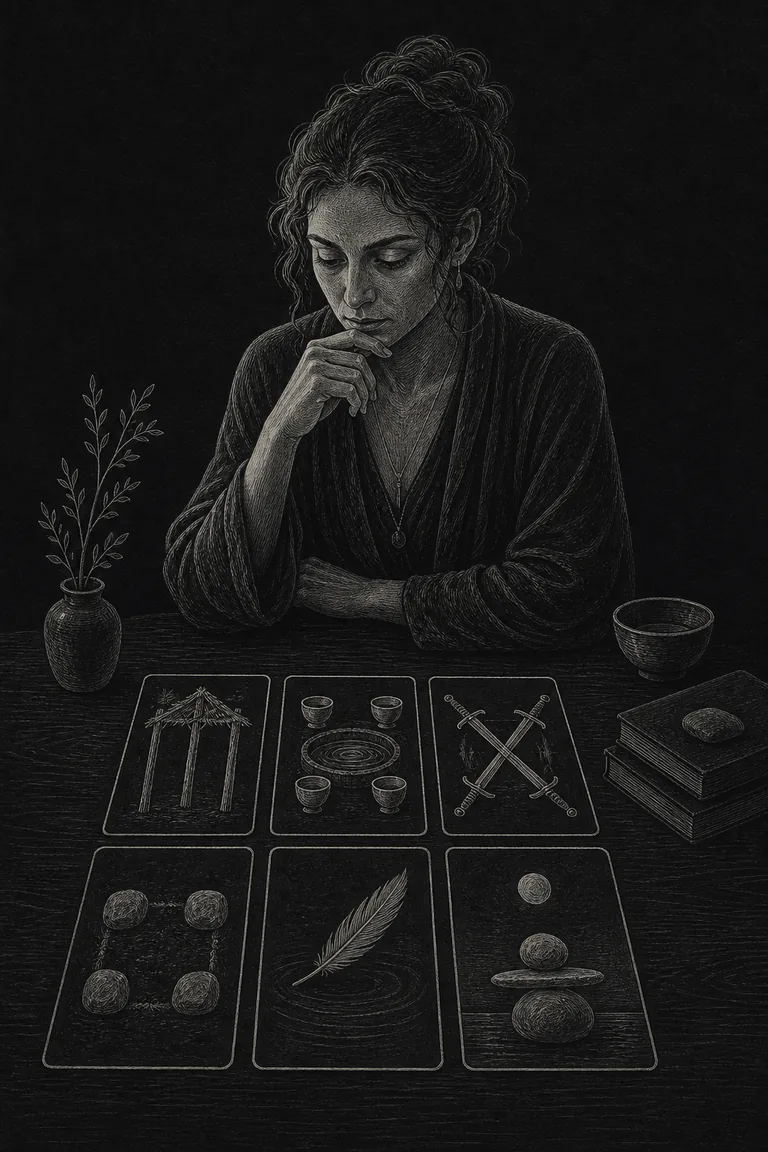
Many Fives in a Tarot reading usually concentrate attention on several points of friction, loss, conflict, scarcity, or adjustment. Count them, keep their suits and positions separate, and identify the response each one actually supports.
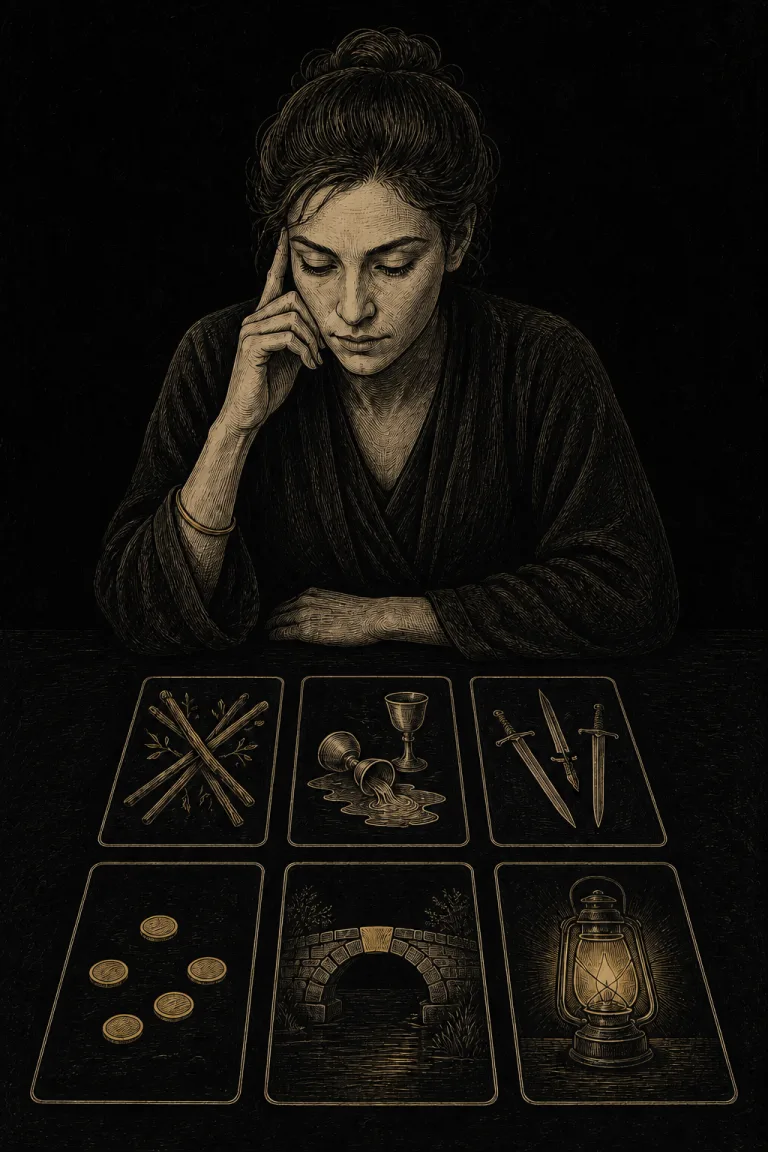
Many Fives in a Tarot reading do not automatically predict crisis. They show that the rank Five is repeated across the spread, so several cards may be describing instability, disagreement, disappointment, constraint, or the work of adapting after conditions change. The useful question is not "Is this bad?" but "What is unsettled in each position, and what response is available?"
Start with the number of Fives and the total number of cards. Two Fives in a three-card spread carry more visual and structural weight than two in a twelve-card spread. Then read the suit, image, position, orientation, neighboring cards, and the question asked. Repetition increases attention, not certainty, severity, or permission to ignore evidence.
Take the next insight with you
Explore personalized Tarot guidance in Veritas, available for iOS and Android.
 Scan with your phone
Many Fives meaning at a glance
Start with the Five count and denominator
Write the pattern as a fraction before interpreting it: two Fives out of three cards, three out of ten, or four out of fifteen. The denominator prevents a dramatic count from floating free of the spread. Record whether the cards came from one planned draw and whether clarifiers were included. The card-count guide helps keep the sample and question stable.
Five means adjustment, not automatic disaster
Five often interrupts the relative containment associated with Four. That interruption may appear as competition, grief, disagreement, material pressure, experimentation, or a change in the rules. It can be minor, useful, painful, avoidable, or already passing. Rank alone cannot establish scale, cause, blame, duration, or outcome. Name the exact change shown by the card instead of assigning one global crisis to the whole reading.
Five of Wands: competing movement
The Five of Wands can show several efforts colliding, unclear coordination, rehearsal, rivalry, or productive testing. Ask who is participating, whether the goal and rules are shared, and whether the contest is voluntary. It does not prove hostility or violence. In a planning position it may ask for roles and a decision rule; in an outcome position it may warn that unresolved coordination continues.
Five of Cups: attention after disappointment
The Five of Cups can focus on loss, regret, unmet expectation, or the part of an experience that cannot be restored. It can also show remaining support that is hard to notice while attention stays on what changed. Do not force gratitude or closure. Clarify what was actually lost, what remains, what repair is possible, and what deserves grief, documentation, support, or time.
Five of Swords: cost and terms of conflict
The Five of Swords can raise questions about victory, humiliation, withdrawal, coercion, damaged trust, or a contest whose cost exceeds its value. It cannot identify an abuser, liar, or future attack by itself. Check power, consent, safety, records, alternatives, and who bears the consequences. Where harm is possible, use direct evidence and appropriate professional or emergency support rather than a card-based accusation.
Five of Pentacles: access and material strain
The Five of Pentacles can point to scarcity, exclusion, illness imagery, damaged shelter, or difficulty reaching available help. It does not diagnose disease, predict homelessness, or prove financial ruin. Identify the actual resource, access barrier, eligibility, deadline, cost, support channel, and minimum safe standard. A symbolic reading cannot replace medical care, benefits advice, financial records, or legal guidance.
Position tells you where the disruption belongs
A Five in the background may describe a previous break in continuity. In the present it may identify the active strain. In advice it should become a bounded action such as clarifying rules, acknowledging a loss, leaving an unfair contest, or locating support. In an outcome it shows what may remain unsettled if present conditions continue. Keep these jobs separate so one image does not become a total life forecast.
Several Fives may describe one system or separate issues
First test whether the cards share a concrete system. The Five of Wands and Five of Pentacles might show a team competing for insufficient equipment. The Five of Cups and Five of Swords might show disappointment followed by a costly argument. If the spread positions refer to unrelated domains, keep the Fives separate. Similar rank does not prove a single hidden cause.
Use suits to distinguish affected resources
Wands can emphasize initiative and coordination, Cups relationship and emotional meaning, Swords information and conflict, and Pentacles material conditions and maintenance. These are reading conventions, not facts. Compare the deck artwork and guidebook. The element-imbalance guide handles the separate question of spread-wide suit distribution.
Non-Five cards are counterweights, not footnotes
A Star, Temperance, Six, court card, or Ace may show capacity, support, transition, skill, or a new option, depending on its position and image. A difficult Five does not cancel those cards, and a reassuring card does not erase material risk. Read the full spread as evidence with tensions. The Minor Arcana pattern guide provides a wider baseline.
Reversed Fives need a declared method
If you use reversals, decide what reversal means before interpreting: blocked expression, internalized experience, reduced intensity, excess, delay, or a prompt to inspect the image differently. A reversed Five is not automatically healed, hidden, or worse. Compare it with the position and surrounding cards. The reversal guide offers a consistent framework.
A six-step method for a Five-heavy spread
- Record the pattern
Write the Five count, total cards, original question, spread positions, and whether reversals are used.
- Name each disruption
Describe the specific conflict, loss, constraint, or adjustment shown in that position without combining the cards too early.
- Identify the resource
State whether the issue concerns effort, relationship, information, safety, money, time, access, or another concrete resource.
- Check counterweights
Read every non-Five, real-world record, alternative explanation, available support, and missing voice.
- Choose one response
Define a proportionate repair, boundary, request, experiment, or support step within your authority.
- Set a review
Record evidence, owner, cost, stop condition, and a date for checking what changed.
Worked example: conflict at work
A six-card work spread contains the Five of Wands in the present, Five of Swords in the obstacle, and Three of Pentacles in advice. Three Fives are not present, so the reader records two out of six. They separate coordination problems from the cost of adversarial tactics, then use the advice card to request written roles, an owner, and a review meeting. The reading does not prove sabotage or predict dismissal.
Worked example: relationship disappointment
A relationship spread shows the Five of Cups in one person's concern, Five of Pentacles in shared conditions, and Six of Pentacles in a practical next step. The reader names disappointment and access to support as different issues. They discuss time, money, care, and reciprocity directly. The cards do not establish hidden feelings, fidelity, compatibility, separation, or another person's consent.
Do not keep drawing until the Fives disappear
Repeated clarifiers can change the denominator and encourage answer shopping. Decide the draw rule in advance. If one term needs clarification, state it and draw a limited card once, then stop. Record the full sequence. Do not pull until the reading looks positive, because that hides uncertainty and makes the final pattern impossible to evaluate.
Compare many Fives with many Fours
Many Fours focuses on structures, pauses, protected resources, and maintenance. Many Fives focuses on what happens when containment is tested, disrupted, or no longer adequate. A spread containing both can ask which structure should be repaired, released, renegotiated, or protected, but each card still keeps its own position and evidence.
Turn the pattern into one bounded test
Choose the smallest response that can produce useful evidence: clarify one rule, request one record, acknowledge one loss, compare one support option, or pause one costly contest. State what would count as improvement and what would require escalation or withdrawal. Symbolic repetition can help frame the test, but observed outcomes determine what happens next.
Save each Five as a separate adjustment
Use Veritas to record the Five count and denominator, suit, position, image evidence, affected resource, non-Five counterweights, one response, owner, stop condition, and review date.
A practical journal prompt
Complete: "This spread contains __ Fives out of __ cards. The first disruption is __, the second is __, and they are connected or separate because __. The strongest counterevidence is __. One response within my authority is __, and I will review it when __." Add the original question and any information the cards cannot supply.
Responsible limits
Many Fives in a Tarot reading are a symbolic pattern, not scientific evidence of disaster, betrayal, abuse, illness, violence, poverty, debt, job loss, separation, legal guilt, or future events. Do not use the cards to diagnose, accuse, invest, gamble, abandon duties, or override consent. Visit the <a href="/tarot">Tarot journal hub</a>, keep the complete spread visible, and use records, direct communication, qualified guidance, and ordinary safety checks.