Tarot Journal
Tarot Element Imbalance: Reading Suit Distribution
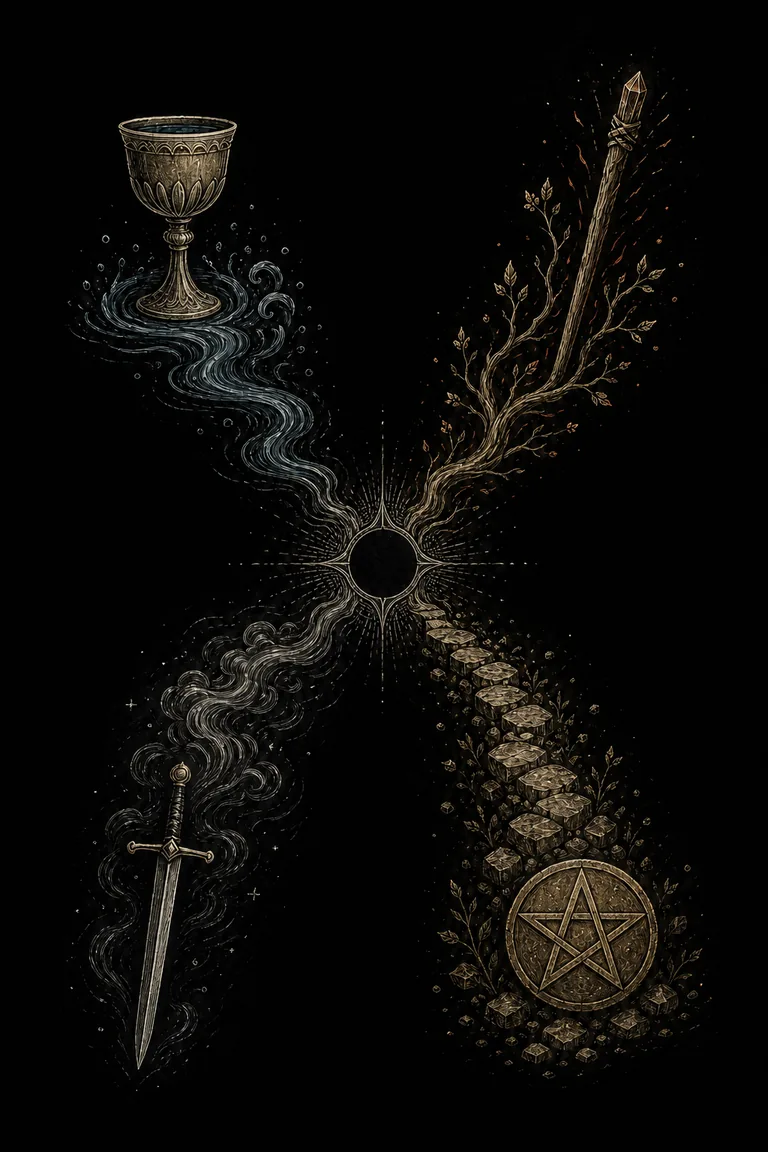
Tarot element imbalance describes an uneven distribution of Wands, Cups, Swords, and Pentacles in a completed spread, interpreted through count, position, question, and deck context.
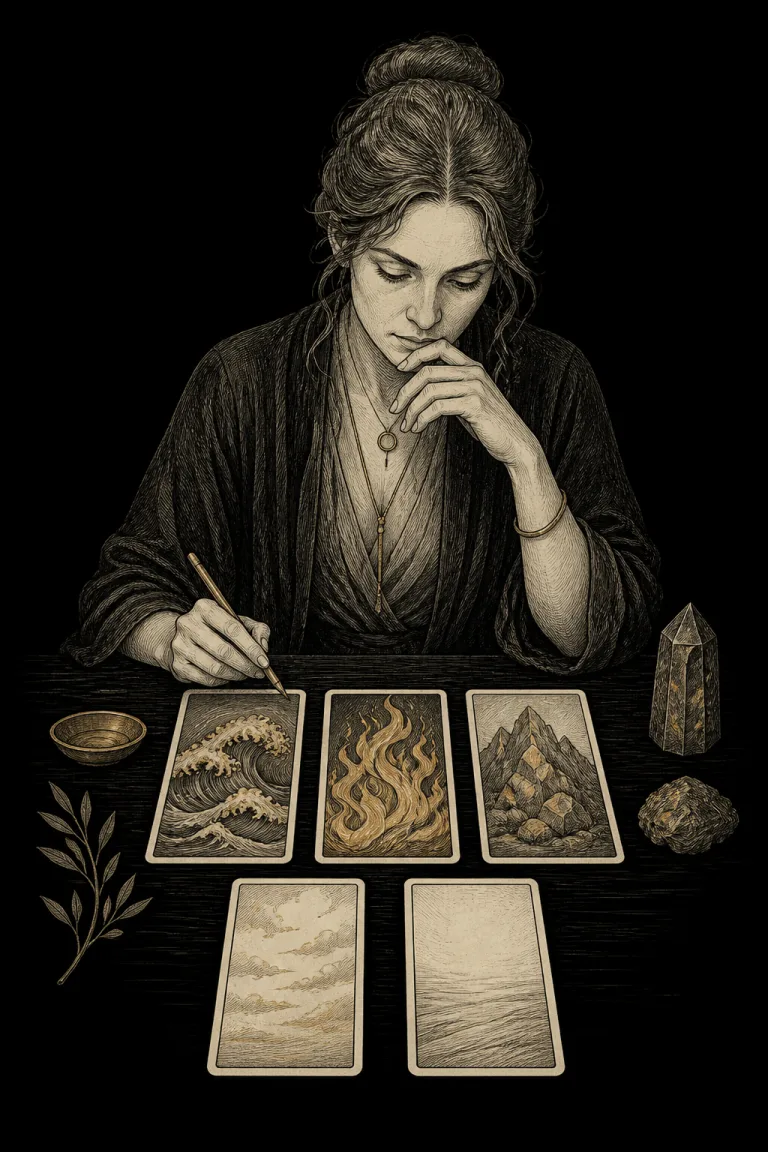
Tarot element imbalance appears when one or more elemental suits are unusually common, sparse, or absent in a spread. Wands are commonly associated with fire, Cups with water, Swords with air, and Pentacles with earth. The useful observation is not that one element is simply good or bad. It is that the reading gives different amounts of visible space to action, feeling, thought, and material conditions, subject to the deck, spread, question, and cards involved.
Count only after the draw is complete, keep the original positions fixed, and record both raw frequency and positional importance. A missing suit does not prove that an ability, person, resource, or future event is missing. A dominant suit does not prove excess. Treat the pattern as a prompt to inspect emphasis, blind spots, and counterevidence before writing one bounded interpretation.
Take the next insight with you
Explore personalized Tarot guidance in Veritas, available for iOS and Android.
 Scan with your phone
Tarot element imbalance at a glance
Start with the four suit associations
In the most common modern convention, Wands correspond with fire, Cups with water, Swords with air, and Pentacles with earth. Some decks use different names, symbols, or correspondences. Check the guidebook before counting. The Tarot suits guide explains each suit as a card system, while the separate fire, water, air, and earth guides examine visible imagery rather than suit membership.
Count the spread before interpreting it
Write a simple tally for the cards drawn. In a five-card spread containing three Wands, one Cup, and one Major Arcana card, the raw suit count is fire 3, water 1, air 0, earth 0, with one Major Arcana kept outside the suit tally. Do not quietly reclassify the Major card to make the distribution look balanced. Preserve the observable count first.
Spread size changes the strength of the pattern
One absent suit in a two-card draw is ordinary because only two suits could appear. The same absence across a fifteen-card spread is more notable, although still not a verdict. Small samples produce large-looking percentages easily. Report both the number and the spread size, such as "four of seven cards are Wands," instead of saying only that fire dominates.
Use a baseline that fits the deck
A standard seventy-eight-card deck usually contains fourteen cards in each Minor Arcana suit, but themed, expanded, or oracle-hybrid decks may not. Cards removed for study also change the available pool. Check whether the deck was complete and properly randomized according to the reader's declared method. A count is only comparable when the underlying pool is known.
Overrepresentation means emphasis, not automatic excess
Several Swords may emphasize decisions, language, analysis, conflict, boundaries, or uncertainty, depending on the actual cards. They do not automatically mean overthinking or an argument. Several Cups may describe relationships or emotional information without proving emotional overwhelm. Begin with the suit family, then read rank, image, orientation, position, and question.
Absence and weak presence are different
An absent suit has a raw count of zero. A weak presence may be one card placed in a peripheral or historical position. Keep these claims separate. Even a zero does not license a statement such as "there is no practical support." It supports a narrower question: does the spread directly represent material conditions, and if not, what verified information should be checked outside the cards?
Position can change emphasis without changing count
A single Pentacle in an outcome or central position may carry more interpretive weight than three Wands in background positions. Record the raw count before applying position weights so the method remains inspectable. Name the spread position and why it matters. The guide to laying out Tarot cards helps distinguish positional roles from card meanings.
Major Arcana should remain visible
Major Arcana may introduce a theme that the suit count does not capture. Depending on tradition, readers sometimes assign elemental correspondences to individual Major cards. If you use that system, report it as a second layer rather than merging it silently into the Minor Arcana tally. This lets another reader reproduce both the raw and adjusted views.
Court cards need the same declared rule
The simplest count places each court card in its printed suit. Some traditions also assign an element to rank, creating combinations such as fire of fire or water of air. That technique can be useful, but it answers a more detailed question. Keep the printed-suit count intact and label any rank-element analysis separately.
Element imbalance is not elemental dignities
Tarot elemental dignities examine how neighboring cards may strengthen, weaken, or remain neutral toward one another under a declared correspondence system. Element imbalance examines distribution across the spread. One method asks how elements interact locally; the other asks how much representation each suit receives globally. They can be used together only if their records stay separate.
Reversals do not remove a suit
A reversed Three of Cups remains a Cup for the raw tally. Reversal may modify expression according to the reader's method, but it does not turn water into another element or erase it. See the reversed cards guide before adding reversal language.
A six-step element imbalance method
- Freeze the draw
Keep the chosen spread, positions, orientation, deck, and question unchanged before counting.
- Record the raw tally
Count printed suits and list Major Arcana or ambiguous cards separately.
- Check the baseline
Note spread size, deck composition, removed cards, and the declared correspondence system.
- Map position weight
Identify central, outcome, advice, background, and other roles without replacing the raw count.
- Test context and counterevidence
Read the actual ranks and images, ask what the question makes relevant, and look for evidence that challenges the first pattern.
- Write one bounded claim
State the observed distribution, a plausible emphasis, uncertainty, and one real-world check or reversible action.
Worked example: a relationship spread
Imagine five cards with three Cups, one Sword, and one Major Arcana card. The raw pattern gives water more representation than air, fire, or earth. In a relationship conversation, this may foreground felt experience and connection while leaving practical arrangements underrepresented. It does not prove emotional dependence, honesty, compatibility, or lack of money. A grounded follow-up is to ask directly about needs and also review the schedule, costs, and commitments that the spread barely depicts.
Worked example: a work decision
Suppose a seven-card work spread contains four Wands, two Swords, and one Pentacle. Action and momentum may be prominent, while material capacity appears once. If the Pentacle occupies the central constraint position, it may deserve more weight than its frequency suggests. Check budget, staffing, tools, and time before acting. The cards cannot validate demand, funding, safety, or consent.
Compare readings only when the method matches
A journal can reveal recurring distributions, but comparisons require the same deck, similar spread size, stable counting rules, and distinct questions. Repeatedly drawing until a preferred balance appears destroys the original sample. The Tarot journal guide offers a practical record structure.
Save the count before the conclusion
Use Veritas to record the deck, spread, question, raw suit tally, Major Arcana, position weights, first interpretation, counterevidence, real-world checks, and later outcome.
Accessibility and visual uncertainty
Readers with low vision or decks with abstract suits may rely on card titles, tactile markers, accessible digital labels, or a trusted deck list. If a symbol is unclear, verify the card identity rather than guessing from color alone. Accessibility support improves the data and does not make the reading less intuitive.
Responsible limits
Tarot element imbalance is a symbolic reading method, not scientific evidence of personality, mental state, illness, pregnancy, danger, money, compatibility, wrongdoing, timing, or a future event. Do not use a dominant or missing suit to diagnose someone, accuse them, deny consent, replace records, or make medical, legal, financial, employment, or safety decisions. Visit the <a href="/tarot">Tarot journal hub</a> and use direct communication, primary evidence, qualified advice, and ordinary safeguards for consequential choices.