Tarot Journal
Many Kings in a Tarot Reading: What It Means
Many Kings in a Tarot reading concentrate attention on mandate, decision rights, delegation, and consequence, but count, suit, position, evidence, appeal, and review keep authority accountable.
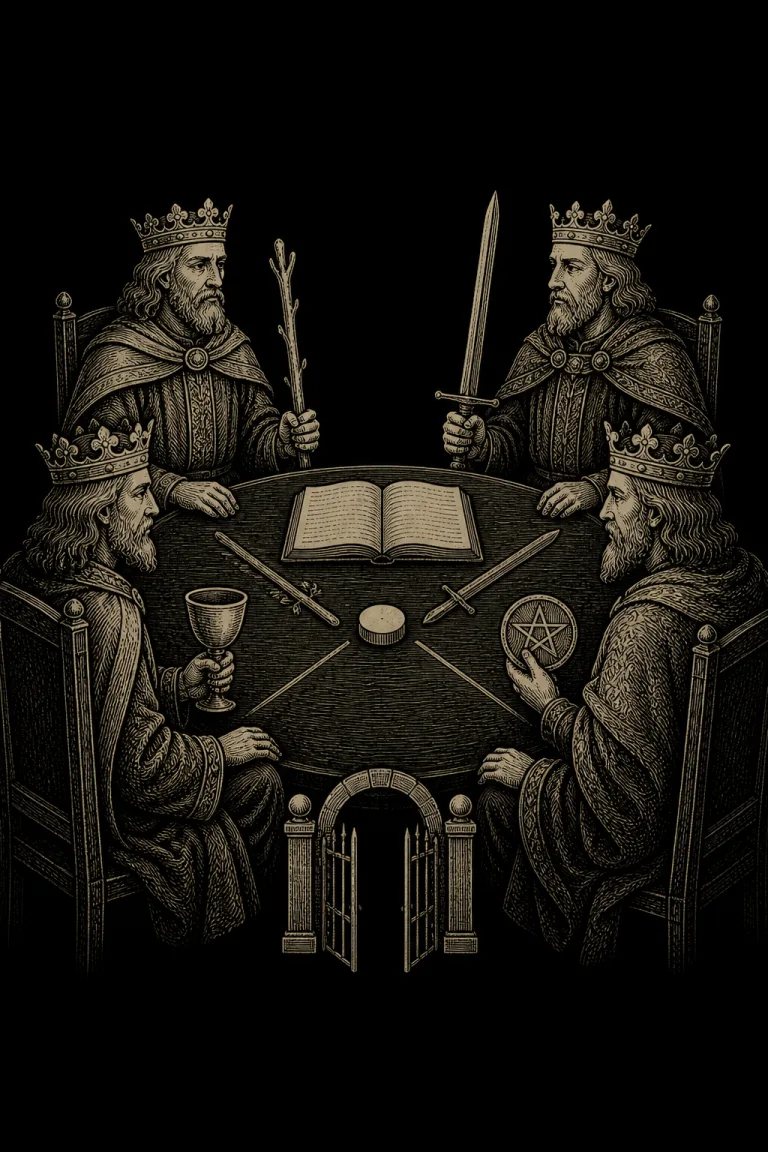
Many Kings in a Tarot reading usually emphasize who may decide, what falls inside that authority, and how choices become accountable. They do not prove that several men, fathers, executives, or powerful people are involved. First count the Kings against the spread size, confirm the deck was complete, and locate each card in its actual position before turning rank into a story.
A King-heavy spread is most useful as a mandate audit. Separate the four suits, name the decision each King can make, and identify the people, resources, and consequences affected. Then check the evidence, delegation, appeal, review, and exit that prevent authority from becoming vague control. Several Kings can coordinate distinct mandates or expose a conflict about who owns the final call.
Take the next insight with you
Explore personalized Tarot guidance in Veritas, available for iOS and Android.
 Scan with your phone
Many Kings at a glance
Count before assigning authority
A standard seventy-eight-card deck contains four Kings, one in each suit. Two Kings in a three-card spread create a stronger rank concentration than two in a twelve-card layout. Write the count and denominator, verify that all courts were available, and note deliberate deck selection, duplicate cards, multiple decks, or unusual reshuffling. A King pattern belongs to the recorded draw, not to extra cards retrospectively promoted because they looked commanding.
Kings are roles, not gender or status labels
Treat King as a function that receives a mandate, defines scope, makes or ratifies a decision, delegates execution, and accepts consequences. A King may describe the reader, another participant, a policy, a committee, a phase, or a quality of judgment. It does not establish sex, gender identity, age, fatherhood, seniority, wealth, dominance, or moral superiority. The court cards guide helps separate person, role, and process without stereotypes.
Separate the four decision domains
The King of Cups can govern emotional conditions, confidentiality, care limits, and calm response. The King of Wands can authorize direction, initiative, visibility, and strategic risk. The King of Swords can set evidence, language, rules, and adjudication. The King of Pentacles can decide about money, tools, time, property, maintenance, and durable value. Preserve these domains before combining them.
Position defines the mandate
A King in an obstacle position does not make leadership inherently harmful. It may show unclear jurisdiction, competing owners, an unreviewable decision, authority without resources, or responsibility assigned without decision rights. In advice, a King may ask the reader to define who can authorize the next step. In an outcome, the card describes the governance implied by current choices, not a guaranteed promotion, ruling, relationship, contract, or victory.
Authority differs from control
Accountable authority has a named source, bounded scope, relevant evidence, affected participants, and a route for correction. Control becomes harder to justify when scope expands silently, objections carry penalties, information is withheld, or the decision-maker avoids consequences. For each King, ask who granted the mandate, what it excludes, who is affected, what refusal is possible, and which record allows later review. Tarot can frame these questions but cannot confer legal, clinical, financial, or organizational authority.
Decision rights need an appeal path
A final decision may still need challenge, escalation, or independent review. Record who can question the evidence, how a conflict is disclosed, what deadline applies, and who can pause implementation. If no appeal is possible, name the safeguard that limits damage and the evidence threshold for reopening the choice. A King-heavy spread becomes more useful when it identifies the architecture around a decision instead of merely praising confidence.
Delegation does not transfer accountability
Several Kings may show multiple owners who must hand work across domains. A Wands mandate can set direction, Swords can approve standards, Pentacles can release resources, and Cups can protect human capacity. Delegation should name the task, recipient, resources, limits, reporting route, and return condition. The person who authorizes a risky choice does not erase responsibility by assigning execution to someone with less power.
Reversed Kings call for a governance diagnostic
A reversed King may suggest absent authority, overreach, indecision, concealed criteria, accountability without power, power without review, or a necessary refusal to hold an unsafe mandate. It does not automatically describe tyranny, corruption, weakness, cruelty, or a bad man. Use the reversed cards method: state the upright function, identify what is blocked or distorted, and test the claim against position, neighbors, records, and observable conduct.
Look for coordinated and competing mandates
Kings cooperate when their domains, handoffs, and tie-breaking rules are explicit. Cups may set a capacity limit, Swords may determine the evidence standard, Wands may choose the strategic route, and Pentacles may approve budget and maintenance. They conflict when two roles claim the same decision or when one domain externalizes cost onto another. Use card combinations to describe the relationship, then resolve it through real governance rather than symbolic rank.
Counterweights show what authority still needs
A Page can supply a report that remains unverified. A Knight can carry an authorized decision along a route. A Queen can hold the conditions and capacity that make implementation sustainable. A Five may reveal who absorbs the cost, while Justice can emphasize formal review and the Emperor can widen the question of structure. Counterweights do not cancel the Kings. They show whether a mandate is informed, resourced, accepted, delivered, and revisable.
A practical King-heavy method
- Verify
Record King count, spread size, deck integrity, suits, positions, orientation, and neighbors.
- Name the mandate
State the exact decision, source of authority, scope, exclusions, and affected people for each King.
- Test the basis
Identify evidence, uncertainty, conflicts, consent, resources, and consequences before action.
- Map accountability
Define delegation, reporting, appeal, stop authority, repair, and who owns the outcome.
- Review
Set a date and threshold for continue, revise, escalate, share, reverse, or end the mandate.
Worked relationship example
A relationship spread contains the Kings of Cups and Swords. Rather than predicting two men or a struggle for dominance, the reader separates emotional capacity from the terms of a decision. Cups asks what each person can discuss safely and when a pause is needed. Swords asks which agreement, evidence, and refusal must be explicit. Neither card gives one partner authority over the other, so the outcome is a consent-based conversation with an appeal to time apart or outside support.
Worked work example
A launch spread shows the Kings of Wands, Swords, and Pentacles. The team assigns product direction, compliance approval, and budget ownership to distinct roles. A Queen of Cups limits support load, while a Page provides early user reports that still need verification. The cards do not prove demand, legality, safety, or executive permission. They reveal that launch authority, evidence, funding, capacity, rollback, and review require named owners.
Compare many Kings with many Queens
Many Queens owns stewardship, standards, reception, access, and capacity. Many Kings owns formal mandate, scope, decision rights, delegation, and consequence. The many court cards guide owns overall court density and rank distribution. When Queens and Kings appear together, conditions should inform authority, and the final mandate should protect the people and resources that must sustain it.
Keep a mandate ledger
In a Tarot journal, create one row per King: card, suit, position, decision, mandate source, scope, exclusions, evidence, uncertainty, affected people, consent, resources, delegation, appeal, consequence, review, and exit. Add the real outcome later, including reversals and quiet decisions. This record tests whether the reading improved accountability instead of merely describing someone as powerful or decisive.
Save the mandate behind each King
Use Veritas to record count, denominator, suit, position, mandate, scope, evidence, affected people, delegation, appeal, consequence, review, and exit.
Responsible limits
Many Kings in a Tarot reading are a symbolic framework, not evidence of gender, age, fatherhood, a literal man, status, competence, wealth, authority, legal rights, safety, guilt, or another person's thoughts. Visit the <a href="/tarot">Tarot journal hub</a>. Use direct communication, written mandates, consent, qualified guidance, and real appeal or safeguarding procedures for consequential choices.