Tarot Journal
Many Court Cards in a Tarot Reading: What It Means
Many court cards in a Tarot reading can concentrate attention on roles, skills, authority, learning, movement, and social dynamics, but they do not automatically predict several people.
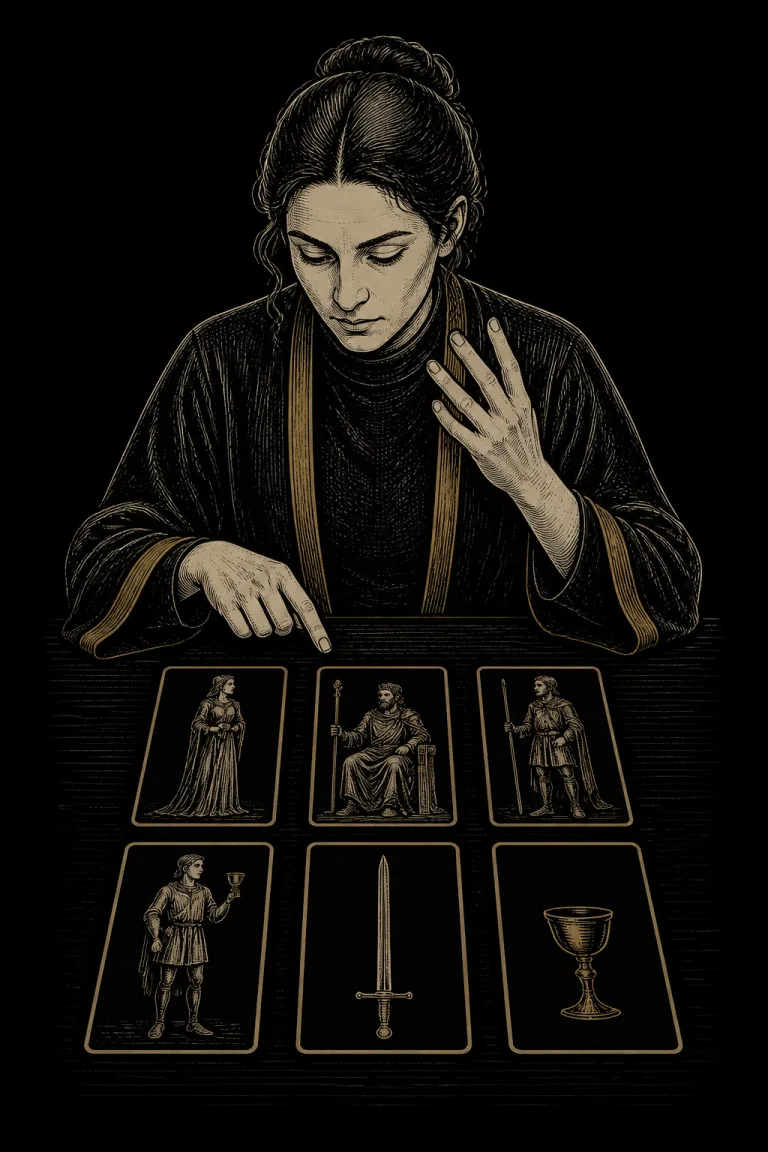
Many court cards in a Tarot reading means that several cards in the completed spread are Pages, Knights, Queens, or Kings. The pattern may emphasize people, but it can also describe roles, stages of skill, styles of response, responsibilities, or different parts of one situation. Court density alone cannot identify anyone or prove that new people will arrive.
Record the court count and total spread size first. Then read each card in its named position, compare rank and suit, test a person-based interpretation against at least one role-based alternative, and keep the non-court cards visible. Three courts in a three-card spread and three in a ten-card spread create different patterns, while both still require context and real evidence.
Take the next insight with you
Explore personalized Tarot guidance in Veritas, available for iOS and Android.
 Scan with your phone
Many court cards at a glance
Start with the court count and denominator
A raw count is incomplete. Write "three of five cards are courts" rather than only "three court cards appeared." In a standard seventy-eight-card deck, sixteen cards are courts, so one court is not unusual. Decks that rename ranks, add cards, or use a reduced pool change the baseline. Confirm the deck and stopping rule before interpretation.
Court density is not the same as Minor Arcana density
Every standard court card belongs to the Minor Arcana, but most Minor Arcana cards are not courts. Keep two separate tallies: Minor versus Major, then courts within the Minors. The guide to many Minor Arcana owns the broad arcana-proportion question. This article owns the narrower concentration of Pages, Knights, Queens, and Kings.
A court card does not have to be a person
Before the draw, choose the kinds of hypotheses your method permits. A court may represent a known person, a temporary role, a skill level, an approach, a responsibility, a voice in a group, or an aspect of the querent. The court cards guide explains this role-based method. Do not switch to a literal person only because that reading feels dramatic.
Read rank as a function, not a hierarchy of worth
Pages can frame receiving, learning, noticing, or carrying an early message. Knights can frame pursuit, movement, testing, or implementation. Queens can frame stewardship, cultivation, internal authority, or sustained care. Kings can frame standards, accountability, coordination, or public authority. These are working hypotheses, not fixed personalities or measures of maturity.
Suit specifies the field of the role
Rank becomes clearer when combined with suit. A Page of Swords may learn through questions and evidence, while a Page of Pentacles may learn through practice and resources. A King of Cups may coordinate an emotional response, while a King of Wands may coordinate direction and initiative. Read the printed card and position before generalizing from rank.
Suit concentration remains a separate pattern
Four courts can be spread across all four suits or concentrated in one. The first pattern may show several domains or voices; the second may keep returning to one field. Do not call either pattern an elemental imbalance until you count every card. The suit-distribution guide provides that separate calculation.
Positions decide what each court is doing
A Queen in resources is not equivalent to the same Queen in obstacle, advice, or outcome. State the position first, then combine it with rank, suit, action, posture, and surrounding cards. An outcome position remains conditional on current choices. It does not turn a court into a guaranteed person or appointment.
Repeated ranks can show a shared function
Two Pages may emphasize parallel learning tasks, two Knights may show competing methods of pursuit, and two Queens may compare forms of stewardship. This does not prove two literal people. Ask what function repeats, how the suits change it, whether the cards support or challenge one another, and what evidence would distinguish the options.
Mixed ranks can describe one process
A Page, Knight, and King can describe receiving information, testing a response, and setting a standard within one project. They do not necessarily describe a younger person, traveler, and older authority. Sequence is only relevant when positions or card relationships support it. Avoid forcing rank order into a prediction.
One non-court card can anchor the whole reading
A numbered Minor or Major Arcana card may define the resource, event, constraint, or broad theme around which several roles operate. Preserve that counterweight. If four courts surround the Eight of Pentacles, the practical evidence may concern training, quality, repetition, and division of work rather than four separate personalities.
Court cards are not identity labels
Traditional titles and artwork may contain gendered, age-coded, racialized, class-coded, or able-bodied imagery. Depiction is not personal identity. Do not assign a card to someone because of appearance, gender, age, status, ethnicity, disability, or family role. The guides to gender symbolism and age symbolism offer safer alternatives.
Reversals modify the role, not the card class
A reversed court remains a court and keeps its suit and rank. Under a declared reversal method, it may describe delay, resistance, excess, internalization, poor fit, or a blocked function. It does not automatically reveal dishonesty, immaturity, manipulation, or a bad person. Use the reversal guide consistently.
A six-step method for a court-heavy spread
- Freeze the draw
Save the deck, question, spread, positions, orientation rule, total count, and stopping point.
- Count courts
State the court count and denominator, then list ranks, suits, and non-court cards separately.
- Read positions
Describe what each position asks before deciding whether its court is a person, role, skill, or stance.
- Compare hypotheses
Write one person-based interpretation and at least one role-based or process-based alternative.
- Test evidence
Name observable facts, direct conversations, records, and contradictions that could support or weaken each version.
- Choose one check
Use a bounded question, role clarification, document review, practice task, or scheduled observation instead of another speculative draw.
Worked example: three courts in five cards
Imagine a work spread with Page of Swords in information, Queen of Pentacles in resources, and King of Wands in coordination. A person-based reading might identify three contributors. A role-based reading assigns research, resource stewardship, and direction. Check the actual roster, authority, budget, and communication before deciding. The spread cannot appoint anyone or prove motives.
Worked example: all courts in three cards
Suppose a situation, response, and review spread contains three courts. Keep the small sample visible. The cards may compare three stances within one interaction or three responsibilities held by one person. Do not draw more cards simply to obtain a numbered card. Ask which interpretation creates a clear, ethical, testable next step.
Combinations must preserve individual roles
Court combinations can describe negotiation, mentoring, delegation, conflict, or handoff, but each claim should come from rank, suit, position, and visible action. The card combinations guide shows how to build a sentence without erasing the cards. Avoid fixed formulas such as two Kings always meaning a power struggle.
Do not keep drawing to identify people
Extra cards often create more possible identities rather than clarity. Set a stopping rule before the draw. If the real question is who owns a task, ask the people involved or inspect the record. The guide to how many cards to pull helps limit interpretation debt.
Keep an evidence log
Record the court ratio, ranks, suits, positions, first hypothesis, alternative hypothesis, supporting facts, contradictions, practical check, and review date. Include readings that do not lead to striking events. A complete record reduces hindsight bias and makes it easier to see whether your court method is actually useful.
Turn court roles into one practical check
Use Veritas to save the court count, denominator, ranks, suits, positions, person and role hypotheses, counterevidence, one bounded action, and a review date.
Accessibility and card identification
Readers may identify courts through printed titles, accessible digital labels, tactile markers, a trusted card list, or a companion reader. Do not infer rank or suit from color, clothing, body shape, or facial detail alone. Confirm the card identity before counting it. Accessible identification strengthens the record.
Responsible limits
Many court cards in a Tarot reading are a symbolic pattern, not scientific evidence about a person, motive, identity, age, gender, status, message, visitor, relationship, conflict, promotion, legal role, diagnosis, or future event. Do not use courts to profile, accuse, pressure, monitor, hire, fire, diagnose, or make medical, legal, financial, employment, relationship, or safety decisions. Visit the <a href="/tarot">Tarot journal hub</a> and rely on direct evidence, consent, qualified advice, and ordinary safeguards for consequential choices.