Tarot Journal
Many Queens in a Tarot Reading: What It Means
Many Queens in a Tarot reading concentrate attention on stewardship, standards, access, and mature response, but count, suit, position, consent, evidence, and review keep the pattern useful.
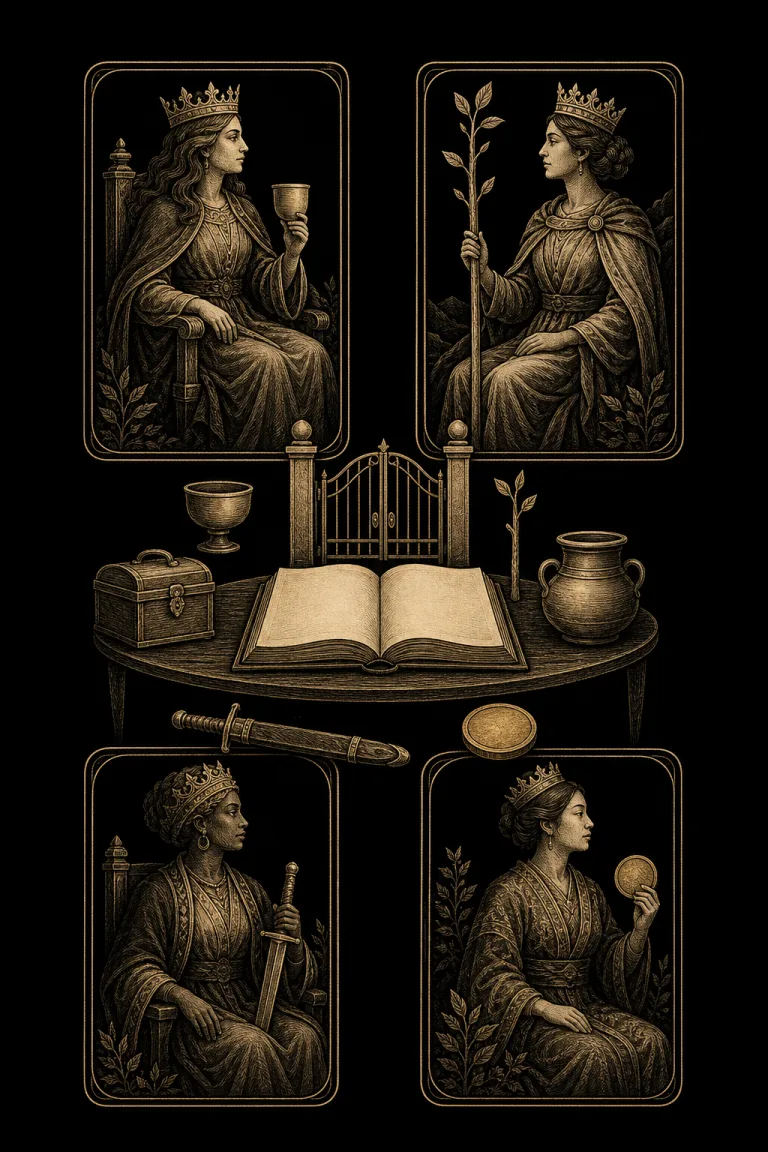
Many Queens in a Tarot reading usually emphasize how conditions are held: what receives care, who has access, which standards protect the work, and when a resource should be developed or refused. They do not prove that several women are involved, that a mother or partner will appear, or that anyone is emotionally mature. First count the Queens against the spread size, confirm the deck was complete, and locate every card in its actual position.
A Queen-heavy spread is most useful as a stewardship review. Separate the four suits, name the people or systems affected, and ask what each Queen is protecting, cultivating, evaluating, or containing. Then define the standard, evidence, consent, capacity, and review that make the response accountable. Several Queens can cooperate around shared conditions or reveal competing forms of care, truth, initiative, and material responsibility.
Take the next insight with you
Explore personalized Tarot guidance in Veritas, available for iOS and Android.
 Scan with your phone
Many Queens at a glance
Count before assigning meaning
A standard seventy-eight-card deck contains four Queens, one in each suit. Two Queens in a three-card spread create a stronger rank concentration than two in a twelve-card spread. Write the count and denominator, check that all court cards were available, and note deliberate deck selection, duplicate cards, extra decks, or unusual reshuffling. A Queen pattern describes the draw you actually made, not every image that felt Queen-like afterward.
Queens are roles, not gender labels
Treat Queen as a function that receives information, holds conditions, allocates attention, develops skill, and decides what a domain can support. A Queen may describe the reader, another participant, a team, a policy, a phase, or a quality of response. It does not establish sex, gender identity, age, appearance, motherhood, relationship status, or superiority. The court cards guide helps distinguish person, role, and process without stereotyping.
Separate the four stewardship domains
The Queen of Cups can hold emotional information with empathy, privacy, and boundaries. The Queen of Wands can sustain initiative, presence, and participation without demanding attention. The Queen of Swords can define evidence, language, access, and a clear refusal. The Queen of Pentacles can steward time, money, tools, bodies, and maintenance. Preserve these jobs before combining them.
Position determines what is being held
A Queen in an obstacle position does not make care or competence harmful. It may show an inaccessible standard, overloaded steward, hidden cost, blurred boundary, or a domain held by someone without enough authority or support. In advice, a Queen may ask for conditions and capacity before action. In an outcome, she describes the stewardship implied by current choices, not a guaranteed person, promotion, relationship, or state of maturity.
Standards need evidence and access rules
A standard is useful only when people can understand how it is applied. For each Queen, name the resource, intended beneficiary, quality threshold, evidence, privacy rule, access decision, exception process, and review date. Ask who created the standard, who carries its cost, and who can appeal or refuse. A boundary that protects capacity differs from a gate that preserves status without a defensible reason. Tarot cannot decide that distinction without real context.
Care and capacity must be read together
Several Queens may appear when many needs are being held at once. More care imagery does not create unlimited time, money, attention, emotional availability, or expertise. Record present capacity, protected recovery, dependencies, and what must be paused if demand grows. A sustainable response can include referral, delegation, delay, a narrower offer, or a clear no. Sacrifice is not automatically the most mature Queen expression.
Reversed Queens call for a stewardship diagnostic
A reversed Queen may suggest inaccessible support, porous limits, withheld information, rigid standards, depleted capacity, inconsistent care, or a necessary withdrawal. It does not automatically describe jealousy, manipulation, coldness, weakness, or a bad woman. Use the reversed cards method: state the upright function, identify what becomes blocked or redirected, and test the interpretation against position, neighbors, and observable evidence.
Look for cooperation and competing conditions
Queens can cooperate when their domains and handoffs are explicit. Cups may establish privacy and emotional capacity, Swords may document consent and evidence, Wands may invite participation, and Pentacles may confirm resources and maintenance. They can also compete when one standard consumes another domain. Use card combinations to describe the relationship, then decide which real constraint, person, or rule resolves it.
Counterweights clarify authority and motion
A Page can bring a report that the Queens must verify. A Knight can move a plan whose conditions still need approval. A King can hold a formal mandate that differs from day-to-day stewardship. A Five may expose strain; a Four may protect capacity; a Major Arcana card may widen the value conflict. Counterweights do not cancel the Queens. They show whether good conditions can be authorized, communicated, resourced, and maintained.
A practical Queen-heavy method
- Verify
Record Queen count, spread size, deck integrity, suits, positions, orientation, and neighbors.
- Name the domain
Identify the people, information, energy, money, tools, or environment each Queen is holding.
- Define conditions
State the standard, access rule, consent, capacity, privacy, evidence, and exception process.
- Check the burden
Name who performs the care, who benefits, what it costs, and what support or delegation exists.
- Review
Set a date and evidence threshold for continue, revise, refer, share, pause, or stop.
Worked relationship example
A relationship spread contains the Queens of Cups and Swords. Rather than predicting two women or emotional distance, the reader separates privacy from clarity. Cups asks what each person can hear without becoming overloaded. Swords asks which words, agreements, and refusals must be explicit. A Pentacles card adds time and care duties. The result is a scheduled conversation either person may pause, not a claim about hidden feelings or guaranteed reconciliation.
Worked work example
A team spread shows the Queens of Wands, Swords, and Pentacles. The team defines who may propose experiments, what evidence and accessibility standard applies, and who owns budget, support, and rollback. A Page supplies user reports that still require verification. The cards do not establish demand, compliance, fairness, or authority. They reveal that participation, evidence, and maintenance need separate owners and one documented review.
Compare many Queens with many Knights
Many Knights owns routes, pace, delivery, authority to move, and course correction. Many Queens owns the conditions that receive, protect, develop, or refuse what arrives. The many court cards guide owns overall court density and rank distribution. When Queens and Knights appear together, approve the conditions before movement and review whether the route respects them.
Keep a stewardship ledger
In a Tarot journal, create one row per Queen: card, suit, position, domain, beneficiary, resource, standard, access, consent, capacity, evidence, burden, exception, review, and exit. Add the real outcome later, including refusals and quiet results. This record tests whether the interpretation improved stewardship instead of merely describing someone as caring, powerful, intuitive, or mature.
Save the conditions each Queen is holding
Use Veritas to record count, denominator, suit, position, domain, resource, standard, access, consent, evidence, burden, capacity, review, and exit.
Responsible limits
Many Queens in a Tarot reading are a symbolic framework, not evidence of gender, age, motherhood, a literal woman, maturity, care, loyalty, authority, diagnosis, financial security, legal rights, safety, or another person's thoughts. Visit the <a href="/tarot">Tarot journal hub</a>. Use direct communication, records, consent, qualified guidance, and real safeguarding procedures for consequential choices.