Tarot Journal
Many Knights in a Tarot Reading: What It Means
Many Knights in a Tarot reading emphasize movement already underway, but the useful interpretation comes from count, suit, direction, pace, authority, evidence, and the option to change course.
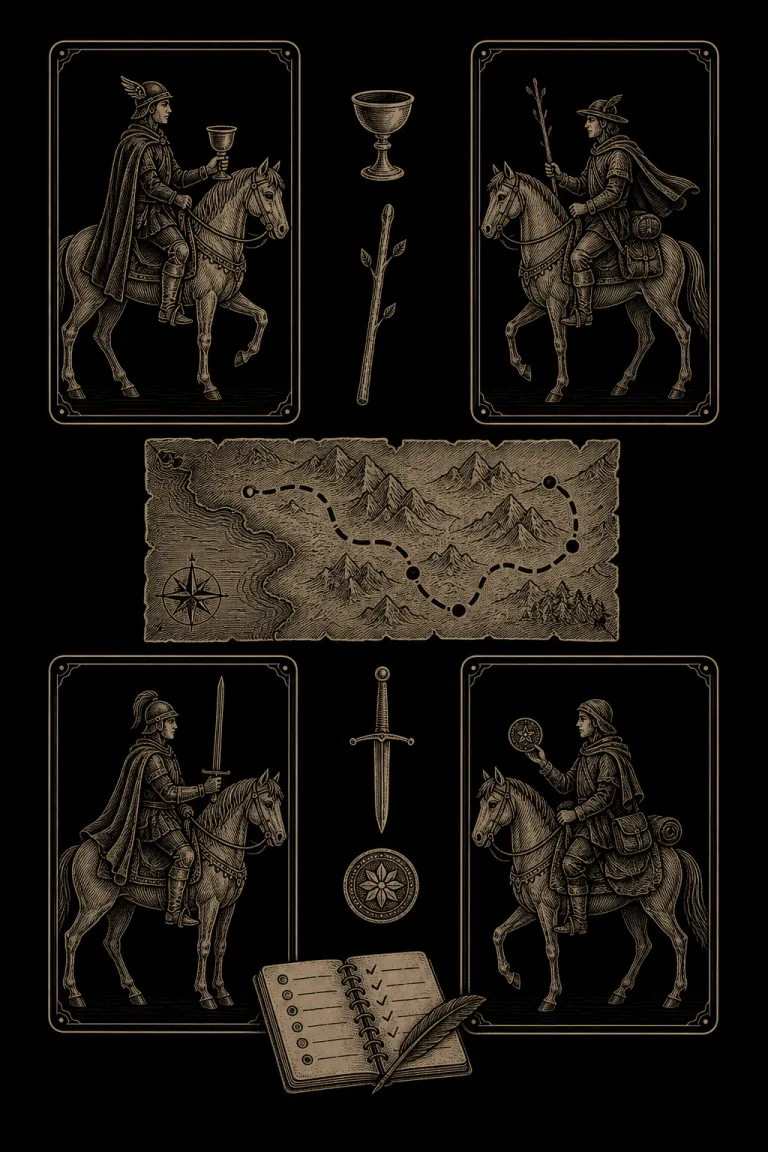
Many Knights in a Tarot reading usually concentrate attention on movement, pursuit, delivery, and decisions that are already leaving the planning stage. They do not guarantee travel, a visitor, conflict, romance, promotion, or fast results. First verify how many Knights appeared, how large the spread was, whether the deck was complete, and which positions they occupy. Then read each Knight as a different mode of carrying something forward.
A Knight-heavy spread is most useful as a route review. Ask what is moving, who has authority to move it, what pace is sustainable, what evidence marks progress, and what condition requires a turn or stop. Suit, position, neighboring cards, and the actual question matter more than the rank alone. Several Knights can describe coordinated motion, competing directions, or repeated urgency, so synthesis must preserve their differences.
Take the next insight with you
Explore personalized Tarot guidance in Veritas, available for iOS and Android.
 Scan with your phone
Many Knights at a glance
Count before interpreting the pattern
A standard seventy-eight-card deck contains four Knights, one in each suit. Two Knights in a three-card draw are proportionally stronger than two in a twelve-card spread. Write the count and denominator, confirm that all four court cards were available, and note whether extra cards, duplicate decks, deliberate court-card selection, or reshuffling changed the odds. A pattern begins with the actual draw, not with a dramatic label applied afterward.
Knights are roles, not literal riders
Treat Knight as a function: carrying an intention into motion, testing a route, delivering effort, and encountering consequences. A Knight can describe the reader, another participant, a workflow, a phase, or a quality of action. It does not establish gender, age, occupation, transport, or identity. The court cards guide offers broader ways to choose between a person, role, and process without stereotyping.
Separate the four suit routes
The Knight of Cups can carry an invitation, value, or emotional proposal that needs consent and clear terms. The Knight of Wands can test momentum, initiative, and appetite for risk. The Knight of Swords can accelerate inquiry, argument, or a decisive message. The Knight of Pentacles can sustain delivery, maintenance, and measured progress. Keep their jobs distinct before combining them.
Read position as route assignment
A Knight in an obstacle position does not mean movement is bad. It may show excessive pace, unclear destination, weak authority, missing resources, or a route that ignores others. In an advice position, it can ask for a bounded next leg rather than immediate completion. In an outcome position, it describes the direction implied by current conditions, not a guaranteed arrival. Translate the spread label into a concrete route question and preserve uncertainty.
Direction and pace are separate
A clear destination with unsustainable speed is still a poor plan. A slow pace toward the wrong goal is not responsible simply because it is careful. For every Knight, record destination, current leg, pace, resources, dependencies, and evidence of arrival. Then ask what new information would justify acceleration, delay, rerouting, or cancellation. This prevents the reading from collapsing all motion into a vague instruction to act.
Reversed Knights require a diagnostic
A reversed Knight may suggest stalled motion, scattered effort, avoidable haste, inaccessible routes, unspoken resistance, or necessary refusal. It does not automatically mean recklessness, failure, dishonesty, or a dangerous person. Use the method in the reversed cards guide: name the proposed function, identify what changes, and check the surrounding cards and evidence. Sometimes stopping is the competent action.
Look for coordination and collision
Several Knights can support one another when their routes, sequence, authority, and handoffs are explicit. Cups may establish terms, Swords may clarify the decision, Wands may run a test, and Pentacles may maintain delivery. They can also compete for time, budget, attention, or consent. Use card combinations to read the relationship between cards, then check whether one shared plan actually connects their actions.
Counterweights change the reading
A stationary Major Arcana card, a Four, or a boundary-focused card may slow the Knights, define a checkpoint, or require acceptance before motion. A Page may bring an unverified report; a Queen may hold conditions and stewardship; a King may carry formal authority. Counterweights do not cancel the Knights. They specify who can approve the route, what must remain protected, and which evidence must exist before the next leg begins.
A practical Knight-heavy method
- Verify
Record Knight count, spread size, deck integrity, suits, positions, orientation, and neighbors.
- Assign routes
Give each Knight a distinct destination, current leg, resource, dependency, and evidence marker.
- Check authority
Name who may act, who must consent, and who can pause or redirect the route.
- Set pace
Define a sustainable increment, checkpoint, cost ceiling, and recovery capacity.
- Review
Compare actual evidence with the plan and choose continue, reroute, hand off, pause, or stop.
Worked relationship example
A five-card relationship spread contains the Knights of Cups and Swords. Instead of predicting a romantic message and argument, the reader separates two routes. Cups asks for a respectful proposal that either person may decline. Swords asks for a direct clarification with a time limit and no repeated pressure. A boundary card requires privacy and a stop if either person withdraws consent. The reading organizes communication; it cannot reveal private feelings or guarantee contact.
Worked work example
A project spread shows Wands, Pentacles, and Swords Knights. The team maps a small prototype, a maintenance owner, and a decision brief. Each leg has a budget, security check, accessibility review, rollback, and named approver. The cards do not prove market demand, delivery, promotion, or legal compliance. They reveal that three kinds of motion need sequencing so enthusiasm, maintenance, and decisions do not compete invisibly.
Compare many Knights with many Pages
Many Pages owns first reports, learning, verification, and limited authority. Many Knights owns routes already moving, pace, delivery, and course correction. The many court cards guide owns overall court density and rank distribution. If Pages and Knights appear together, verify the report before turning it into motion and record who accepts responsibility for the handoff.
Keep a route ledger
In a Tarot journal, draw one row per Knight: card, suit, position, route, pace, authority, consent, resource, checkpoint, arrival evidence, warning, and stop condition. Add the actual result later, including quiet outcomes and contradictory evidence. The ledger makes it harder to convert ordinary events into a perfect prediction after the fact and easier to see whether the reading improved a decision.
Save each Knight's route before acting
Use Veritas to record the count, denominator, suit, position, route, pace, authority, consent, evidence marker, course correction, stop condition, and review date.
Responsible limits
Many Knights in a Tarot reading are a symbolic framework, not evidence of travel, arrival, a message, conflict, love, promotion, diagnosis, danger, legal authority, financial return, or another person's intentions. Visit the <a href="/tarot">Tarot journal hub</a>. Use direct communication, records, consent, qualified guidance, and real safety procedures for consequential choices.