Tarot Journal
Tarot and Mythology: A Source-Aware Reading Method
Tarot and mythology can be compared through shared images and narrative functions, but a useful reading names its deck and story source instead of claiming one ancient hidden code.
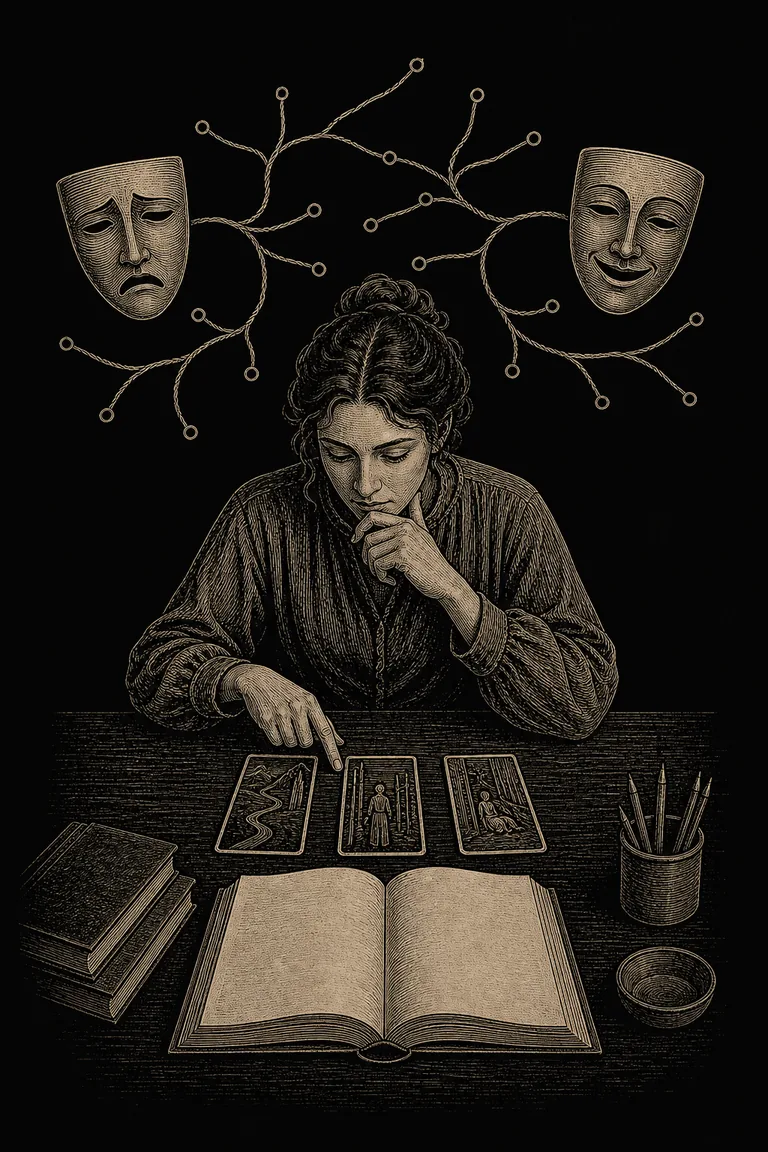
Tarot and mythology meet when a card image recalls a recognizable story pattern: a difficult threshold, a descent, a test, a reversal, a homecoming, or a transfer of responsibility. That comparison can enrich a reading, provided the myth is treated as one chosen lens rather than the card's secret original identity.
A grounded method begins with visible card evidence, names the exact version of the story, maps one narrative function, and then tests where the comparison fails. The mismatch is often as useful as the resemblance. It prevents a familiar myth from taking over the spread and keeps the final interpretation tied to the reader's actual question.
Take the next insight with you
Explore personalized Tarot guidance in Veritas, available for iOS and Android.
 Scan with your phone
Tarot and mythology at a glance
Did Tarot come from mythology?
The earliest surviving Tarot packs emerged in fifteenth-century Italy as playing cards. Their allegorical trumps drew on the visual culture around them, including Christian, civic, courtly, and classical motifs. Later occultists and deck creators added new correspondences and mythic interpretations. The beginner Tarot guide therefore starts with the card and spread rather than claiming that every image descends from one Egyptian, Greek, Celtic, Norse, or other complete myth system. A modern comparison may still be valuable when its source and status are stated honestly.
Myth, motif, and archetype are not identical
A myth is a culturally located story with characters, relationships, actions, and transmission history. A motif is a smaller recurring element such as a forbidden door or difficult crossing. Archetype is a theoretical category used in several different ways. Calling every old story an archetype can erase its cultural setting and make unlike figures seem interchangeable. In a reading, say whether you are comparing a full plot, one motif, or a modern psychological pattern.
A six-step comparison method
- Start with the card
Describe the figure, object, direction, action, tension, and spread position before naming a story.
- Choose one source
Record the culture, title, version, translation, or retelling rather than blending remembered fragments.
- Map one function
Compare a threshold, bargain, test, descent, disguise, return, witness, or consequence.
- Name the mismatch
Identify one important way the card and story differ in agency, motive, ending, power, or relationship.
- Build a rival reading
Interpret the same card without the myth, using the deck image, position, surrounding cards, and ordinary context.
- Return to the question
Keep only the comparison that clarifies a proportionate choice or reviewable hypothesis.
Worked example: The Hermit and a descent story
Suppose The Hermit appears in the position, What resource helps me finish this project? The visible evidence is a solitary figure, limited light, height, and deliberate pace. A chosen descent story might contribute the function of entering uncertainty with one guide or tool. The mismatch matters: the card may show no underworld, rescue mission, or return companion. A rival reading is simple expert focus. The useful conclusion could be to narrow the task, consult one specialist, and define the evidence needed before proceeding, not to declare that the reader is reenacting a sacred journey.
Why the exact deck matters
Decks change scenes, titles, sequence numbers, cultural references, and character identities. A myth named explicitly in one deck guidebook may be absent from another card with the same title. Begin with the printed image and the creator's stated system. The Major Arcana guide supplies broad card functions, but it should not flatten deck-specific evidence.
Do not turn resemblance into identity
A woman beside a lion does not automatically become every lion-associated goddess or heroine. Water does not make every card one sea deity. A tower, cave, tree, crown, or pair of scales can appear in many traditions for different reasons. Phrase the connection as, This scene shares a function with this version of the story. Avoid saying, This card is the deity, unless a deck creator explicitly made that identification and you cite the deck context.
Cultural and religious responsibility
Some narratives belong to living religions, communities, languages, lands, and ceremonial settings. Use reliable editions and community scholarship where available. Do not strip a sacred figure into a personality label, combine traditions because their English summaries look similar, or claim initiation and authority from a card pull. If a source has access restrictions or contested translation, respect them and choose a more appropriate public source.
Using mythology in a multi-card spread
Do not assign a different myth to every card and then force them into one crowded epic. First connect the cards through visible changes and explicit grammar. The Tarot storytelling method and card combinations guide help establish the sequence. Add one mythic comparison only where it explains a specific transition better than the card language alone.
Keep the comparison traceable
Use Veritas to save the deck evidence, exact story version, narrative function, important mismatch, rival interpretation, real-world check, and later review.
Mythology as a writing prompt
For creative work, a card and myth can generate alternatives without claiming prediction. Ask what happens if the threshold is refused, the helper is unreliable, the promised reward changes, or the return does not restore the old order. Label invented developments as fiction. For personal reflection, the guide to questions to ask Tarot keeps prompts focused on agency rather than fate.
Journal the source and the miss
Record the card, position, visible details, source citation, selected episode, shared function, mismatch, and rival interpretation. Revisit the note after the decision or event. This makes it possible to see whether the myth clarified the situation or merely supplied a memorable story. A Tarot journal is especially useful for detecting favorite narratives that appear regardless of the cards.
Common mistakes
Common mistakes include claiming Tarot is an unchanged ancient myth book, mixing several versions without disclosure, treating similar objects as proof of one origin, assigning deities by gender stereotypes, ignoring a story's political or religious setting, quoting a modern retelling as ancient evidence, and using a dramatic myth to overrule a modest spread position. Another error is interpreting every challenge as a heroic initiation instead of checking ordinary constraints and support.
Limits and responsible use
Tarot and myth are interpretive traditions, not scientifically validated forecasting or historical proof. A comparison cannot establish ancestry, divine identity, reincarnation, spiritual rank, cultural permission, hidden motives, recovered memory, or a guaranteed life path. It cannot replace religious authorities, historians, translators, clinicians, legal advisers, or direct evidence. Use the story as a declared lens and remain willing to discard it when the card, source, context, or outcome does not support the comparison.