Tarot Journal
Tarot Object Symbolism: An Evidence-First Guide
Tarot object symbolism becomes useful when you identify an item carefully, examine who can use it and what it does in the scene, then compare meanings instead of applying a fixed symbol dictionary.
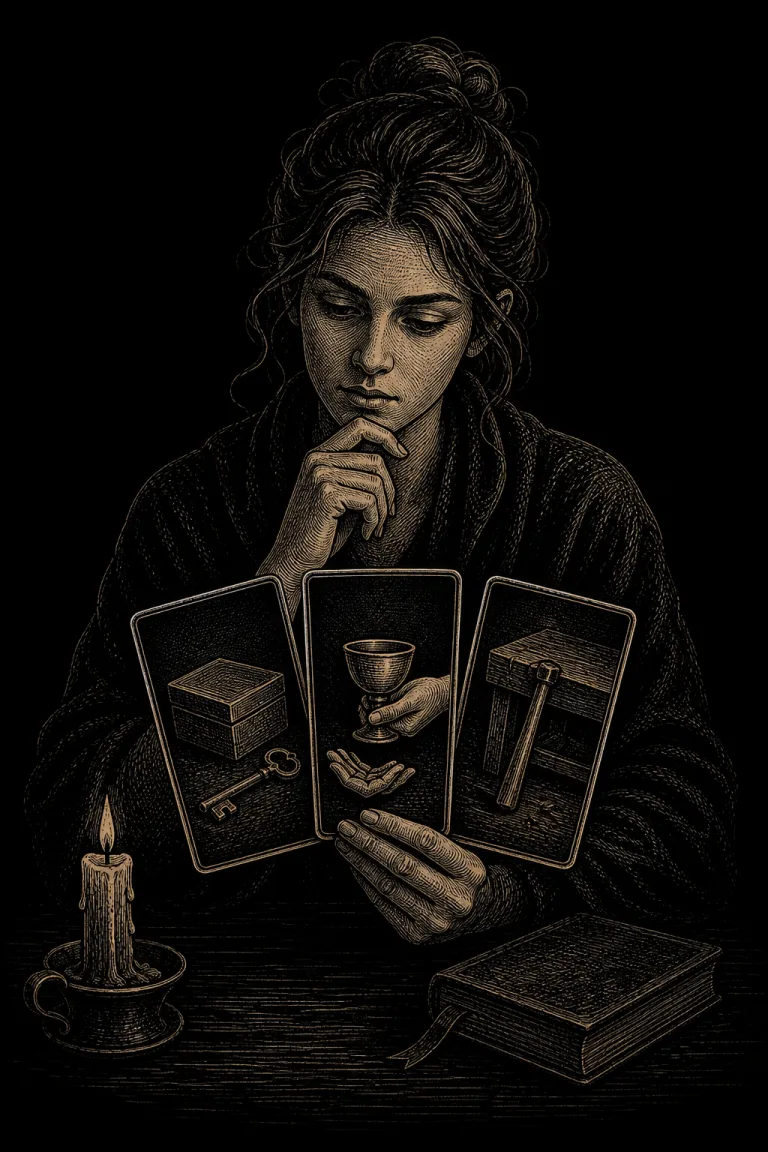
Objects give Tarot scenes practical structure. A key can open something, remain unused, be hidden, or simply mark status. A cup can hold, receive, spill, or be offered. A tool may be ready, damaged, displayed, or actively changing material. The item matters, but its condition, placement, access, and relationship to the figures matter more than a memorized keyword.
A grounded reading begins with identification confidence. Name what is visible, note uncertainty, describe its ordinary function, and ask who owns, reaches, carries, protects, refuses, or uses it. Then test at least two interpretations against the card title, deck guide, gesture, posture, architecture, spread position, and question. An illustrated object can support reflection, but it cannot prove a future event, a hidden intention, or a literal possession.
Take the next insight with you
Explore personalized Tarot guidance in Veritas, available for iOS and Android.
 Scan with your phone
Tarot object symbolism at a glance
Start with an object inventory
List the distinct human-made or portable items before interpreting them. Include what a figure holds, wears, sits on, works with, receives, leaves behind, or keeps nearby. Separate an object from surrounding architecture and landscape. A throne is furniture within a built setting; a gate belongs to architecture; a mountain belongs to terrain. This first pass prevents one visually dominant item from erasing quieter evidence.
Verify what the item actually is
Small reproductions can turn a spindle into a wand, a scroll into fabric, or a pouch into a stone. Zoom the original art, compare the guidebook, and use accurate alt text when available. If the identity remains uncertain, describe form and position instead: a narrow handled tool, a closed container, a round metal object. A confident meaning built on a mistaken identification is weaker than a modest description.
Function comes before association
Ask what the object can do in ordinary terms. A key changes access, a vessel contains, a blade cuts, a rope binds or supports, a scale compares, and a lamp provides light. Function does not settle meaning. A blade used for harvest differs from one raised in conflict, and a rope securing a load differs from one restricting a figure. Conventional associations become useful only after the depicted use is clear.
Ownership, access, and control
An item may belong to the person holding it, be borrowed, ceremonial, communal, or contested. Notice who can reach it and who cannot. Is it offered with an open hand, gripped close to the body, placed between people, locked away, or abandoned? The gesture guide helps distinguish offering from display, while the posture guide can show whether access is easy or strained.
Condition changes the reading
Record whether an object is intact, worn, broken, empty, full, sharp, blunt, open, sealed, polished, rusted, repaired, or unfinished. Condition describes the pictured state, not an inevitable outcome. A cracked vessel may no longer contain liquid, may have been repaired, or may function as evidence of prior use. Check whether damage is deliberate artwork, printing wear, glare, or cropping before interpreting it.
Placement, distance, and scale
An object held at eye level has a different visual role from the same object beneath a chair or far in the background. Compare distance from hands, doors, paths, other figures, and the center of the composition. Oversized items may signal narrative importance or artistic convention rather than literal power. The architecture guide helps when an object controls entry, work, shelter, or boundaries inside a built space.
Repeated and grouped objects
Count repeated items carefully, but do not assume quantity creates independent confirmations. A row of cups may be a suit convention, a stored resource, a display, or a compositional rhythm. Ask whether the objects are identical, individually used, arranged by someone, or scattered by an event. Grouping can show organization or abundance, but it can also make access harder or attention more diffuse.
Tools, containers, barriers, and weapons
Tools transform material and imply a skill only when someone can use them. Containers hold, protect, conceal, transport, or limit contents. Barriers regulate access and may protect as well as obstruct. Weapons can threaten, defend, cut, display authority, or mark a suit. Avoid collapsing these categories into good or bad. Describe action, orientation, target, control, and consequence inside the image.
A six-pass object method
- Name with confidence
Identify the object and mark the identification as certain, probable, or ambiguous.
- State ordinary functions
List what the object can practically hold, open, cut, support, measure, protect, display, or change.
- Map the relationship
Record owner, user, access, distance, grip, exchange, obstacle, and any visible effect on the scene.
- Inspect condition and placement
Note wear, fullness, damage, readiness, scale, foreground or background position, and nearby boundaries.
- Offer two readings
Write two functions that fit the same evidence and identify the detail that would favor one over the other.
- State the boundary
Keep the conclusion reflective and do not turn a pictured item into proof of an event, possession, diagnosis, or intention.
Worked example: a key beside a closed box
The key and box establish possible access, but the scene does not show that the key fits, who owns either object, or whether opening is desirable. One reading is available access not yet used. Another is a visual pairing that asks the viewer to notice uncertainty about permission. Check distance, hand position, locks, and the card title. The image does not guarantee a secret will be revealed.
Worked example: a cup being offered
A person extends a cup toward another figure. Verify whether the recipient reaches back, looks away, or is absent. The cup may function as an offer, duty, display, or request for participation. Contents and ownership may be unknown. Read the exchange with gesture and gaze rather than assuming affection, apology, pregnancy, reconciliation, or acceptance.
Worked example: a worn tool at a bench
Wear can indicate repeated use, age, or simply texture in the illustration. The nearby bench provides a work context, yet no figure may be using the tool. One function is skill supported by a familiar instrument. Another is maintenance deferred because the tool rests unused. Look for finished material, hands, debris, and sequence across adjacent cards before choosing.
Objects across a spread
Repeated objects across cards can create a useful comparison when the deck uses them consistently. Track changes in possession, condition, access, and use instead of merging every item into one symbol. A closed vessel followed by an open one may show a visual contrast, but spread positions determine whether that contrast refers to context, advice, outcome, or two separate people. Use the card combination method to test the sequence.
Reversals and cropped digital art
Reversal changes orientation, not the physical condition of an object. A cup does not automatically spill and a key does not become unusable unless the artwork shows that result or your declared reversal method supports it. Mobile crops can remove the hand, lock, table edge, or recipient that establishes function. Verify the full card before interpreting an isolated object.
Deck context and source awareness
Objects change across decks, periods, and cultures. A historical instrument may have a specific practical or ceremonial role that a modern viewer misses. Consult the creator's guide and reliable historical sources when the distinction matters. The broader Tarot symbolism guide explains how to separate artwork evidence, deck convention, inherited tradition, and personal association.
Keep an object evidence record
Use Veritas to save the card and deck, object identification and confidence, ordinary function, owner or user, access, condition, placement, two competing readings, contradictions, spread position, and what later review changed.
A focused journal exercise
Choose three cards from one deck: one with a tool, one with a container, and one with an object exchanged or guarded. Describe each without symbolic keywords. Then add two possible functions and one missing fact. Check the guidebook only after writing. A Tarot journal reveals whether your object meanings remain consistent across different questions.
Common mistakes
Common errors include misidentifying a small item, treating traditional keywords as visible facts, ignoring who controls access, equating damage with failure, reading an empty container as lack in every context, assuming a weapon predicts violence, and counting repeated suit objects as separate confirmations. Another mistake is describing what an object supposedly means before stating what it actually does in the scene.
Limits and responsible use
Tarot object symbolism is a visual interpretation method, not evidence of theft, weapons, contracts, medical conditions, pregnancy, gifts, money, property, or another person's private plans. It cannot establish safety, ownership, legal rights, value, authenticity, or a future event. For consequential decisions, verify the real object and circumstances through direct evidence and qualified guidance.