Tarot Journal
Tarot Posture Symbolism: An Evidence-First Guide
Tarot posture symbolism becomes useful when you describe how a figure is supported, where its weight goes, what it faces, and how it occupies space before assigning emotion or intent.
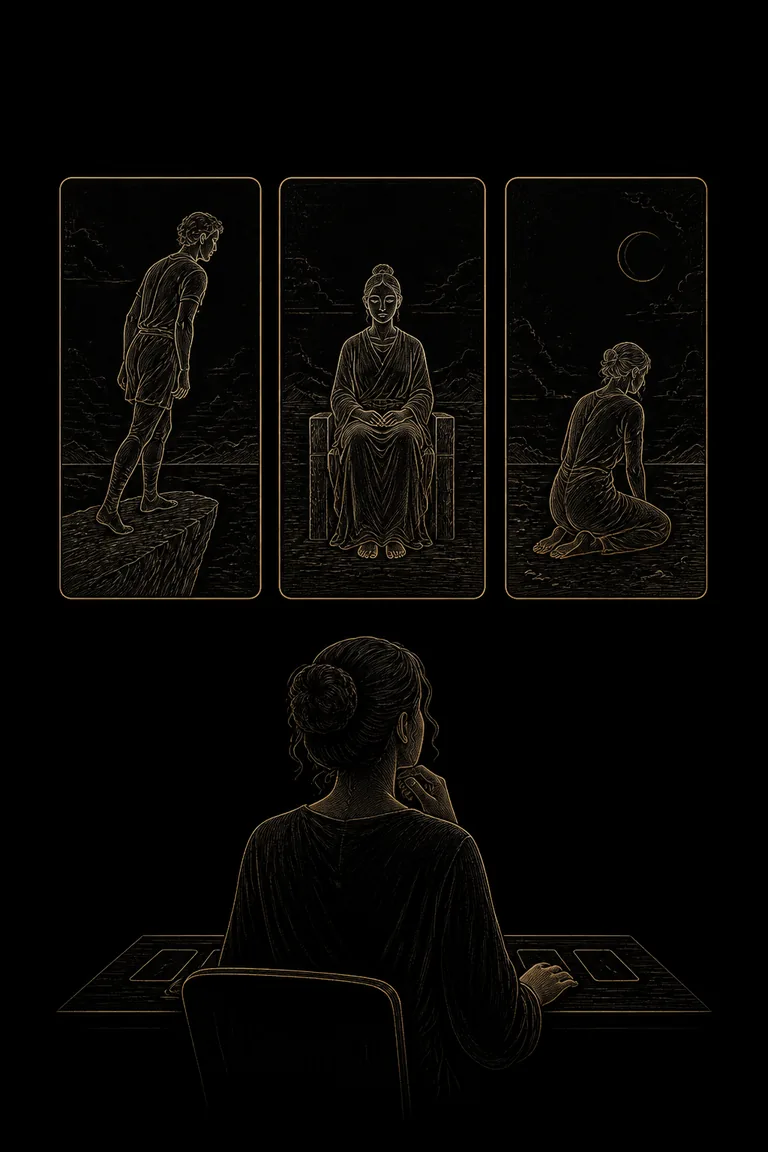
Posture in a Tarot card is the visible arrangement of a whole body within a designed scene. A figure may stand with weight forward, sit inside a rigid frame, kneel near an object, turn away from a group, or balance between two supports. These choices shape movement, stability, distance, and attention, but they do not provide a universal code for confidence, guilt, surrender, illness, or truthfulness.
A grounded reading begins with what the image actually shows. Record the base of support, weight direction, body orientation, available route, nearby objects, and other figures. Then propose more than one function and test each against the card, spread position, deck guide, and question. This keeps posture distinct from mind reading and gives the detail a proportionate role in the full interpretation.
Take the next insight with you
Explore personalized Tarot guidance in Veritas, available for iOS and Android.
 Scan with your phone
Tarot posture symbolism at a glance
Begin with a neutral posture inventory
Describe the pose without psychological labels. Instead of "she is defensive," write "the seated figure keeps the torso upright, feet together, and shoulders inside the chair's vertical frame." Instead of "he is eager," write "the standing figure leans toward the path with weight over the front foot." Neutral language preserves evidence and makes disagreement possible.
Find the base of support
Every pose depends on something that carries weight: feet, knees, a chair, bed, wall, staff, ledge, animal, or another person. Ask whether the support looks stable, temporary, narrow, shared, damaged, or unavailable. A throne may provide structure while limiting movement. A staff may aid travel or show that the terrain demands effort. The same support can offer capacity and constraint at once.
Trace weight and possible movement
Weight centered over both feet can make stillness visually important, while weight shifted forward can suggest that movement is possible or already beginning. A backward lean may create distance from an object, but it can also be caused by balance, perspective, or the artist's need to fit the figure into the frame. Follow the likely next movement and ask what in the scene enables or blocks it. Do not convert one lean into a fixed forecast.
Read orientation before expression
Note whether the torso faces the viewer, another figure, an object, the edge of the card, or a route through the landscape. Then compare head, hips, and feet. A body facing one way while the head turns another can create divided attention, review, vigilance, or simple visual connection. The image shows a relationship between directions, not a hidden motive.
Standing, sitting, and reclining
Standing usually offers more immediate mobility than sitting, yet stance matters. A standing figure boxed in by terrain may have fewer options than a seated figure beside an open door. Sitting can support authority, concentration, waiting, recovery, ceremony, or confinement. Reclining can show sleep, rest, illness, exposure, contemplation, or artistic display. Let objects and context decide which functions deserve attention.
Kneeling, bowing, and lowered positions
A lowered body may participate in work, care, ritual, grief, negotiation, submission, observation, or reaching something near the ground. Identify whether the posture is voluntary within the scene, whether the figure can rise, and how other figures respond. A kneeling image cannot establish consent, social rank, humiliation, or spiritual devotion by itself. Historical art conventions and deck lineage may change the scene's intended grammar.
Open and closed silhouettes
A wide stance or expanded silhouette can occupy space, while a compact pose reduces it. These visual effects can serve stability, display, protection, fatigue, cold, concentration, or composition. Avoid fixed body-language dictionaries that call every compact pose fear and every expansive pose confidence. Compare the figure with weather, clothing, furniture, architecture, and the action in the card.
Distance, grouping, and shared posture
Measure who stands near whom, who shares a baseline, and who occupies a different level or side of the image. Mirrored poses can link figures, while opposing orientations can create contrast. Distance may indicate separate tasks, privacy, hierarchy, danger, perspective, or simply the scene's geography. In a spread, repeated facing directions may create a visual sequence, but the sequence remains an interpretive option rather than proof of relationship dynamics.
A six-pass posture reading method
- Describe the whole pose
Record standing, sitting, kneeling, reclining, leaning, turning, and visible tension without naming an emotion.
- Map support and weight
Identify what bears weight, how stable it appears, and where the body could move next.
- Trace orientation
Compare torso, head, hips, feet, objects, other figures, and available routes.
- Check the environment
Test whether terrain, architecture, clothing, furniture, or perspective explains the posture.
- Offer two functions
Write at least two plausible scene roles and identify the evidence that would favor each.
- Return to the spread
Use the position, question, neighboring cards, deck source, and real-world facts to decide how much weight the detail deserves.
Worked example: a forward-leaning figure
Imagine an unlabelled card showing a figure on a narrow ledge, torso angled toward a descending path and weight over the front foot. One reading is readiness to proceed. Another is unstable commitment because the support is narrow and the route is steep. A third is careful inspection before movement. The spread position and surrounding cards can favor one function, but the pose cannot guarantee travel, risk, or action.
Worked example: an upright seated figure
A figure sits centered in a high-backed chair with feet planted and the torso aligned to the frame. The posture may support deliberation, formal responsibility, authority, waiting, or reduced flexibility. If the card appears in a resource position, stability may matter. In an obstacle position, rigidity or dependence on a role may matter. Neither conclusion comes from uprightness alone.
Worked example: a figure kneeling apart
A kneeling figure turns partly away from two standing figures while tending a vessel. The pose might show focused care, specialized work, lower leverage, privacy, or separation caused by the task. Check gaze, hands, distance, floor level, and whether the vessel connects the group. Do not infer shame, obedience, or exclusion without additional visual and contextual evidence.
Posture versus gesture
Posture describes how the whole body occupies and is supported by space. The Tarot gesture symbolism guide focuses on visible actions involving hands, arms, pointing, offering, touch, and gaze direction. Read them in sequence: first map the body's spatial condition, then ask what a specific gesture does within it. Keeping the scopes separate prevents one raised hand from defining an entire pose or one lean from inventing an action.
Deck lineage and artistic convention
The same card can stage a figure differently across Rider-Waite-Smith, Marseille, Thoth, and contemporary decks. A copied pose may carry an inherited composition, while a revised pose may redirect the scene. Compare the card with its own deck and guidebook before importing a meaning from another image. The Rider-Waite-Smith and Marseille comparison shows why visual grammar changes across lineages.
Accessibility and alternative observation
Small art, stylization, low contrast, cropping, visual impairment, and limited mobility knowledge can make posture hard to identify. Use a high-resolution image, guidebook description, screen magnification, or a trusted verbal description. If a joint angle is unclear, record only what is certain, such as seated or facing left. Do not assume that an unusual body position represents pain, disability, moral character, or symbolic damage.
Save a posture evidence record
Use Veritas to record the figure, base of support, weight direction, orientation, distance, possible route, environmental explanation, two competing functions, spread position, deck source, and later review.
A journal protocol for repeated poses
Choose one deck and record posture details from ten readings before building personal associations. Link each observation to the exact card and spread position. At review, count supporting examples, contrary examples, and cases where terrain or furniture explained the pose better. The Tarot journal guide helps preserve original interpretations instead of rewriting them after events.
Common posture-reading mistakes
Common errors include naming emotion before describing the pose, ignoring the base of support, treating stillness as passivity, calling every forward lean progress, reading a lowered body as consent, importing modern body-language claims into historical art, and overlooking deck variation. Another error is letting one posture override the card title, spread position, or direct evidence in the real situation.
Limits and responsible use
Tarot is a symbolic reflection practice, not a validated method for assessing psychology, health, honesty, danger, consent, or another person's intentions. A drawn posture cannot independently prove abuse, attraction, illness, guilt, readiness, or a future action. Use direct communication, documented facts, and qualified medical, legal, financial, or mental health support for consequential decisions.