Tarot Journal
Tarot Gesture Symbolism: An Evidence-First Guide
Tarot gesture symbolism becomes clearer when you describe who moves, what the hands or arms do, where the action points, and how the scene responds before assigning emotion or intent.
A gesture in a Tarot card is a visible action within a designed scene. An open palm may offer, display, request, pause, bless, or simply balance the composition. A pointing hand may direct attention, issue an instruction, mark a route, or quote an older artistic convention. Start with the actor, movement, target, contact, and response rather than a fixed gesture dictionary.
Gesture is not mind reading. Folded arms cannot prove defensiveness, an extended hand cannot prove consent, and a turned gaze cannot prove deception. Compare the action with objects, distance, clothing, terrain, other figures, deck lineage, spread position, neighboring cards, and the question. The strongest reading explains what the gesture does in this particular card while preserving at least one fair alternative.
Take the next insight with you
Explore personalized Tarot guidance in Veritas, available for iOS and Android.
 Scan with your phone
Tarot gesture symbolism at a glance
Describe action before meaning
The figure extends one hand toward a cup is an observation. Generosity, invitation, bargaining, warning, and visual emphasis are interpretations. Keeping those levels separate is the foundation of the Tarot card symbolism method. It prevents a popular body-language claim from replacing what the illustration actually shows.
Use an actor-action-target sentence
Write one neutral sentence with three parts: the actor, the action, and the target. For example, the seated figure raises a palm toward the approaching figure. Add contact and response only when visible. This grammar exposes missing information. If no target is shown, do not invent one outside the frame. If the other figure does not respond, do not assume acceptance or refusal.
A six-pass gesture method
- Identify the actor
Name which figure, hand, arm, face, or body part performs the visible action without assigning a personality.
- Describe the movement
Record open, closed, raised, lowered, extended, withdrawn, pointing, holding, touching, or turning in neutral language.
- Locate the target
Notice whether the action addresses an object, route, person, boundary, empty space, or something outside the frame.
- Check contact and response
Separate near from touching, offered from received, and directed attention from a visible response.
- Offer two functions
Write one likely scene function and one plausible rival, including compositional or historical convention when useful.
- Test the full card
Compare objects, distance, gaze, clothing, landscape, guidebook, question, position, adjacent cards, and later evidence.
Hands that hold, carry, or manipulate objects
A hand around a tool, cup, coin, rein, or blade creates a relationship between figure and object. Check grip, weight, orientation, use, and whether the object is active or merely displayed. Holding tightly may support control, protection, strain, or the practical need not to drop something. The object and task matter more than a universal meaning for closed fingers.
Pointing and directional gestures
A finger, staff, face, or extended arm can direct the viewer across the image. Trace the line. Does it meet a person, path, horizon, object, border, or blank space? Pair it with the landscape method when terrain supplies the target. A pointing gesture can emphasize a choice or route, but it does not command the reader to take that route in life.
Offering, receiving, and withholding
An offered object is not the same as a completed exchange. Look for distance, orientation, the receiver's hands, shared attention, and whether transfer has occurred. A hand held close to the body may protect, reserve, prepare, or simply support an object. Translate the scene into a question about terms and reciprocity rather than declaring generosity or refusal.
Touch, distance, and consent
Touch can show support, restraint, work, conflict, ritual, care, or compositional connection. The image alone cannot establish consent or safety. Notice who initiates, where contact occurs, whether either figure moves away, and what the card position asks. In real relationships, consent comes from direct communication, not a symbolic image.
Gaze is a directional cue, not a confession
Gaze can connect figures and objects or move the viewer through a composition. Record where the face or eyes appear directed and whether the target is actually visible. Looking away may indicate another focus, caution, staging, or an artistic profile. It does not prove avoidance, dishonesty, attraction, or a hidden motive.
Gesture and clothing work together
Sleeves, gloves, armor, carried loads, and restrictive garments change what an arm or hand can do. Use the clothing symbolism guide to check whether a gesture reflects practical limits. A small movement inside heavy clothing may require more effort than a wide movement in loose fabric, but neither automatically reveals emotional intensity.
Worked example: the raised palm
Imagine one figure raising an open palm toward another who is approaching. One reading is pause or boundary. Another is greeting, display, blessing, or balance within the picture. Check distance, facial direction, objects, route, the second figure's movement, and spread position. Boundary becomes stronger when the gesture interrupts an active approach and the surrounding scene supports separation.
Worked example: an object extended between figures
Suppose one person extends a coin while the other person keeps both hands occupied. The scene may concern an offer whose practical receipt is unresolved. A rival explanation is that the coin is being shown or counted rather than transferred. Do not call it generosity, debt, or agreement until direction, hands, roles, and card context support that claim.
Worked example across three cards
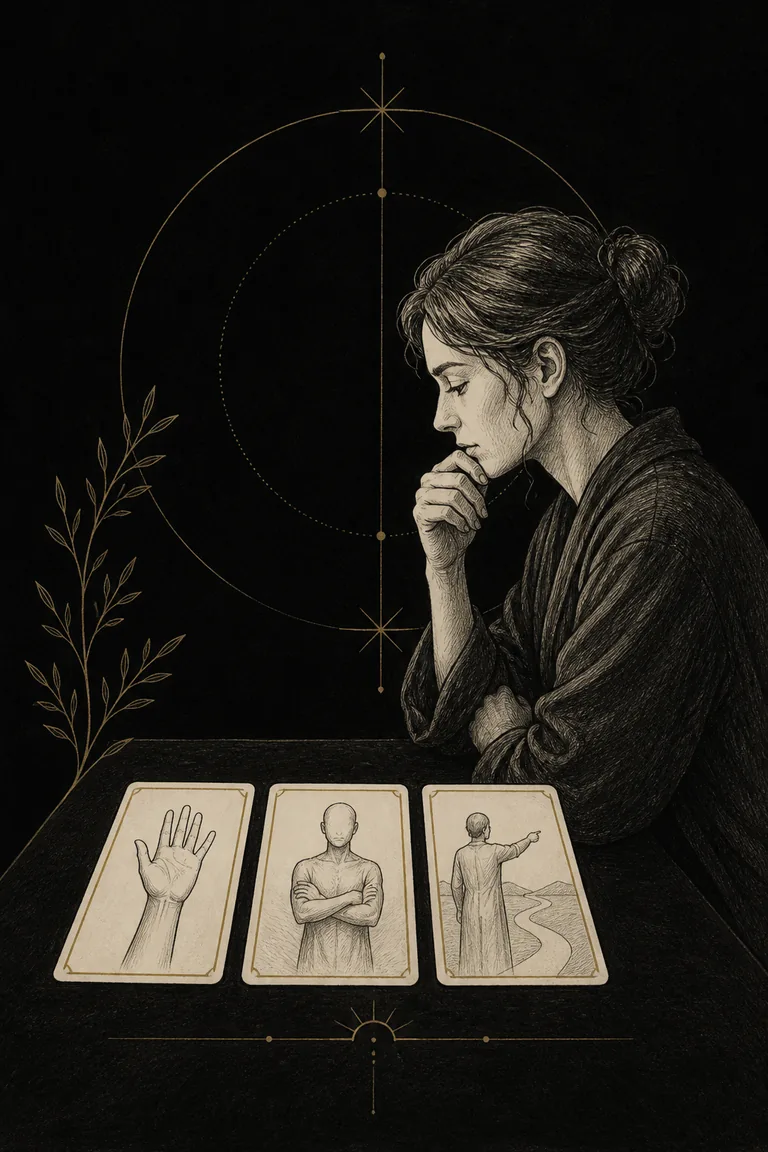
A spread might move from crossed arms to an open palm and then a hand indicating a road. A coherent story could describe reservation, clarification, and a proposed direction. A rival reading is that the gestures belong to unrelated scenes. Use the Tarot storytelling method to name the connector and test whether positions, repeated objects, and the question truly support a sequence.
Deck lineage and artistic convention
Rider-Waite-Smith-derived decks, Marseille decks, historical religious art, theater, comics, and contemporary illustration use different gesture conventions. A raised hand may quote a formal pose instead of naturalistic behavior. Consult the guidebook and source tradition before applying a modern body-language claim. The Rider-Waite-Smith and Marseille comparison shows why visual grammar changes across decks.
Accessibility without fine hand detail
When fingers or eyes are difficult to see, use arm direction, silhouette, distance, object placement, torso orientation, contact, and large lines of movement. An enlarged image or deck guide can clarify details, but record uncertainty rather than inventing a grip or facial expression. The reading remains useful when it rests on larger, verifiable relationships.
Save a gesture evidence record
Use Veritas to record actor, action, target, direction, contact, response, object, scene context, deck source, two possible functions, uncertainty, and the evidence that later supported or challenged each reading.
A practical journal protocol
Choose one card with a clear interaction. Write an actor-action-target sentence, then add contact and response. Draw a simple line showing the gesture's direction. Write two interpretations and one compositional explanation. Compare a second card from the same deck that uses a similar gesture, then revisit both after reading the guidebook. A Tarot journal makes deck-specific visual habits easier to verify.
Common gesture-reading mistakes
Common mistakes include treating crossed arms as proof of defensiveness, open hands as proof of honesty, touch as consent, pointing as a command, and averted gaze as deception. Readers may ignore objects, crop boundaries, artistic convention, disability, or practical clothing limits. Describe the action, preserve a rival explanation, and keep claims proportional to visible evidence.
Limits and responsible use
Tarot gesture symbolism is an interpretive visual practice. It cannot independently reveal another person's thoughts, consent, honesty, diagnosis, identity, danger, or future behavior. Use direct communication, documented evidence, qualified advice, and appropriate safety planning for consequential decisions. For agency-preserving prompts, see questions to ask Tarot.