Tarot Journal
Tarot Clothing Symbolism: A Deck-Specific Reading Guide
Tarot clothing symbolism becomes useful when you describe garments, layers, fit, condition, movement, and practical function before assigning a role or personality to the figure wearing them.
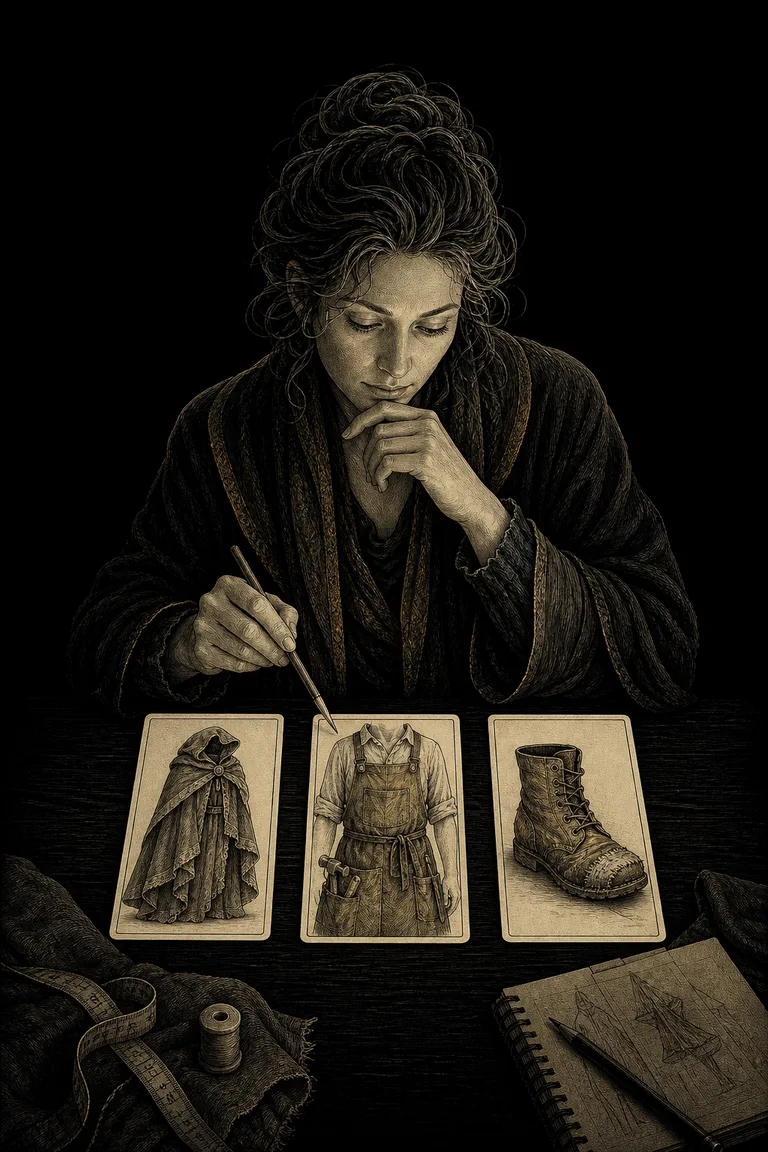
Clothing in a Tarot card changes what a figure can do and how the scene presents that person. A heavy cloak can protect against weather while limiting movement. An apron may support work, mark a role, or simply belong to the artist's period. Bare feet can show contact with the ground, missing protection, ritual convention, or an ordinary design choice. Meaning starts with what the garment visibly covers, permits, restricts, carries, and communicates inside this deck.
Read costume as evidence, not biography. Record garment type, layers, fit, fastening, material, wear, repair, footwear, headwear, exposed areas, and response to motion or weather. Then compare posture, setting, objects, spread position, neighboring cards, guidebook, and historical context. Clothing can support a reading about role or readiness, but it cannot prove class, profession, gender identity, wealth, character, or future status.
Take the next insight with you
Explore personalized Tarot guidance in Veritas, available for iOS and Android.
 Scan with your phone
Tarot clothing symbolism at a glance
Describe the garment before naming its meaning
A figure wears a long cloak fastened at the throat is an observation. Secrecy, authority, grief, warmth, ceremony, and historical fashion are interpretations. Several can fit the same image. The Tarot card symbolism guide keeps visible details separate from associations. That distinction prevents a familiar costume stereotype from replacing the actual scene.
A six-pass clothing method
- Inventory the clothing
Name garments, layers, closures, footwear, headwear, gloves, belts, pockets, tools attached to clothing, and exposed areas without interpreting them.
- Check fit and condition
Notice loose or fitted construction, clean or stained fabric, intact or torn edges, deliberate repair, borrowed appearance, and whether condition is actually visible.
- Test practical function
Ask how the clothing affects warmth, protection, movement, labor, storage, visibility, ceremony, or access in this environment.
- Separate role from person
Treat uniform, crown, veil, armor, or workwear as a possible scene role, not proof of the wearer's permanent identity or character.
- Offer two functions
Write one likely reading and one fair rival explanation, including an artistic, historical, or compositional reason when appropriate.
- Test the full card
Use posture, gaze, gesture, setting, objects, deck source, question, position, adjacent cards, and later evidence to decide cautiously.
Layers, protection, and exposure
Layers may answer a practical need for warmth, armor, modesty, ceremony, concealment, or carrying capacity. Ask what the environment demands. A cloak in wind behaves differently from a cloak in a still interior. Exposed skin can increase vulnerability, freedom of movement, heat tolerance, intimacy, ritual meaning, or visual contrast. More coverage is not automatically more guarded, and less coverage is not proof of honesty or risk.
Fit, fastening, and movement
Tight sleeves, a trailing hem, open laces, a secured belt, or a raised hood can change movement and readiness. Check whether the figure is walking, working, seated, running, or posing. Clothing that appears restrictive in one action may be appropriate for another. Translate the image into a question such as what preparation supports this task, rather than declaring that the wearer is trapped or ready.
Condition, wear, and repair
A patched boot can indicate maintenance, limited resources, valued continuity, practical skill, or an artist's realism. Frayed cloth may show repeated use without proving poverty or neglect. Compare condition across the deck: if every garment is heavily textured, wear may be part of the illustrator's normal style. Repair becomes more meaningful when seams, tools, posture, and surrounding objects support it.
Workwear, uniforms, and ceremonial dress
Aprons, armor, robes, crowns, veils, and uniforms can identify what a figure is doing in the card's scene. They can also quote an artistic tradition or simplify visual storytelling. Ask which duties, permissions, standards, or constraints belong to the pictured role. Do not convert a costume into a diagnosis of personality, a prediction of promotion, or a claim about the querent's real occupation.
Headwear, hands, and footwear
Headwear changes silhouette, protection, visibility, and sometimes rank within a deck. Gloves can protect hands, improve grip, restrict touch, or complete a costume. Footwear links the body to terrain: boots, sandals, bare feet, and damaged soles create different practical relationships with ground and weather. Read these details with the landscape method rather than assigning a universal meaning to each item.
Color is a separate layer
Garment construction and garment color answer different questions. First establish what the clothing does. Then, if hue is clear and the deck uses color consistently, apply the deck-specific color method. A red cloak may be warm, ceremonial, visible, or simply part of the palette. Do not let a color keyword erase material, movement, condition, and scene context.
Worked example: a layered cloak
Suppose a standing figure wears a layered cloak on an exposed ridge. One reading says the figure is prepared for difficult conditions. Another says the garment creates visual weight and ceremonial presence while the clear path shows little practical hardship. Check wind marks, fastening, footwear, load, posture, route, and card position. Preparation is a stronger claim when the clothing visibly answers the terrain.
Worked example: an apron at a bench
An apron beside tools may support a reading about active work, protection, repeated practice, or an assigned role. A rival explanation is that the artist uses recognizable workwear to make the scene legible. Ask whether the hands are working, inspecting, resting, or receiving instruction. The clothing does not prove competence; action, result, and feedback supply that evidence.
Worked example across three cards
Imagine a spread moving from an oversized coat to rolled sleeves and then a repaired boot. A coherent story might describe poor fit, active adjustment, and maintained capability. A rival reading is that three unrelated scenes use different period costumes. Connect them only when position, posture, repeated materials, and the question support the sequence. The Tarot storytelling method helps expose the connectors instead of assuming them.
Deck lineage and historical costume
Rider-Waite-Smith-derived decks often preserve early twentieth-century interpretations of medieval and Renaissance clothing. Marseille decks use different workshop conventions, and contemporary decks may relocate the scene into modern, futuristic, or culture-specific dress. Consult the guidebook and credible costume sources before attaching a historical role. The Rider-Waite-Smith and Marseille comparison shows why imagery cannot be transferred unchanged between traditions.
Accessibility without relying on fine detail
If small details or color differences are hard to see, use silhouette, layer count, garment length, edge shape, closure placement, contrast, contact with the ground, and effect on posture. A deck guide or enlarged image can clarify construction, but avoid inventing stitches or materials that are not visible. Recording uncertain details as uncertain is part of a sound reading.
Save a clothing evidence record
Use Veritas to record garment type, layers, fit, condition, movement, practical function, scene role, deck source, two possible readings, uncertainty, and the evidence that later supported or challenged each idea.
A practical journal protocol
Choose one card with a clearly dressed figure. Describe the clothing from head to foot in neutral language. Add one sentence about protection, one about movement, and one about role. Write two interpretations plus one ordinary artistic explanation. Compare another figure from the same deck, then revisit the entry after reading the guidebook. A Tarot journal makes these deck-specific patterns easier to verify.
Common clothing-reading mistakes
Common mistakes include treating every robe as spiritual, every crown as success, every torn garment as poverty, every bare foot as freedom, and every uniform as a permanent identity. Readers may impose modern class or gender assumptions on historical costume, overlook practical weather needs, or infer material and condition from color alone. Inventory first and preserve a competing explanation.
Limits and responsible use
Tarot clothing symbolism is an interpretive visual practice. It cannot independently prove a person's identity, culture, religion, profession, income, health, consent, trustworthiness, or future status. Use direct communication, documented evidence, qualified advice, and appropriate safety equipment for consequential decisions. For questions that preserve agency, see questions to ask Tarot.