Tarot Journal
Many Major Arcana in a Tarot Reading: What It Means
Many Major Arcana in a Tarot reading can make broad themes more visible, but the count must be interpreted through spread size, positions, individual cards, and real context.
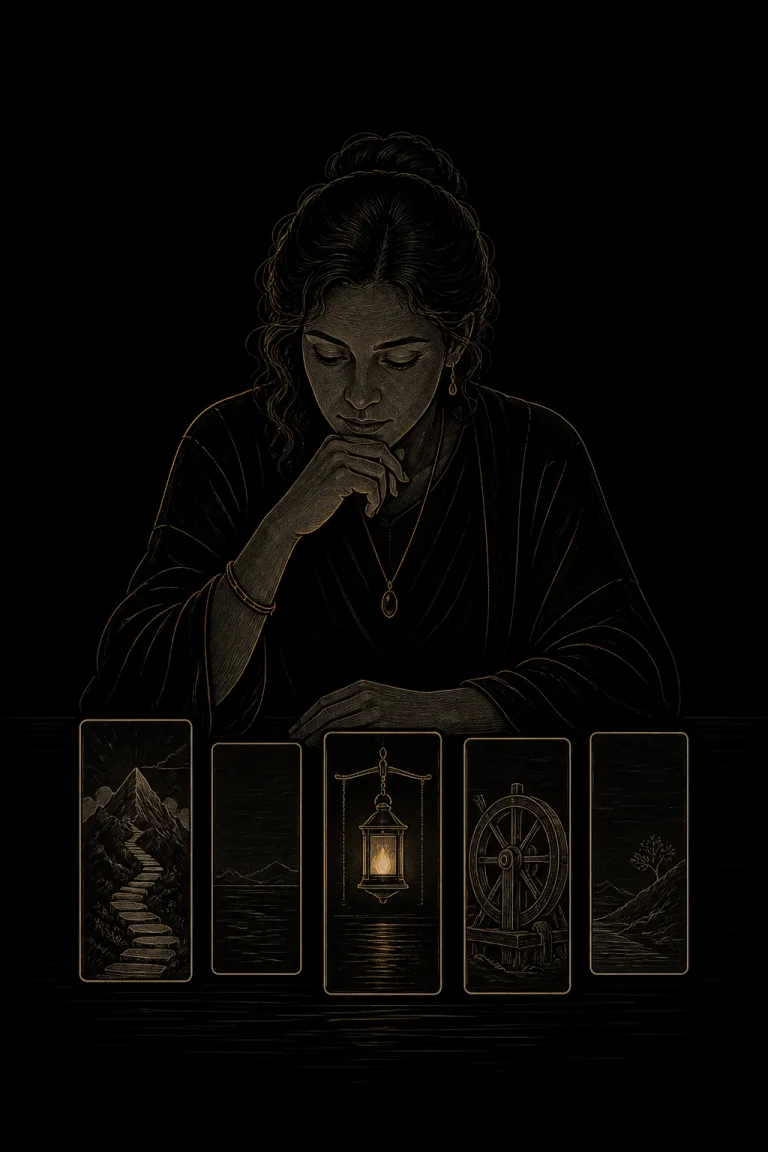
Many Major Arcana in a Tarot reading means that a large share of the completed spread comes from the deck's twenty-two archetypal cards rather than its fifty-six Minor Arcana cards. Readers often experience the pattern as weighty because Major cards address broad processes such as choice, change, responsibility, uncertainty, and integration. The pattern can emphasize the reading's larger frame, but it does not prove fate, permanence, spiritual intervention, or an unusually important future event.
Record the number of Major cards and the total spread size before interpreting them. Then read each card in its named position, preserve the Minor and court cards as counterevidence, and compare the result with the question and verified circumstances. Three Major cards in a three-card spread and three in a ten-card spread are not the same proportion, and neither result overrides consent, records, professional advice, or observable facts.
Take the next insight with you
Explore personalized Tarot guidance in Veritas, available for iOS and Android.
 Scan with your phone
Many Major Arcana at a glance
Start with the standard deck baseline
A standard Tarot deck has twenty-two Major Arcana and fifty-six Minor Arcana, so Majors make up a little more than one quarter of the full deck. That baseline is descriptive, not a rigid threshold. Expanded decks, missing cards, study decks, and nonstandard systems change the available pool. Confirm that the deck was complete and that the draw rule was fixed before any faces were seen. The Major Arcana guide explains the individual cards, while the Minor Arcana guide covers the four suits.
Always report the spread size
A count without a denominator hides the pattern. Two Majors in a two-card reading fill the entire spread, while two in a ten-card Celtic Cross occupy one fifth of it. Write "two of five cards are Major Arcana" instead of only "many Majors appeared." Small spreads can produce striking proportions easily, so the result should be described before it is dramatized.
There is no universal number that means fate
Traditions do not share one validated cutoff for when a spread becomes major. A reader may set a study rule, such as noticing when at least half of a spread is Major Arcana, but the rule must be declared before the draw and treated as a prompt for closer reading. Changing the threshold after seeing the cards turns the method into confirmation seeking.
Read the cards before the category
The category "Major Arcana" is too broad to supply the whole interpretation. The Hermit, Justice, the Tower, and the Star do not make the same claim. Read title, imagery, orientation, position, question, and nearby cards. A cluster may describe several stages of one process, competing responses, or unrelated themes distributed across different positions.
Position changes the practical weight
A Major card in an advice position describes a reflective lens for action. A Major in a background position may describe context. A Major in an outcome position remains conditional on the question, spread design, and choices represented elsewhere. Do not convert every position into a prediction. Name the positional role and explain how the card addresses it.
Look for a sequence, not a forced story
Several Majors can form a useful sequence when the spread positions already create order. For example, a card about suspension in the present, one about evaluation in advice, and one about renewal in a later review position can suggest pause, assess, and respond. This is a reading hypothesis. It should remain open to other sequences and to the actual events that follow. The card combinations guide shows how to connect cards without erasing their positions.
Minor Arcana provide concrete counterevidence
Minor cards may specify the conversation, task, resource, conflict, feeling, or routine through which a broad Major theme becomes visible. A single Pentacle in a resource position may matter more to the next decision than several dramatic images elsewhere. Do not call Minors unimportant. They often contain the practical conditions that make an interpretation testable.
Court cards need their own evidence
Court cards may describe a role, communication style, developmental stance, or person, depending on the declared method. They should not be silently promoted into Major cards or reduced to gender and age stereotypes. Keep them in the printed suit count and interpret their positions with the court cards guide.
This pattern is not suit imbalance
Tarot element imbalance counts Wands, Cups, Swords, and Pentacles across a spread. This article counts Major versus non-Major cards. A spread may contain many Majors and no measurable suit dominance, or few Majors and a strong suit concentration. Keep both tallies separate so one pattern does not borrow certainty from the other.
Reversals do not change arcana membership
A reversed Major card remains Major Arcana. Reversal may modify expression through delay, resistance, internalization, excess, or another declared convention, but it does not demote the card. Use the reversed cards guide before adding that layer, and keep the original orientation in the record.
A six-step method for a Major-heavy spread
- Freeze the draw
Save the deck, question, spread, positions, orientation rule, card count, and stopping point before interpreting.
- Count and state the proportion
Record the number of Major cards and the total, then list Minor and court cards separately.
- Check the baseline
Confirm the deck is complete and note any nonstandard additions, removals, or selection rules.
- Read every position
Interpret each Major card in its assigned role and preserve the concrete evidence supplied by other cards.
- Test rival readings
Write at least one alternative sequence and identify facts that support, contradict, or leave each version unresolved.
- Choose a bounded response
Turn the synthesis into one reversible action, direct question, practical check, or scheduled review.
Worked example: three Majors in a five-card decision spread
Imagine three Major cards in positions for current context, central tension, and advice, plus a Sword in available information and a Pentacle in resources. The Major proportion makes the broader decision process visible, but the Sword and Pentacle define what can actually be checked: written terms, missing facts, budget, time, and capacity. The cards do not decide which option is safe or lawful.
Worked example: all Majors in a three-card reading
If all three cards are Major Arcana, first preserve the small sample size. Read the spread positions and sequence, then ask which ordinary situations fit and which do not. Do not add cards until a Minor appears merely to make the reading feel practical. Instead, translate the existing synthesis into a real-world question and verify it outside the deck.
Do not redraw to manufacture or erase significance
Drawing again because the spread feels too dramatic or not dramatic enough changes the sample. If a card was genuinely exposed, damaged, or drawn outside the declared method, use the replacement rule chosen beforehand. Otherwise preserve the result and stop. The guide to how many Tarot cards to pull helps set a clear limit.
Compare repeated readings carefully
A journal can track Major proportions across time only when deck, spread size, draw method, and question type are comparable. Reusing the same deck without fully returning and mixing cards changes the pool. Recording only dramatic readings creates selection bias. Include ordinary and contradictory draws, then review at a scheduled date.
Save the proportion before the story
Use Veritas to record the deck, spread size, Major count, positions, Minor and court evidence, rival readings, practical checks, action, and later review.
Accessibility and card identification
Readers may identify cards through printed titles, large-print decks, tactile markers, accessible digital labels, or a trusted card list. Do not guess arcana membership from color or image complexity. Verify the card identity first. Accessibility support improves the reliability of the count and does not reduce interpretive skill.
Responsible limits
Many Major Arcana in a Tarot reading is a symbolic pattern, not scientific evidence of destiny, crisis, spiritual status, permanent change, mental state, health, pregnancy, guilt, compatibility, money, timing, or future events. Do not use the count to diagnose, frighten, pressure, accuse, override consent, or make medical, legal, financial, employment, relationship, or safety decisions. Visit the <a href="/tarot">Tarot journal hub</a> and rely on direct evidence, qualified advice, and ordinary safeguards for consequential choices.