Tarot Journal
Tarot Animal Symbolism: A Deck-Specific Reading Guide
Tarot animal symbolism becomes clearer when you identify the creature, describe its behavior, and test its role in the scene before reaching for a fixed symbolic meaning.
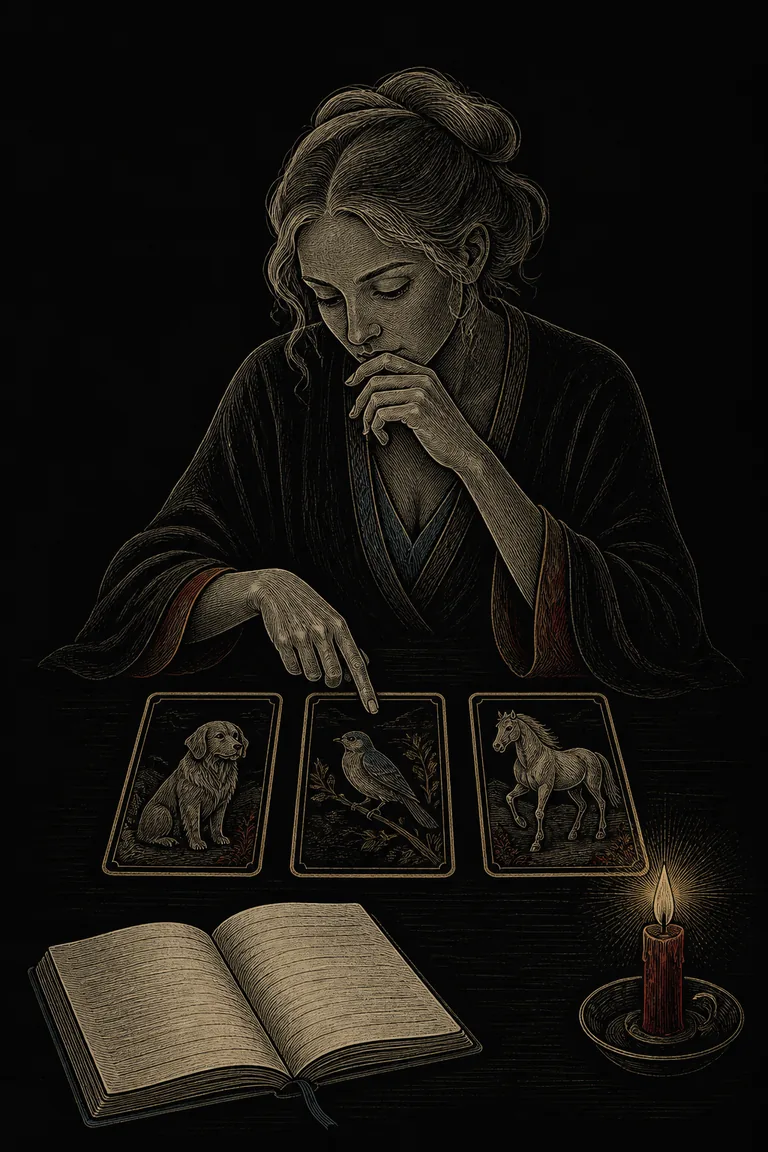
Tarot animal symbolism covers the dogs, horses, birds, lions, rabbits, fish, insects, and imagined creatures that appear in illustrated decks. An animal may guide the eye, mirror a human figure, change the pace of a scene, mark a boundary, or connect several cards. Its useful meaning comes from those visible relationships, not from a universal bestiary.
Start with evidence that another reader could see: species if identifiable, posture, direction, distance, scale, and interaction. Then compare the deck guidebook, artistic tradition, spread position, and question. This method allows a dog to suggest companionship in one image and an ignored warning in another without making either association permanent.
Take the next insight with you
Explore personalized Tarot guidance in Veritas, available for iOS and Android.
 Scan with your phone
Tarot animal symbolism at a glance
Animal evidence versus animal association
A small dog jumps toward a walking figure is an observation. Loyalty, instinct, distraction, play, protection, and warning are associations. Several can fit the same image. The broader Tarot card symbolism guide separates visible evidence from a proposed meaning. Apply that distinction before deciding what the animal represents.
A six-pass method for reading animals
- Identify cautiously
Name the creature only as precisely as the artwork supports. Bird may be more accurate than eagle.
- Describe behavior
Record posture, movement, gaze, tension, sound cues, and whether the animal acts or waits.
- Map relationships
Note who controls, follows, feeds, watches, avoids, rides, confronts, or ignores the animal.
- Find the visual job
Ask whether it directs attention, changes pace, marks a threshold, mirrors emotion, or balances the composition.
- Offer two meanings
Write a primary interpretation and one fair alternative that also fits the scene.
- Test the context
Check the deck source, spread grammar, neighboring cards, question, and later evidence.
Species and uncertainty
A specific species can matter when the artist makes it recognizable, but false precision weakens a reading. An owl, falcon, raven, and generic dark bird carry different cultural associations, yet a stylized silhouette may not support any one label. Describe observable features and verify creator notes before building an interpretation around taxonomy.
Behavior matters more than a keyword
The same horse may stand, charge, resist, carry, or turn away. The same bird may soar, perch, feed, or become trapped. Behavior changes the verb of the image. Ask what is happening now, what has just happened, and which movement seems possible next. This creates a scene-based reading instead of a noun followed by a memorized definition.
Domestic, wild, and imagined animals
Domestic animals often appear inside relationships of care, work, dependence, or control. Wild animals may introduce distance from human plans, although they do not automatically mean danger or freedom. Imagined creatures can combine qualities that the deck deliberately refuses to keep separate. These are starting contrasts, not moral rankings.
Worked example: a dog at a threshold
Imagine a dog beside a traveler stepping across a cliffside threshold. The dog faces the traveler while the traveler looks outward. One reading is immediate feedback: enthusiasm needs awareness of the next step. Another is companionship at the beginning of an experiment. The question and spread position determine which is more useful. Neither image proves that a real friend is loyal or that an accident will occur.
Worked example: birds above a conversation
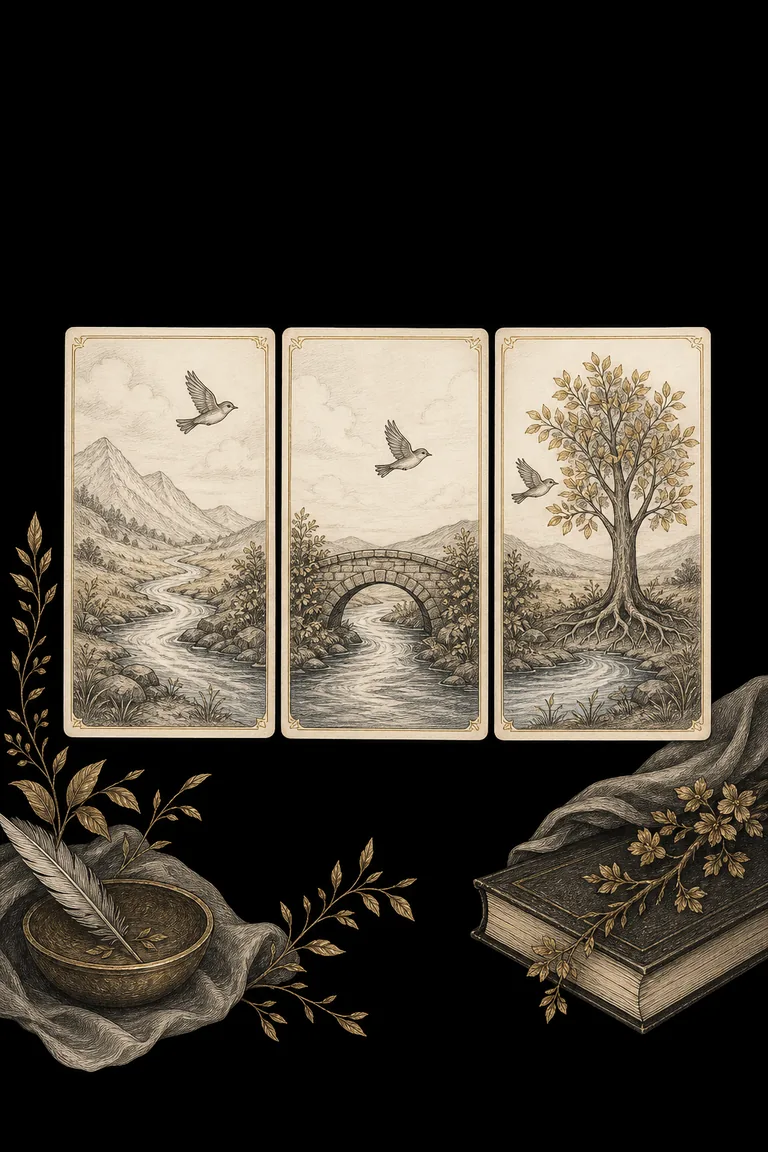
Suppose two figures talk below several birds moving in different directions. The birds might widen the scene beyond the speakers, visualize scattered attention, or simply create depth in the sky. Compare direction, number, and repetition with adjacent cards. The Tarot storytelling method helps determine whether the birds continue an established movement or introduce a new one.
Worked example: rider and horse
In a mounted figure, read rider, horse, and their coordination as a system. A calm horse with a tense rider differs from a charging horse whose rider pulls back. Ask where momentum comes from and who appears to direct it. In a Tarot card combination, another animal or vehicle may confirm, redirect, or complicate that pace.
Repeated animals across a spread
Repetition can connect cards, but count only what the deck actually shows. Track whether the creature changes owner, distance, posture, freedom of movement, or environment. A bird moving from cage to branch may support a transition reading; three unrelated decorative birds may not. Compare animal repetition with color, direction, suit, and position rather than letting one motif dominate.
Deck history and creator notes
Historical printing limits, copied compositions, heraldry, religious art, local fauna, and modern redesign all affect animal imagery. A Marseille-derived deck may use an animal differently from a Rider-Waite-Smith derivative or a contemporary ecology-centered deck. The Rider-Waite-Smith versus Marseille guide explains why deck lineage should be named rather than assumed.
Mythology and folklore are source-dependent
An animal can carry mythic or folkloric associations, but traditions differ by place, period, and story version. Cite the exact source and ask whether the deck signals that reference. A lion in one image may echo a specific narrative; in another it may simply create scale, tension, or warmth. Similarity is not proof that every story attached to the animal belongs in the reading.
Save an animal-symbol audit
Use Veritas to record the creature, visible behavior, relationships, two possible functions, deck source, spread context, practical question, and later evidence.
A practical journal protocol
Choose one card with an animal and write facts for sixty seconds without interpretation. Add one sentence about behavior, one about relationship, and one about visual role. Then propose two readings and one ordinary artistic explanation. Revisit the entry after consulting the guidebook. A Tarot journal reveals which associations remain useful across readings and which belong to one deck.
Common mistakes
Common mistakes include misidentifying a species, assigning one moral quality to every animal, ignoring what the creature actually does, importing mythology the deck does not reference, treating predation as proof of a harmful person, and reading a pet-like figure as a literal pet prediction. Another error is noticing a motif only after the outcome and then calling it obvious.
Limits and responsible use
Tarot animal symbolism is an interpretive visual practice, not a validated method for identifying danger, diagnosing illness, judging another person, locating a missing animal, or predicting wildlife, pregnancy, travel, conflict, or death. Use the image to form a question that can be checked through observation, records, conversation, or a reversible action. For agency-centered prompts, see questions to ask Tarot.