Tarot Journal
Tarot Distance Symbolism: An Evidence-First Guide
Tarot distance symbolism starts with visible proximity, depth, barriers, and access, then asks what the spacing does in this deck and scene before assigning a relationship or prediction.
Tarot distance symbolism concerns how far apart figures, objects, routes, and destinations appear within a card or spread. A cup held at the chest, a gate across a courtyard, and a mountain on the horizon create different kinds of access. Distance can organize attention, effort, privacy, connection, or sequence, but it does not automatically mean emotional withdrawal, delay, travel, or an exact amount of time.
Read distance as designed visual evidence. Name the two endpoints, identify the depth cues, note anything that opens or blocks the route, and compare the pattern with the deck baseline. Then test at least two scene functions. This keeps a useful spatial observation separate from claims the image cannot prove about another person, a future event, or a private motive.
Take the next insight with you
Explore personalized Tarot guidance in Veritas, available for iOS and Android.
 Scan with your phone
Tarot distance symbolism at a glance
Start by naming two endpoints
Near and far are incomplete unless you say near to what. Write a neutral sentence such as the figure stands close to the gate but far from the lit house. The sentence identifies two different relationships in one scene. It also follows the evidence-first habit in the Tarot card symbolism guide: observation first, interpretation second.
Four kinds of distance to keep separate
Picture-plane distance is the visible gap on the printed card. Implied world distance uses perspective, overlap, paths, horizon lines, and relative size to suggest depth. Functional distance asks whether a route can actually be crossed. Relational distance describes how the arrangement affects interaction within the scene. A tiny printed gap may represent a long road, while two adjacent figures may remain functionally separated by a wall, rank, task, or turned attention.
A six-pass distance method
- Choose the endpoints
Name the two figures, objects, boundaries, or destinations being compared without assuming what either represents.
- Describe the gap
Record close, touching, separated, foreground, middle ground, background, above, below, or outside the frame in plain language.
- Check depth cues
Notice overlap, convergence, relative size, shadows, terrain, framing, and whether the deck uses naturalistic perspective.
- Trace access
Follow the visible route and note doors, water, steps, walls, helpers, tools, ownership, permission, and missing connections.
- Offer two functions
Test a practical scene function and a fair alternative, including visual hierarchy or artistic convention.
- Compare context
Check the deck baseline, card position, adjacent cards, question, guidebook, and ordinary evidence before drawing a conclusion.
Depth cues are evidence, not universal meanings
Overlap often makes one form appear in front of another. Converging paths, smaller distant objects, atmospheric softness, and a high horizon can deepen the scene. Yet many Tarot decks flatten space, combine viewpoints, or enlarge an important object without naturalistic perspective. Use the scale and proportion guide to separate apparent size from importance, and record when the artwork does not support a reliable depth estimate.
Access matters more than empty space
A wide open courtyard may be easy to cross. A narrow channel may be impossible without a bridge. Examine the route, surface, boundary condition, direction of gates, available tools, and who appears authorized to move. The architecture symbolism method helps distinguish an opening from usable access. Distance becomes more informative when paired with what connects or interrupts the endpoints.
Distance between figures
Figures standing close may cooperate, compete, share a task, crowd one another, or simply fit the composition. Figures far apart may have different roles, viewpoints, responsibilities, or stages of action. Do not convert spacing into intimacy, conflict, attraction, or abandonment. Look for mutual orientation, movement, objects, contact, and response. The gesture guide can clarify visible interaction without pretending to read minds.
Distance to an object or goal
A tool in hand is immediately usable, an object behind glass is visible but restricted, and a landmark on the horizon may organize direction without being the next step. Ask what actions and conditions lie between figure and object. A distant crown does not guarantee promotion. A nearby coin does not guarantee ownership. The scene may be describing attention, preparation, custody, aspiration, display, or a practical route.
Foreground, middle ground, and background
Foreground elements often demand attention because they are large and close to the viewer, but background details can supply context, destination, weather, or consequence. Use the composition guide to trace the whole viewing path. Avoid the rule that foreground always means present and background always means future. That timing convention is optional, deck-dependent, and must be established before use.
Worked example: a lantern and a distant house
Imagine a figure holding a lantern on a path while a lit house appears beyond a stream. One reading is that immediate information supports a longer route toward shelter. Another is that the house provides contrast while the real task is examining the next few steps. Check whether a bridge exists, where the figure faces, how the path continues, and what the spread position asks. The picture does not reveal travel time or promise arrival.
Worked example: two figures across a table
Two figures sit on opposite sides of a table with one document between them. The spacing may support negotiation, role clarity, or formal procedure. It may also be ordinary furniture arrangement. Check who can reach the document, whether either person points or signs, whether the table protects work space, and what neighboring cards add. Do not infer agreement, hostility, or legal outcome from the gap alone.
Distance across a three-card spread
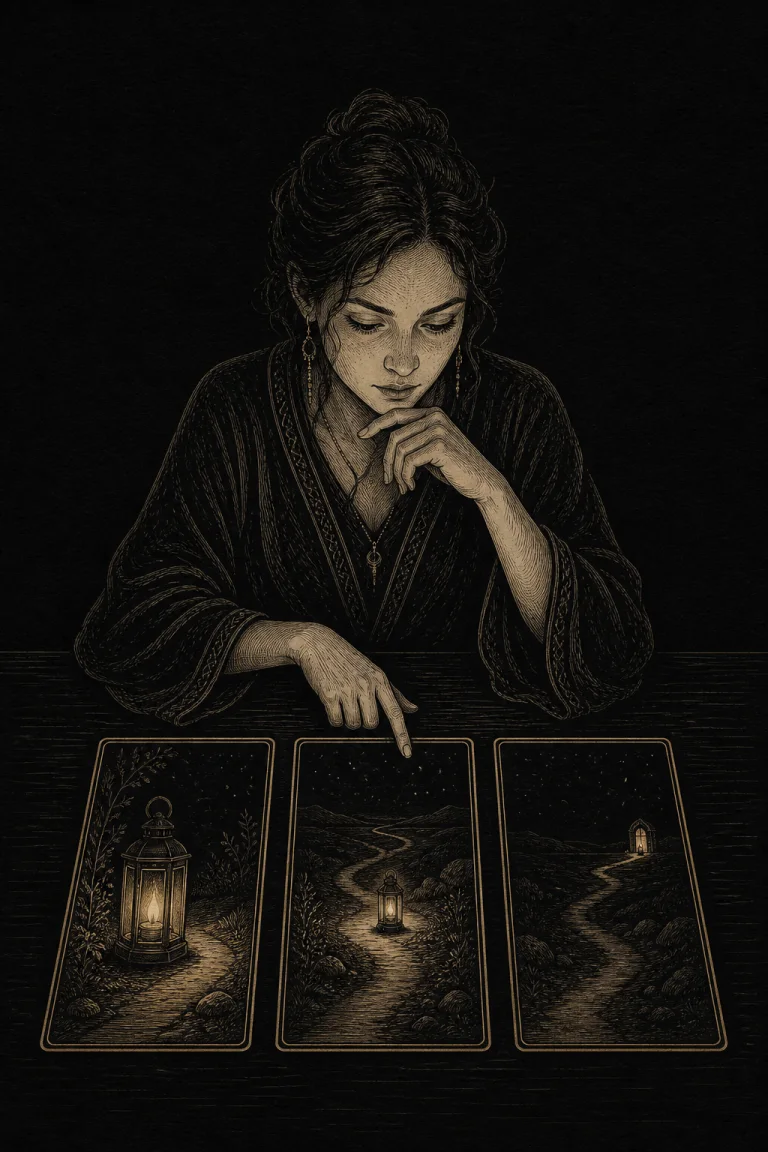
Suppose the first card places a lantern in the foreground, the second places it midway along a road, and the third shows it inside a shared room. The repeated object may describe changing access or use. It may instead reflect three unrelated compositions. Use card combination evidence: repetition, positions, direction, and a single connector that explains all three cards without ignoring differences.
Deck baselines and historical perspective
Compare several cards from the same edition. Does the artist routinely place castles on every horizon? Are important figures enlarged regardless of depth? Are rooms shown with tilted floors or stacked viewpoints? A feature that appears throughout the deck may be visual grammar rather than a special message. Guidebooks, art notes, and source decks can explain conventions that a modern naturalistic reading would misclassify.
Accessibility when depth is unclear
If fine perspective cues are hard to see, rely on large overlaps, clear barriers, routes, object contact, figure orientation, and guidebook descriptions. You can describe known layout without estimating exact distance. Enlarging the image may help, but uncertainty is a valid observation. A reading does not become stronger by inventing depth that the card or viewing conditions do not establish.
Save a distance evidence map
Use Veritas to record both endpoints, picture-plane gap, depth cues, route, barriers, access, deck baseline, two scene functions, uncertainty, and the evidence that later supported or challenged the reading.
A practical journal protocol
Choose one card with clear depth. List three endpoint pairs, such as figure to tool, figure to doorway, and doorway to destination. For each pair, describe the gap, route, barrier, and access. Write one practical interpretation and one compositional alternative. Compare two cards from the same deck, then revisit the guidebook. A Tarot journal makes recurring perspective habits easier to distinguish from exceptional choices.
Common mistakes and responsible limits
Common mistakes include treating background as future, proximity as love, separation as rejection, a long road as a fixed delay, or a barrier as permanent. Tarot distance symbolism is an interpretive visual practice, not a method for measuring time, mileage, safety, consent, diagnosis, private feelings, or future behavior. Use direct communication, maps, schedules, documented evidence, qualified advice, and appropriate safety planning for consequential decisions. Visit the <a href="/tarot">Tarot journal hub</a> for related methods.