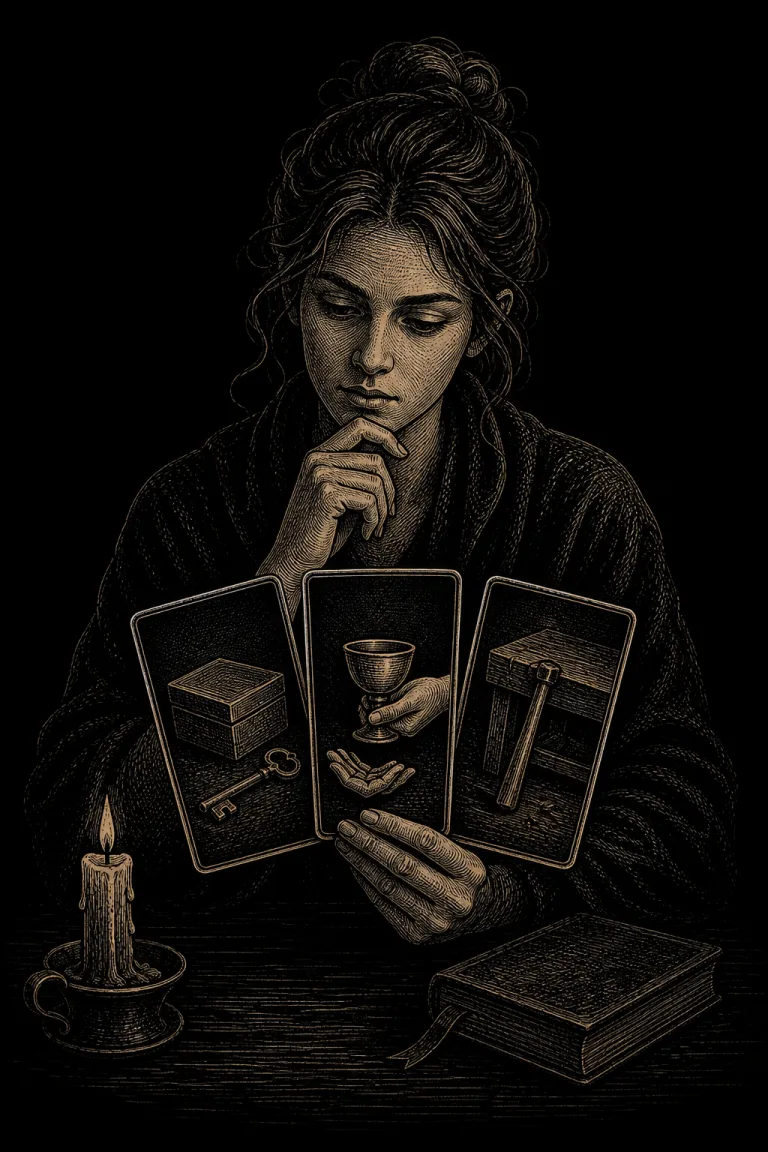
Tarot Journal
Tarot Scale and Proportion Symbolism: An Evidence-First Guide
Tarot scale and proportion symbolism becomes useful when you separate depicted size from real-world size, then test visual prominence, perspective, distance, and deck convention before assigning meaning.
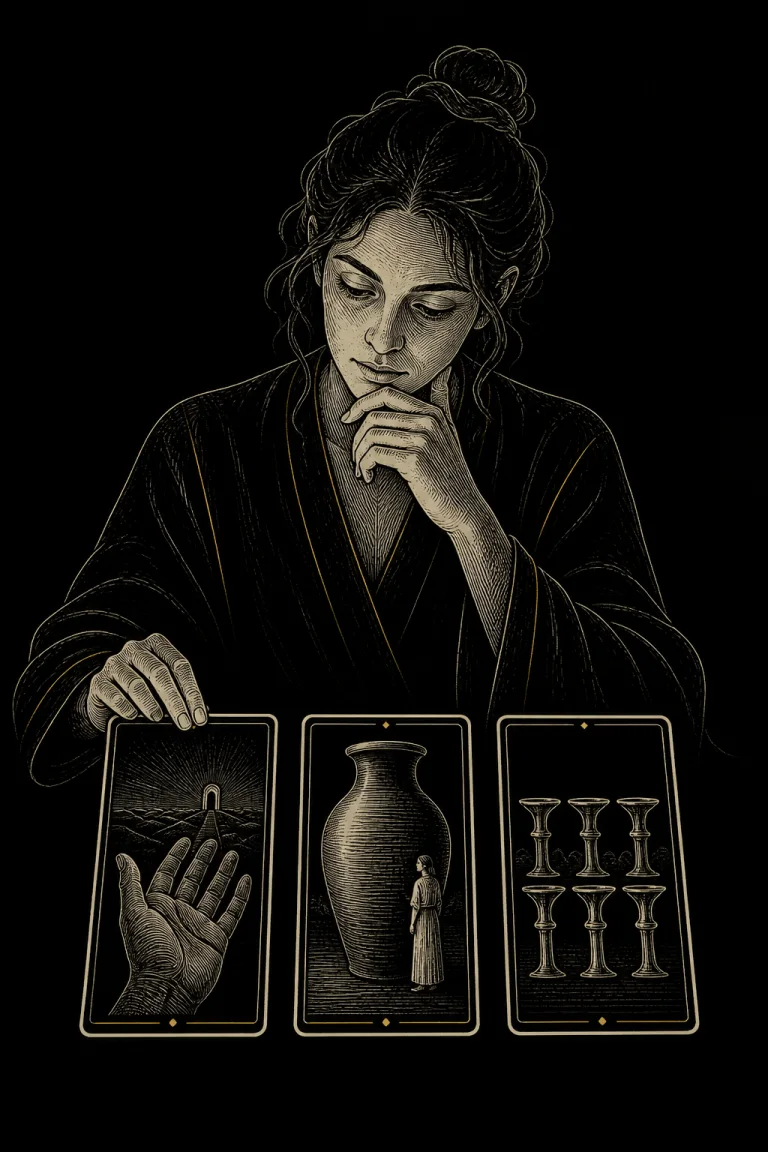
Scale is the relative size of a figure, object, or setting inside a Tarot image. An artist can make a hand fill the foreground, reduce a city to a narrow strip, or place a small person beside an enormous structure. Those choices guide attention and shape the scene, but they do not automatically prove that the largest feature is most powerful, nearest in time, or most important in the reader's life.
A grounded reading first describes what is large or small and asks why it appears that way. Is the difference caused by ordinary perspective, symbolic hierarchy, cropping, repetition, or deliberate distortion? Compare at least two explanations with the card title, deck guide, spread position, question, and neighboring cards. Scale can organize reflection, but it cannot measure literal distance, rank, value, danger, or future timing.
Take the next insight with you
Explore personalized Tarot guidance in Veritas, available for iOS and Android.
 Scan with your phone
Tarot scale and proportion at a glance
Three different meanings of scale
Scale can describe the physical size of the card, the apparent size of an element inside the image, or the relationship between several pictured elements. A large-format deck may reveal details that disappear on a phone, yet its printed size does not change the scene. Within the art, a large foreground hand may simply be close to the viewer. Relational scale asks whether one figure is deliberately larger than another despite occupying the same visual plane. Keep these three questions separate.
Visual hierarchy directs the first look
Large, central, high-contrast, isolated, or sharply detailed forms usually attract attention first. That is visual hierarchy, not a fixed spiritual code. Record the first element your eye meets, then scan the rest of the card before interpreting it. A small bright key can outrank a large dark wall because contrast and isolation make the key more salient. The broader Tarot card symbolism guide helps separate visible evidence from inherited association and personal response.
Foreground, middle ground, and background
Foreground elements appear close and often show immediate action or a point of entry into the scene. Background elements establish environment, destination, history, or context, but their distance does not automatically mean they belong to the future. A small tower on the horizon may be a destination, a memory, a boundary, or ordinary landscape structure. Use the landscape guide to check terrain and route before turning distance into a timeline.
Proportion is a relationship, not a verdict
Proportion compares sizes within one body, object, or group. Realistic proportion supports an ordinary scene, while deliberate disproportion can create emphasis, discomfort, humor, authority, vulnerability, or dreamlike space. Do not label a large figure dominant until you check posture, access, gaze, and action. An enlarged seated figure may be a formal icon, while a smaller standing figure may control the only door or tool.
Perspective can imitate symbolic emphasis
Linear perspective makes nearby forms appear larger and distant forms smaller. Foreshortening can enlarge a hand, foot, blade, cup, or face that projects toward the viewer. Before reading such enlargement as special meaning, trace horizon lines, overlap, floor direction, and repeated objects. If every nearby object expands consistently, perspective is the simplest explanation. If one object breaks that system, deliberate emphasis becomes more plausible.
Architecture establishes human scale
Doors, stairs, windows, chairs, bridges, and walls give the viewer familiar reference points. A person dwarfed by a gate may appear constrained by the setting, protected by it, or simply far from the camera. Check whether the structure permits movement and who controls access. The architecture guide is useful when scale depends on shelter, boundary, entry, or built authority.
Repeated forms reveal comparison rules
A row of equal cups creates a different hierarchy from one large cup surrounded by smaller ones. Count carefully, compare spacing, and ask whether equal size marks shared function, standardized production, visual rhythm, or deliberate equivalence. Variation may show use, depth, damage, or artistic emphasis. Repetition does not provide multiple confirmations, and one enlarged member of a group is not automatically the outcome card.
A six-pass scale method
- Inventory relative size
Name the largest and smallest visible elements, then note their position, overlap, detail, and contrast.
- Check the visual plane
Separate foreground, middle ground, and background so ordinary perspective is not mistaken for symbolic rank.
- Find reference objects
Use bodies, doors, furniture, paths, tools, and repeated forms to estimate whether proportion is realistic or distorted.
- Describe the scene function
Ask what the large or small element actually does, controls, blocks, supports, contains, or receives.
- Offer two readings
Write one compositional explanation and one symbolic explanation, then identify the evidence that favors either one.
- State the boundary
Keep the conclusion reflective and do not convert pictured size into literal power, timing, value, diagnosis, or risk.
Worked example: a large hand and distant doorway
A hand fills the lower foreground while a doorway appears small on the horizon. The first explanation is perspective: the hand is close and the door is far away. A second reading is that present agency occupies attention while access remains remote or requires a route. Check whether the hand points, reaches, grips, or rests, and whether a path actually connects it to the door. Size alone does not say when access will occur.
Worked example: an oversized vessel
A vessel stands taller than a nearby person. It may be a deliberately monumental container, a decorative scale shift, or a perspective effect. Ask what it contains, whether it is open, who can reach it, and whether the figure tends, guards, avoids, or depends on it. The object symbolism method keeps function and access visible instead of reducing the image to abundance or overwhelm.
Worked example: one small figure in a large group
A small figure among larger people may be farther away, younger, lower on a slope, or intentionally minimized. Look for consistent perspective, body proportion, eye lines, and group spacing. If gaze and gesture converge on the smaller figure, visual attention may outweigh physical size. The gaze guide helps test who notices whom without inferring private thoughts.
Scale across a spread
Compare scale only after accounting for different artists, deck systems, and card crops. A large moon in one card and a small moon in another may reflect separate compositions rather than a changing symbolic quantity. If the same deck repeats an element, record whether it moves closer, grows, shrinks, gains detail, or changes function. Then use the card combination method and spread positions to decide whether the contrast forms a meaningful sequence.
Reversals, thumbnails, and mobile crops
Reversal changes orientation but not the printed size of an element. It may move a large form from top to bottom or change the direction of perspective, so apply only the reversal method you declared. Small thumbnails can erase a distant figure and make a central form look simpler than it is. Mobile crops can remove architecture or horizon lines that explain proportion. Verify the full card at a useful resolution before concluding that scale is deliberate.
Deck context and source awareness
Hieratic scale, where important figures are shown larger, appears in several artistic traditions, but it should not be assumed in every deck. Modern collage, surrealism, icon painting, comic perspective, and minimalist design use proportion differently. Read the creator's guide, compare several cards, and consult art-historical context when it matters. A convention repeated throughout the deck is stronger evidence than one isolated size difference.
Accessibility and description
Readers with low vision, color-vision differences, or small screens may not perceive depth and detail in the same way. Useful alt text states relative position and size without embedding a verdict: a large hand occupies the foreground while a small doorway sits at the end of a path. If the perspective is ambiguous, say so. Shared description creates a clearer basis for interpretation than claims about what everyone must notice first.
Keep a scale evidence record
Use Veritas to save the deck and card, largest and smallest elements, foreground and background roles, perspective cues, reference objects, crop check, two competing readings, spread position, contradictions, and what later review changed.
A focused journal exercise
Choose three cards from one deck: one with strong depth, one with deliberate distortion, and one with repeated equal forms. Describe scale without symbolic keywords. Sketch the foreground, middle ground, and background as simple boxes. Then write a compositional explanation and a symbolic explanation for each card. A Tarot journal shows whether your scale interpretations remain stable across different questions and crops.
Common mistakes
Common errors include treating the largest object as the answer, reading background distance as future timing, confusing foreshortening with symbolic enlargement, assuming small means weak, ignoring the visual pull of contrast and isolation, comparing incompatible deck styles, and interpreting a crop rather than the full image. Another mistake is assigning hierarchy before stating the ordinary spatial explanation.
Limits and responsible use
Tarot scale and proportion symbolism is a visual interpretation method, not a measurement of real status, influence, wealth, health, danger, distance, duration, or probability. It cannot establish another person's importance, a power imbalance, a diagnosis, or the timing of an event. Use the <a href="/tarot">Tarot journal hub</a> for reflective learning, and verify consequential questions through direct evidence, consent, and qualified guidance.