Tarot Journal
Tarot Gaze Symbolism: An Evidence-First Reading Guide
Tarot gaze symbolism is most reliable when you trace exactly where a figure looks, what lies on that visual path, and how the rest of the card supports or complicates that relationship.
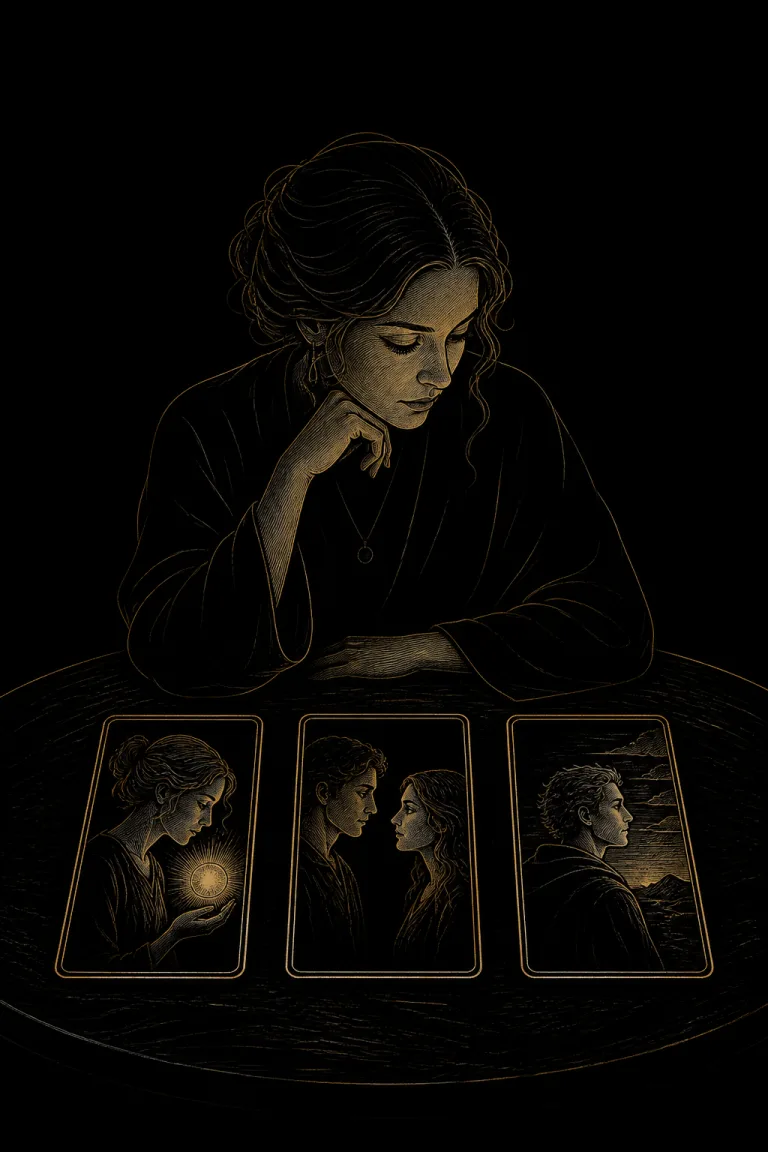
Gaze in Tarot art is a visible line of attention created by the direction of a figure's eyes and head. A person may look at an object, another figure, the viewer, a route, or beyond the card edge. That direction can organize the scene, but it cannot reveal a character's private thoughts or prove what a real person feels, wants, knows, or intends.
A grounded reading starts with a neutral gaze map. Identify the viewer, the apparent target, obstacles between them, the target's response, and any competing visual cue. Then compare at least two scene functions against the whole card, deck lineage, spread position, question, and known facts. This turns gaze into testable visual evidence instead of a body-language shortcut.
Take the next insight with you
Explore personalized Tarot guidance in Veritas, available for iOS and Android.
 Scan with your phone
Tarot gaze symbolism at a glance
Start with a neutral gaze map
Name the figure and describe the direction before naming a motive. Write "the seated figure looks down toward the covered cup" rather than "she regrets the relationship." If the eyes are too small to read, use the head and face direction and mark the target as uncertain. Precision includes admitting when the artwork does not support a precise claim.
Identify the viewer and the apparent target
A gaze line needs a source and a possible destination. The target might be a tool, landscape feature, other figure, empty space, or the card's edge. Follow the line from eyes through the scene and note what it actually reaches. Artists sometimes angle a head for composition rather than narrative, so a target is provisional until objects, gestures, posture, or repetition support it.
Direct gaze at an object
When a figure looks at a cup, coin, blade, letter, doorway, or plant, the object becomes visually connected to the figure. That connection might stage inspection, use, protection, anticipation, memory, or simple compositional balance. Ask whether the hands act on the same object and whether the body can reach it. Looking at an object is not proof of desire, ownership, or future acquisition.
Mutual gaze between figures
Two figures looking toward each other create a reciprocal visual link. The scene may emphasize recognition, exchange, coordination, negotiation, challenge, performance, or witnessed action. Distance, facial detail, objects, and gestures determine which functions fit. Mutual gaze in a card cannot establish love, agreement, consent, honesty, or an actual person's attention.
One-sided and interrupted gaze
If one figure looks toward another who faces elsewhere, record the asymmetry without turning it into rejection. The second figure may be focused on a task, route, threat, audience, or object. A wall, veil, crowd, or card border can interrupt the line. Ask whether the interruption is physical, social, narrative, or simply part of the illustration's layout.
Looking at the viewer
A frontal gaze can make the card feel like an address to the reader. It may function as invitation, warning, witness, display, confrontation, or a traditional portrait convention. Check what the figure presents and what role the card assigns. The visual effect belongs to the artwork; it does not mean the card is literally watching, judging, or sending a private message.
Looking beyond the card edge
A face turned toward the border can imply that the scene continues beyond what is shown. In a spread, the adjacent card may provide a useful compositional target, especially when directions align. Test that idea rather than assuming it. Card orientation, printing crop, deck layout, and random placement can produce a facing pattern without a stable narrative link.
Downward, upward, and closed eyes
A downward gaze may connect a figure to work, an object, terrain, a lower figure, or inward compositional space. An upward gaze may connect to weather, architecture, a raised object, or a taller figure. Closed eyes can represent sleep, prayer, concentration, pain, ritual, or stylization. Direction alone does not prove optimism, shame, spirituality, avoidance, or unconscious knowledge.
A six-pass gaze reading method
- Locate the viewer
Identify whose eyes or head direction can be read and record any uncertainty.
- Trace the line
Follow the apparent direction through the scene without yet assigning emotion or motive.
- Name the target
Record the figure, object, route, empty space, viewer, or card edge on the line.
- Check interruption and response
Note obstacles, distance, reciprocal gaze, turned bodies, and actions along the path.
- Offer two functions
Propose at least two scene roles and list the evidence that would favor each one.
- Return to context
Use deck lineage, card title, spread position, question, neighboring cards, and real facts to set the detail's weight.
Worked example: a figure studies a covered cup
Imagine a figure seated beside three open cups while looking toward one covered cup. The gaze may emphasize an unexamined option, protection of a resource, uncertainty about what is hidden, or the artist's way of balancing the composition. If the hands rest on an open cup, action and attention point to different targets. That tension is useful, but it does not predict a secret or prove avoidance.
Worked example: two figures meet across a table
Two people face each other over a scale and both look toward the exchange. One function is careful negotiation; another is shared inspection of fairness; a third is performance for an unseen audience. Check who touches the scale, whether the table divides or supports them, and whether either figure has an exit. Eye contact alone does not certify trust or agreement.
Worked example: a face turns out of frame
A standing figure holds a lantern but looks beyond the right border while the path bends left. The split may stage vigilance, memory, distraction, or a last check before moving. In a spread, the next card could provide a visual continuation, but the leftward path remains competing evidence. The best reading names both directions and explains why one matters in this position.
Gaze, gesture, and posture have different jobs
Gaze maps a visible line of attention. The Tarot gesture symbolism guide examines actions made by hands and arms, while the posture guide covers whole-body support, weight, orientation, distance, and possible movement. A figure can look toward one target, gesture toward another, and stand ready to move toward a third. Preserve those differences before combining them.
Read gaze across a spread carefully
Facing directions can create sequences across neighboring cards. Record which figures appear to look toward or away from each card, then rotate no cards and preserve the original layout. Treat the pattern as a compositional hypothesis. Compare it with the card combination method and the spread positions instead of letting one directional chain replace the reading.
Deck lineage, cropping, and accessibility
Rider-Waite-Smith, Marseille, Thoth, and contemporary decks may give the same card different faces, targets, or levels of detail. Borderless editions can also crop or extend gaze lines. Use a high-resolution image, guidebook description, magnification, or trusted verbal description when eyes are unclear. The Rider-Waite-Smith and Marseille comparison explains why visual assumptions do not transfer automatically.
Save a gaze evidence record
Use Veritas to record the viewer, apparent direction, target, obstruction, reciprocal response, posture, gesture, two competing functions, spread position, deck source, and later review.
A journal protocol for gaze patterns
Choose one deck and log gaze evidence from ten readings. Preserve the original question, positions, card order, and image orientation. At review, count examples that supported the first function, contradicted it, or were better explained by composition. The Tarot journal guide helps prevent later events from rewriting the original observation.
Common gaze-reading mistakes
Frequent errors include inferring emotion before tracing direction, inventing a target outside the frame, treating mutual gaze as consent, assuming downward eyes mean shame, ignoring small or ambiguous artwork, and forcing adjacent cards into a visual conversation. Another mistake is letting one gaze line override the card title, position, deck guide, direct communication, or known facts.
Limits and responsible use
Tarot is a symbolic reflection practice, not a validated method for detecting attraction, deception, danger, consent, surveillance, health, or another person's mental state. A drawn gaze cannot independently prove a secret, relationship outcome, future contact, guilt, or intent. Use direct communication, documented evidence, and qualified professional support for consequential medical, legal, financial, safety, or mental health decisions.