Tarot Journal
Tarot Line Symbolism: An Evidence-First Guide
Tarot line symbolism becomes useful when you distinguish drawn strokes, contours, edges, and implied connections, then compare their quality and function across the same deck.
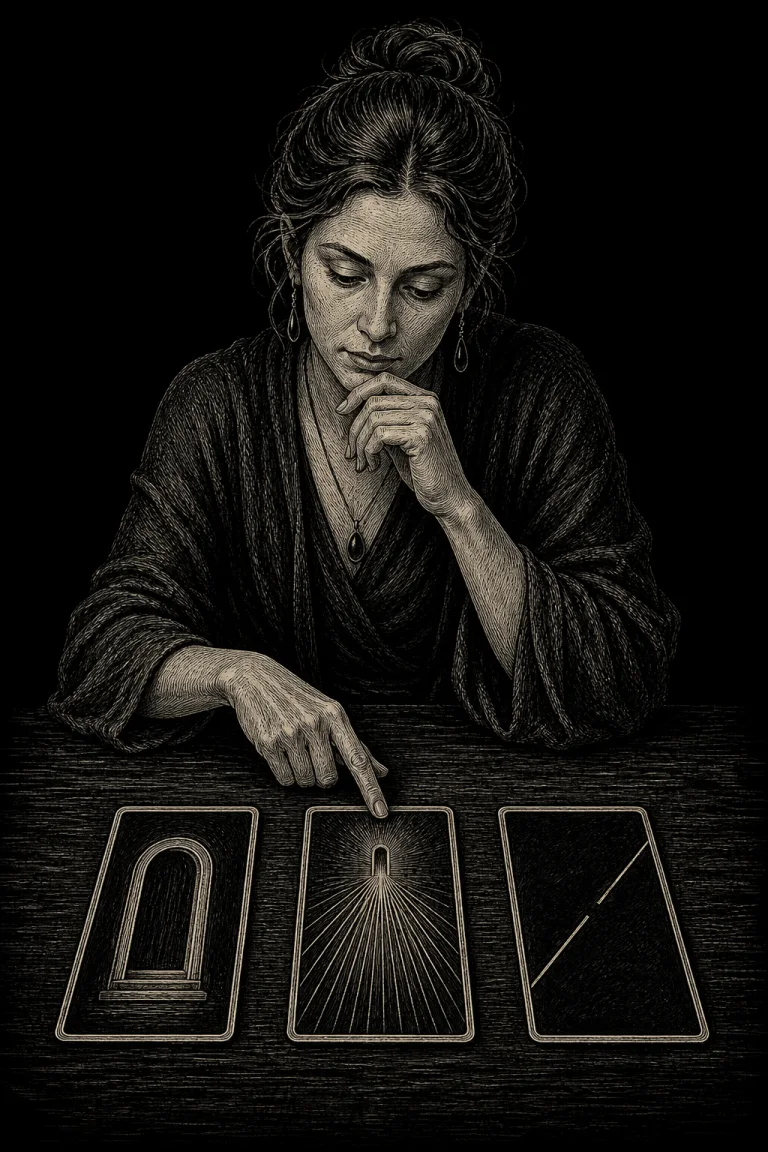
Lines in Tarot art can outline a figure, divide a space, connect two details, create depth, or guide attention. Some are literal marks such as a staff, horizon, crack, ray, border, or fold. Others are implied by aligned objects, repeated points, a pointing hand, or the direction of a face. A line is visual evidence, but its meaning depends on what creates it and what it does inside that particular card.
Start with description rather than a fixed dictionary. Identify the line source, endpoints, continuity, weight, direction, and contact with other forms. Compare it with repeated line choices elsewhere in the deck, then test at least two possible functions against the card title, guidebook, spread position, question, and neighboring cards. A diagonal does not automatically mean conflict, and a curve does not guarantee harmony.
Take the next insight with you
Explore personalized Tarot guidance in Veritas, available for iOS and Android.
 Scan with your phone
Tarot line symbolism at a glance
What counts as a line in Tarot art
A literal line is visibly drawn or formed by an object: the edge of a sword, the bank of a river, a wall seam, a lightning stroke, or the outline of a robe. An implied line appears when separate details align strongly enough for the eye to connect them. Three cups, two faces, or a sequence of stars may create a route without a continuous stroke. The Tarot card symbolism guide helps inventory the details before you decide whether they form a meaningful line.
Contour lines define, protect, and simplify
A contour describes the visible edge of a body, object, cloud, hill, or architectural form. A heavy contour can separate a figure from its setting, while a faint or incomplete contour can let figure and ground blend. Describe that visual effect before calling it protection, isolation, uncertainty, or openness. Printing method, scan quality, and the artist's default style may explain the edge more reliably than card-specific symbolism.
Straight and curved lines are not fixed opposites
Straight lines can create alignment, structure, directness, rigidity, measurement, or simply the believable edge of a building. Curves can create continuity, enclosure, flexibility, rhythm, softness, or the natural form of a body or landscape. Neither family has one emotional value. Ask what the line belongs to, whether it bears weight, whether it changes course, and how nearby forms respond.
Broken, interrupted, and incomplete lines
A broken line may represent damage when the pictured object is visibly cracked, but interruption can also be a doorway, gap, overlap, glare, crop, or deliberate breathing space. Find what causes the break and whether a route continues on the other side. An interrupted boundary can permit access in one scene and expose danger in another. Do not turn every gap into loss or every continuous line into safety.
Line weight, pressure, and visibility
Thick or dark strokes usually carry more visual weight than pale fine ones, but visual prominence is not automatically narrative importance. Compare the line with other contours in the same edition. A bold sword edge may be an artist-wide convention, while one unusually faint bridge among bold architecture may deserve closer attention. The light and shadow guide helps separate actual strokes from edges created only by contrast.
Direction without a universal timeline
Horizontal lines can stabilize a field, verticals can establish height or support, and diagonals can move attention across a card. Those are perceptual effects, not fixed prophecies. Left does not universally equal past, right does not universally equal future, and upward does not always mean improvement. Deck orientation, reading culture, handedness, card reversal, and the pictured object all matter. Describe start, end, and scene function instead of importing a directional code.
Convergence, divergence, and intersection
Lines that meet can direct attention toward a doorway, face, horizon, tool, or empty point. Lines that separate can open alternatives or merely show perspective. An intersection can mark contact, obstruction, construction, or ordinary overlap. Trace each source independently, then note what changes at the meeting point. Convergence is designed attention, not proof that real events are destined to meet.
Repeated lines create rhythm and grouping
Repeated staffs, rays, folds, waves, fence posts, or hatching can create tempo and visual grouping. Count only what is clearly visible, note spacing and variation, and compare the pattern with other cards. Repetition may indicate a deck template rather than special emphasis. The composition guide owns the whole-frame arrangement; line analysis explains one formal element contributing to that arrangement.
A six-pass line reading method
- Inventory the sources
List literal strokes, contours, object edges, boundaries, routes, rays, folds, and strong implied alignments.
- Describe the quality
Record weight, continuity, curve, angle, texture, repetition, visibility, and any change along the line.
- Mark endpoints and contact
Identify where each line begins, ends, intersects, disappears, or meets a figure, object, edge, or open space.
- State the scene function
Explain whether it contains, supports, joins, divides, directs, obstructs, exposes, or constructs depth.
- Compare the deck
Check the same artist's normal contours, hatching, borders, perspective rules, and repeated suit or card templates.
- Test two readings
Write two plausible interpretations and choose only after checking title, guidebook, question, position, and neighboring cards.
Worked example: a heavy enclosing contour
Imagine a seated figure outlined more heavily than the surrounding room. The contour separates the person from the environment and makes the body easy to locate. One reading might emphasize a maintained boundary; another might notice isolation from available support. Check whether the contour is unusually heavy for this deck, whether any opening crosses it, and whether posture or action supports either reading.
Worked example: fine lines converge on an opening
A road edge, roof beam, and row of tiles may converge toward a small door. Perspective makes the opening a visual destination, but it does not guarantee arrival. Ask whether the route is accessible, blocked, occupied, damaged, or merely distant. The movement guide is relevant only if the scene also shows actual change of position, pace, or control.
Worked example: a broken diagonal
Suppose a strong diagonal staff is interrupted by a foreground object. The break may show depth because one object overlaps another, or it may stage a practical obstruction. Look for continued alignment beyond the interruption and compare object functions. If a figure looks toward the gap, the gaze guide can add evidence, but looking direction does not reveal the figure's thoughts.
Lines across a multi-card spread
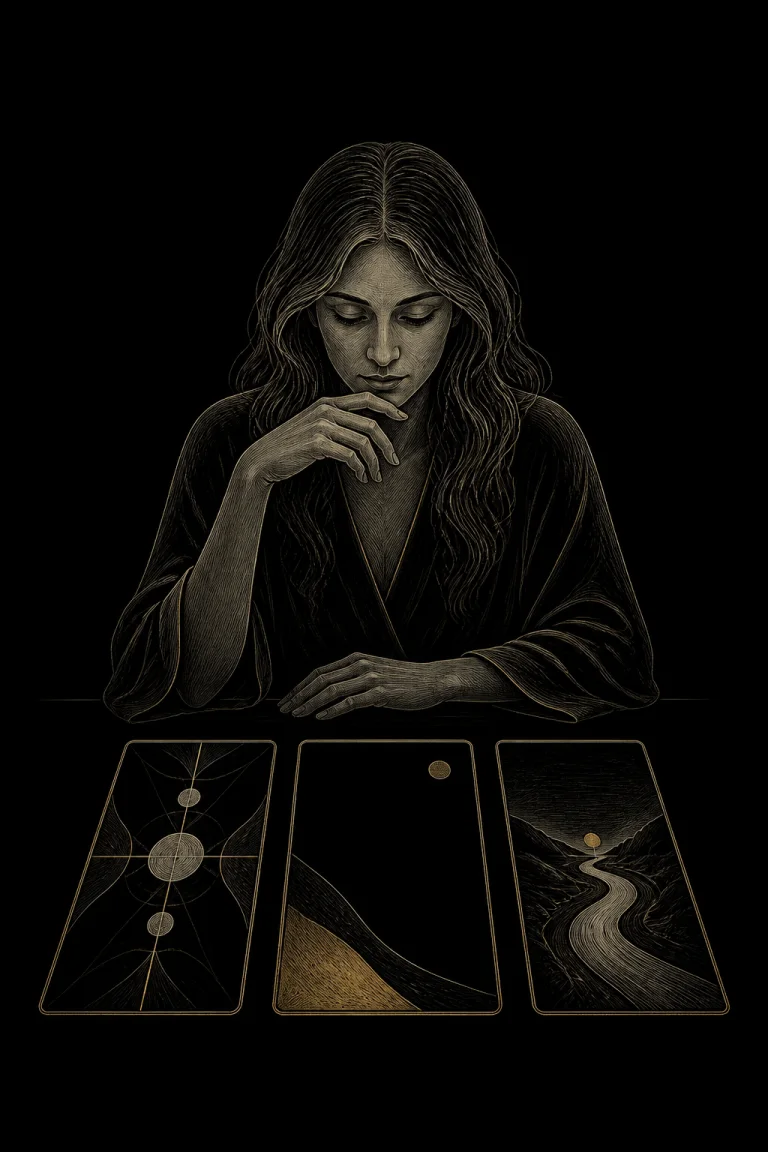
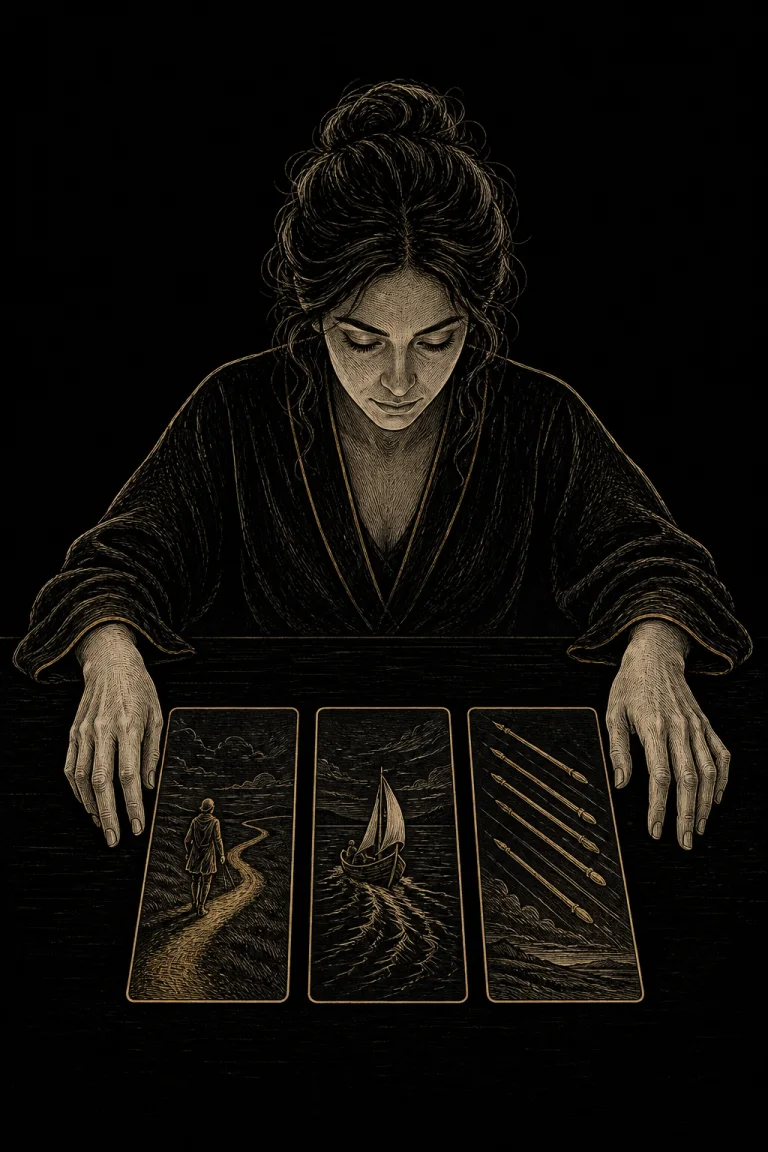
Adjacent card edges can make roads, horizons, gestures, or diagonals appear to continue. Record the visual handoff, then test whether the reading position and question support a relationship. Random dealing can create striking alignments, and different deck crops can remove them. Treat a cross-card line as a compositional prompt, not a secret message or an instruction to ignore card meanings.
Save the evidence before the meaning
Use Veritas to record each line source, quality, endpoints, interruption, deck comparison, two competing functions, the interpretation you chose, and what later evidence would change it.
Reversals, borders, and reproduction quality
Reversing a card changes the viewer's orientation to its lines, but it does not prove that every line function becomes opposite. Borders can contain or crop strokes, and borderless editions may extend an image differently. Phone thumbnails, glare, compression, foil, and worn printing can erase fine marks. Compare a reliable high-resolution image when possible and state whether your reversal method uses orientation at all.
Deck lineage and artist grammar
Marseille pip cards, Rider-Waite-Smith scenes, Thoth-derived geometry, collage decks, and minimalist decks build lines differently. The Rider-Waite-Smith and Marseille comparison explains why imagery assumptions do not transfer automatically. Learn the artist's normal stroke, contour, border, and perspective grammar before calling one line exceptional.
Accessibility and nonvisual practice
Fine line weight, low contrast, visual crowding, and small digital displays can make this method inaccessible. Use official descriptions, enlarged scans, tactile decks, a trusted reader's neutral description, or guidebook notes. A useful description names source and function, such as a narrow road joining foreground to doorway, rather than relying on vague labels such as energetic line.
Common mistakes
Common errors include assigning a personality to every stroke, treating all diagonals as conflict, reading left and right as a universal timeline, confusing perspective with prediction, counting hatching as separate symbols, ignoring the artist's normal style, and letting one dramatic line override card title or question. Another mistake is analyzing the whole layout under the label of line symbolism when composition is the better tool.
Limits and responsible use
Line analysis is an interpretive visual practice, not a scientific method for detecting intention or forecasting events. It cannot replace consent, direct conversation, medical or legal advice, financial evidence, safety planning, or observable behavior. Visit the <a href="/tarot">Tarot journal hub</a> for related methods, and use the Tarot storytelling guide to connect only the evidence the cards actually provide.