Tarot Journal
Tarot Age Symbolism: An Evidence-First Guide
Tarot age symbolism starts with visible life-stage cues, relationships, activity, and deck context, then tests scene function without guessing an exact age or fixed destiny.
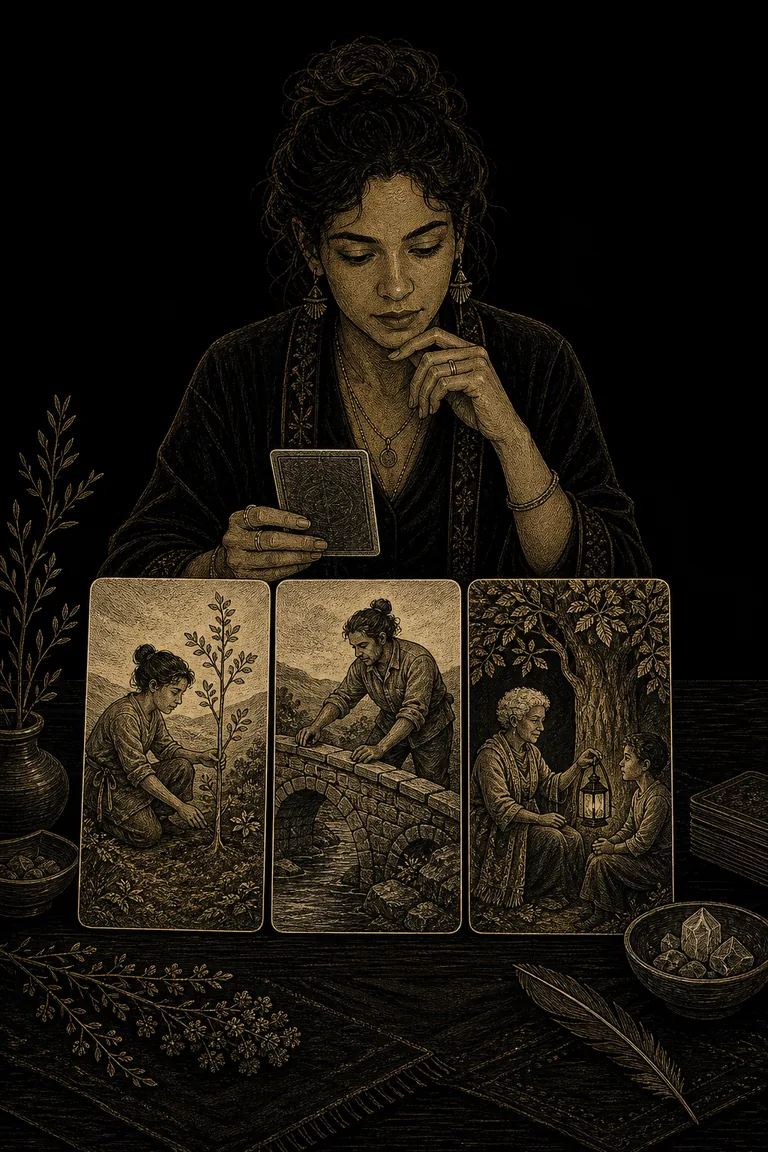
Age symbolism in Tarot concerns how a deck depicts life stages, generations, growth, experience, dependence, responsibility, memory, and succession. A child learning beside an adult, a mature craftsperson maintaining a structure, or an older figure teaching a younger person may organize the scene in meaningful ways. None of those images reveals a real person's exact age, health, competence, lifespan, or future.
Begin with what the card actually shows: relative size, facial treatment, hair, clothing, posture, activity, social role, and the relationships between figures. Compare those cues with the same deck before assigning a life stage. Then ask what the difference does in the scene. The strongest reading describes a visible relationship and leaves room for more than one interpretation.
Take the next insight with you
Explore personalized Tarot guidance in Veritas, available for iOS and Android.
 Scan with your phone
Tarot age symbolism at a glance
What counts as visible age evidence
Useful evidence may include body proportions, facial lines, hair treatment, mobility aids, clothing associated with a social role, the scale of furniture, and who performs which action. One cue is rarely decisive. White hair can indicate age, fashion, light, or a symbolic color. Small size can indicate childhood, distance, hierarchy, or stylization. Start with a neutral inventory using the Tarot card symbolism guide, then combine cues only when they converge.
Represented age is not exact age
Tarot art usually offers broad life-stage coding rather than a measurable birthday. A figure may read as younger than another because of scale, pose, clothing, or role, yet the image cannot support a claim such as twelve years old or over sixty. Use terms like younger figure, older figure, child-coded character, or elder-coded character when the evidence warrants them. Name uncertainty when stylization makes even those descriptions unstable.
Read relationships before labels
Age differences become most useful through relationships. Who teaches, receives care, controls a resource, asks a question, carries the load, or chooses the route? A younger figure may guide an older one. An elder may be learning. A child may hold information the adults ignore. Describe the exchange before assigning wisdom, innocence, authority, weakness, rebellion, or dependence. The action often carries more evidence than the age label.
Children and younger figures
A child-coded figure can support themes of learning, early development, protection, play, vulnerability, inheritance, or a new social role when the scene supports them. Childhood does not automatically mean purity, ignorance, literal pregnancy, or a specific child. Check whether the figure acts, observes, imitates, refuses, creates, or receives instructions. Preserve agency and do not use a card to make claims about a minor's private thoughts or safety.
Adults, work, and responsibility
Adult-coded figures often appear in scenes of labor, exchange, governance, travel, care, or conflict. Do not treat adulthood as proof of independence, authority, competence, marriage, parenthood, or financial stability. Identify the actual task, tools, resources, constraints, and decision rights. The object symbolism guide helps distinguish a role supported by equipment from one projected onto clothing or posture alone.
Older figures and elderhood
An elder-coded figure may organize experience, memory, continuity, teaching, stewardship, fatigue, exclusion, or changing capacity. No one meaning is inherent in gray hair or facial lines. Avoid assuming wisdom, frailty, loneliness, conservatism, illness, death, or retirement. Ask what the person is doing, what access they have, and how others respond. A seated elder who directs a complex task may hold more practical agency than a standing figure nearby.
Posture, clothing, and facial cues
Posture can indicate load, attention, movement, rest, or the design convention of a deck. Clothing can mark profession, rank, climate, period, ceremony, or life stage. Facial lines can reflect style, expression, light, or age coding. Cross-check these layers through the posture, clothing, and facial expression guides instead of allowing one feature to decide the whole reading.
A seven-step age-symbolism method
- Inventory the figures
Count visible people and record their location, scale, activity, and relation without assigning ages yet.
- List converging cues
Note body proportion, face, hair, clothing, posture, setting, and role while keeping each cue separate.
- Use relative language
Describe younger, older, or life-stage coding only as precisely as the image supports.
- Map agency
Identify who acts, chooses, teaches, depends, controls access, receives support, or changes the scene.
- Check the deck baseline
Compare how the same edition depicts children, adults, elders, distance, rank, and repeated characters.
- Test two functions
Offer at least two plausible functions for the age relation and reject any that require invented biography.
- State the limit
Write what the card cannot establish about exact age, health, maturity, family status, or future timing.
Worked example: a sapling and a mature tree
Imagine a younger figure tending a sapling while an older figure repairs the fence around a mature tree. The scene may contrast early growth with maintenance, or it may show two forms of stewardship operating together. It does not prove a parent-child relationship, inheritance, pregnancy, retirement, or a difference in competence. Trees add a parallel growth motif, but the human relationship still requires its own evidence.
Worked example: an elder shares a lamp
An elder-coded figure offers a lamp to a younger person who holds a map. One reading is transfer of experience; another is reciprocal work in which one person provides light and the other provides direction. Check hands, gaze, access, and whether the lamp is offered or merely held nearby. The image cannot prove obedience, family lineage, spiritual initiation, or that older advice is correct.
Age relations across a spread
Read each card in its assigned position first. Then compare who appears younger or older, what roles change, and whether agency shifts. A sequence from learner to maintainer to teacher can support reflection on developing responsibility only if the spread positions establish an order. The card combinations guide helps preserve position and context instead of turning three figures into a literal biography.
Deck tradition and historical context
Historical decks may encode rank and life stage through clothing unfamiliar to a modern reader. Modern decks may deliberately disrupt those conventions or portray the same archetype at different ages. Read the guidebook, artist notes, edition, and card sequence. Do not import a familiar Rider-Waite-Smith figure into artwork that changes gender, age, culture, disability, or role. A deck-specific baseline is more reliable than a universal age dictionary.
Accessibility and stereotype checks
Describe visible features in neutral language and avoid treating youth as beauty, age as decline, disability as dependency, or physical speed as moral progress. People age differently, and art styles compress or exaggerate features. Ask whether the interpretation would still make sense if the figure's exact age were unknown. If not, the reading may depend more on stereotype than evidence.
Record life-stage evidence without inventing a biography
Use Veritas to save the visible cues, relative life-stage language, relationship, agency, deck baseline, two possible scene functions, spread position, stereotype check, and the evidence that would change your reading.
Common mistakes and responsible limits
Common mistakes include guessing an exact age, equating children with innocence, adults with competence, or elders with wisdom or death, and treating a spread as a literal family portrait. Tarot is a reflective practice, not age verification, diagnosis, fertility assessment, safeguarding investigation, or lifespan prediction. It cannot replace direct conversation, consent, medical care, legal advice, professional safeguarding, or emergency help. Keep comparisons in a Tarot journal, use the scale and proportion guide when size may reflect distance or hierarchy, and browse the <a href="/tarot">Tarot journal hub</a>.