
Tarot Journal
No Major Arcana in a Tarot Reading: What It Means
No Major Arcana in a Tarot reading usually shifts attention toward ordinary choices, habits, relationships, and resources, but the absence only belongs to the verified draw and never makes the question trivial.
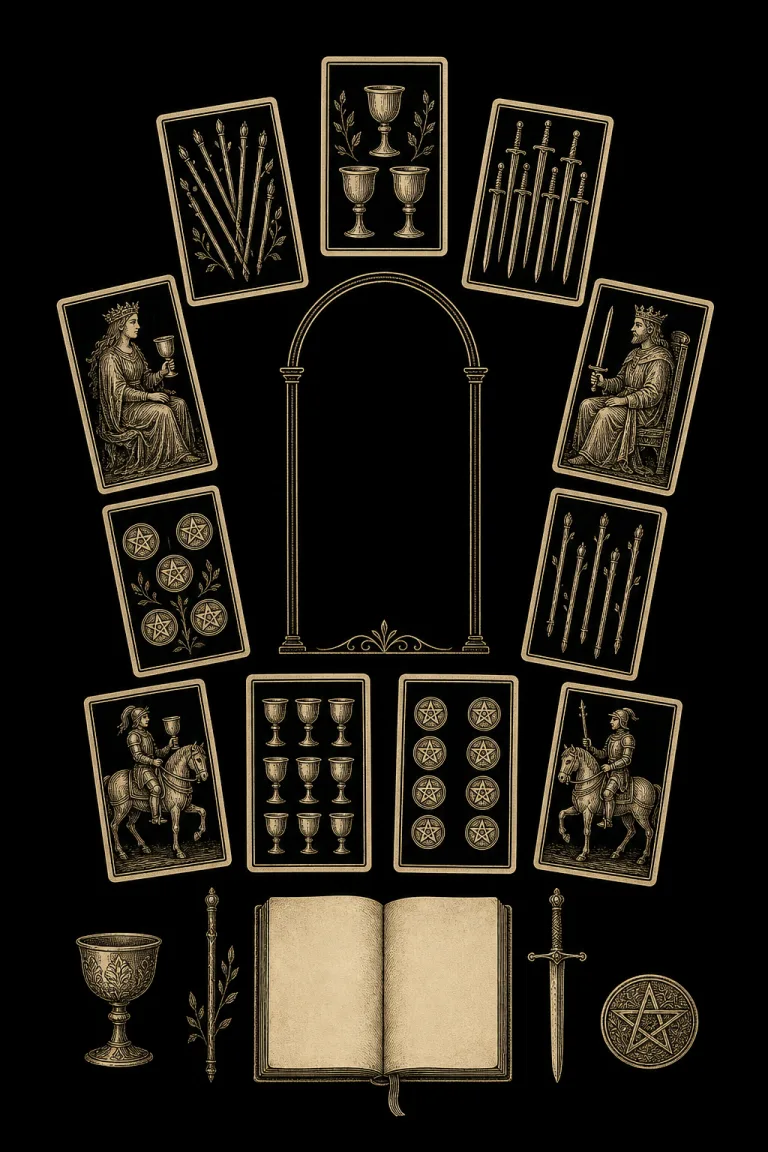
No Major Arcana in a Tarot reading means that every card drawn came from the Minor Arcana. In a complete seventy-eight-card deck, that pattern can place more interpretive weight on current behavior, practical conditions, communication, emotional responses, and manageable decisions. It does not prove that nothing important is happening, that fate is absent, or that the reader should keep drawing until a trump appears.
Read the absence as one feature of a documented spread. Verify that all twenty-two Major Arcana were actually available, record the number of cards drawn, and respect each position. Then examine suits, ranks, repeated numbers, court roles, reversals, and card relationships. The useful question is not why the deck refused to send a major message. It is what the visible Minor Arcana describe clearly enough to observe, choose, test, and review.
Take the next insight with you
Explore personalized Tarot guidance in Veritas, available for iOS and Android.
 Scan with your phone
No Major Arcana at a glance
Verify that the Major Arcana were available
A standard deck contains twenty-two Major Arcana and fifty-six Minor Arcana. Before interpreting their absence, confirm that the deck was complete and that the reading did not use a suit-only deck, a deliberately separated packet, missing cards, duplicate decks, or a custom system with different structure. Record how many cards were drawn. No Majors in three cards and no Majors in fifteen cards are both valid observations, but they do not carry the same concentration. Deck integrity comes before symbolism.
Absence is not a hidden card
Do not assign an invisible Major Arcana card to the empty pattern. The spread contains the cards that were drawn, not a secret Fool, Tower, World, or Wheel waiting behind them. Absence can narrow attention, but it does not name a missing archetype, predict when a major event will arrive, or authorize a reader to invent a trump from intuition. If one position seems unclear, interpret its visible card, question wording, and neighbors before considering a new reading.
Ordinary scope does not mean trivial stakes
Minor Arcana often describe the scale at which people can notice and adjust a process: a conversation, schedule, boundary, payment, task, emotional response, or shared resource. These ordinary mechanisms can still have serious consequences. A contract dispute, unsafe workload, escalating conflict, or health concern does not become harmless because no Major appeared. Use the cards to organize questions, then use qualified evidence and support for legal, medical, financial, employment, or safeguarding decisions.
Read the suit distribution first
The four Tarot suits identify different domains. Cups can emphasize feeling, care, attachment, reception, and emotional capacity. Wands can emphasize initiative, visibility, effort, desire, and direction. Swords can emphasize information, language, disagreement, rules, and decisions. Pentacles can emphasize time, money, tools, the body, maintenance, and material support. Count each suit and note what is absent without treating the absence as proof that a domain does not matter.
Numbers show the stage of the process
Repeated numbers can reveal a shared stage across different suits. A spread with several Twos may center coordination or unresolved alternatives, while several Fives may show distinct disruptions that need separate responses. Tens can point to completion, handoff, or the cost of carrying a process too far. Keep each card inside its suit and position. The number supplies a structural comparison, not a single universal event or a prediction that all areas will move together.
Court cards identify roles and levels of authority
Pages can describe first reports, study, messages, or limited authority. Knights can describe routes, delivery, pursuit, and pace. Queens can describe stewardship, standards, access, and capacity. Kings can describe mandate, scope, delegation, and consequence. The court cards guide helps distinguish person, role, and process. Courts do not prove gender, age, status, profession, or another person's intention.
Position still controls the sentence
A practical card does not mean the same thing in every position. The Eight of Pentacles in resources may describe usable skill, while in an obstacle it may show rework, narrow focus, or labor without authority. The Two of Swords in advice may ask for a pause and clearer criteria, while in an outcome it describes the decision pattern implied by current choices. Read the position label, the question, and the card as one sentence before combining the spread.
Reversals describe changes in function
If the deck uses reversals, a reversed Minor Arcana card can show blocked access, excess, delay, refusal, internalization, correction, or a function that needs another route. It does not automatically make an ordinary issue catastrophic. Use the reversed cards method: name the upright function, identify the specific change, and test it against position, neighboring cards, and facts. Keep orientation rules fixed throughout the reading.
Combinations reveal the operating mechanism
Without a Major Arcana anchor, relationships among the visible cards deserve more attention. A Sword beside a Cup may show how language affects emotional capacity. A Wand beside a Pentacle may compare ambition with time, budget, or maintenance. Courts can show who reports, carries, stewards, or authorizes the process. Use card combinations to write one testable sentence for each pair rather than blending the whole spread into a vague mood.
A practical method for a spread with no Majors
- Verify
Record the complete deck, spread question, card count, positions, orientation rule, and exact draw.
- Map
Count suits, numbers, and court ranks, then note meaningful concentrations and genuine absences.
- Translate
Turn each position into an observable condition, choice, resource, conversation, boundary, or task.
- Choose
Select one proportionate action with an owner, evidence source, limit, and stop condition.
- Review
Set a date and threshold for continuing, revising, escalating, seeking qualified help, or ending the action.
Worked relationship example
A relationship spread shows the Two of Cups, Eight of Pentacles, and Queen of Swords. No Major Arcana appears. The reader does not conclude that the bond is casual or destined to remain unchanged. Cups identifies reciprocity to discuss, Pentacles identifies repeated work and maintenance, and the Queen sets a standard for clear language and access. The couple agrees to one weekly planning conversation and a boundary around unavailable time, then reviews whether effort became more balanced.
Worked work example
A career spread contains the Page of Pentacles, Seven of Wands, and Three of Swords. The Page owns an early report that still needs verification. The Seven identifies a position that requires a defined boundary and enough support to hold it. The Three records a painful fact or conflict without diagnosing anyone's motives. The next step is to document workload, request a specific decision, and define when human resources, legal advice, or an exit becomes necessary.
Compare no Majors with many Majors
The many Major Arcana guide owns density, archetypal scale, cross-position themes, and the risk of turning several trumps into a destiny claim. No Major Arcana owns the opposite pattern: verified absence and the detailed operating layer supplied by suits, numbers, and courts. Neither pattern ranks one reading above another. Both need the same discipline around count, position, evidence, choice, and review.
Do not redraw to manufacture significance
Repeatedly drawing until a Major appears changes the sample and can reward anxiety. If the question was clear and the procedure was followed, finish the reading you have. Draw again only under a declared rule, such as a genuinely new question, a scheduled review after new evidence, or a technical error in the first draw. The guide to reading Tarot for yourself can help separate clarification from answer chasing.
Keep an absence record in your journal
In a Tarot journal, save deck integrity, question, spread size, positions, all cards, suits, numbers, courts, reversals, facts known at the time, chosen action, escalation threshold, and review date. Record what happened without promoting later events into proof that a Major was secretly present. Over many readings, the record can show whether no-Major spreads helped you notice practical levers or merely encouraged underestimating the stakes.
Save the practical layer of the spread
Use Veritas to record deck integrity, card count, suits, ranks, positions, repeated numbers, observable facts, one chosen action, its stop condition, escalation threshold, and review date.
Responsible limits
No Major Arcana in a Tarot reading is a symbolic pattern in one draw, not evidence that life is quiet, an issue is minor, a relationship lacks meaning, danger is absent, or every outcome is under personal control. Review the Minor Arcana meanings and visit the <a href="/tarot">Tarot journal hub</a>. Use direct communication, records, consent, qualified guidance, and real safety procedures for consequential decisions.