Tarot Journal
Tarot Facial Expression Symbolism: An Evidence-First Guide
Tarot facial expression symbolism works best when you describe brows, eyelids, mouth, jaw, and asymmetry before proposing what those visible choices do in the card scene.
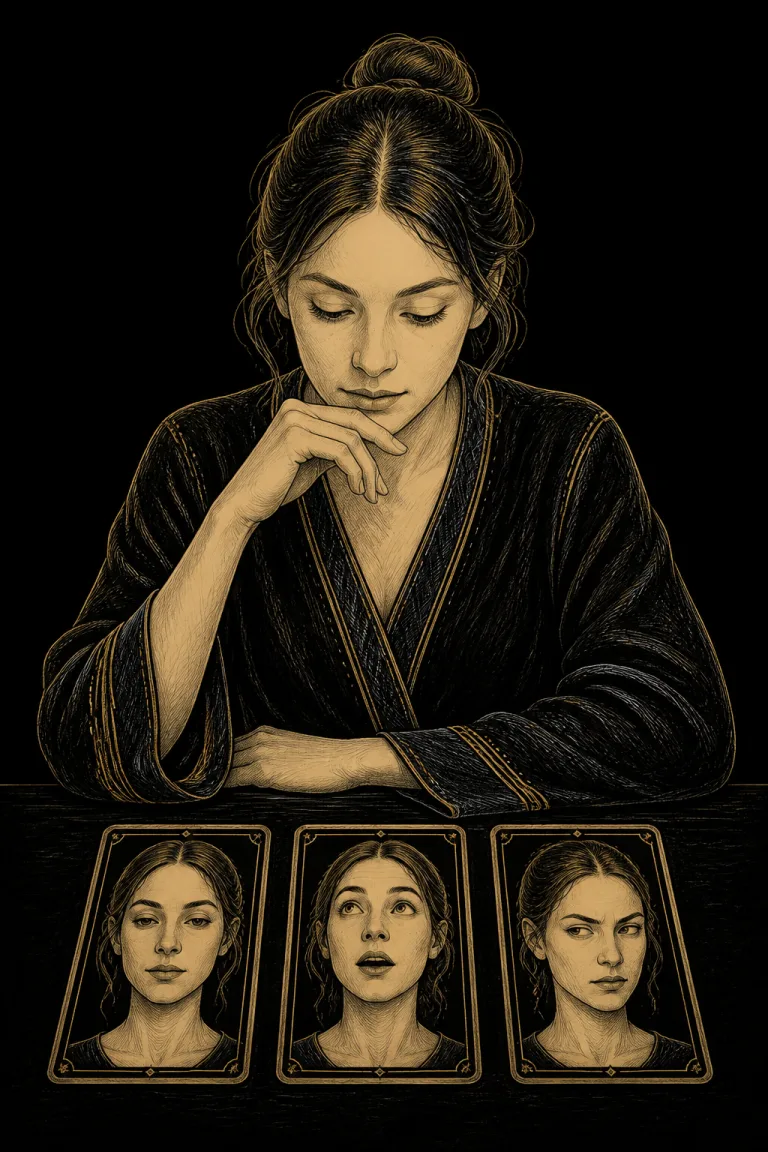
A facial expression in Tarot is a drawn configuration of visible features, not direct access to a character's inner life. Raised brows, lowered lids, a parted mouth, a tight jaw, or an uneven face can organize attention and shape a scene. They cannot prove fear, attraction, dishonesty, grief, consent, illness, or what a real person is thinking.
A grounded reading records the features first, checks whether the artwork is detailed enough to support the observation, and offers at least two plausible scene functions. Then it compares the face with gaze, gesture, posture, objects, card title, deck lineage, spread position, and known facts. This keeps expression useful without turning an illustration into body-language certainty.
Take the next insight with you
Explore personalized Tarot guidance in Veritas, available for iOS and Android.
 Scan with your phone
Tarot facial expression symbolism at a glance
Start with a neutral face record
Write what the image permits before using an emotion word. "The inner brows rise, the eyelids open, and the mouth is slightly parted" is an observation. "The figure is terrified" is one interpretation among several. The same features could stage surprise, speech, effort, ritual address, cold air, or an artist's conventional way of making a face legible at card size.
Brows and forehead
Brows can be raised, lowered, drawn together, angled, or nearly absent in the artwork. Record which part moves and whether both sides match. Raised inner brows and raised outer brows do not create the same shape. A furrow might support concentration, exertion, discomfort, age, or simply engraved shading. Treat the feature as a clue whose weight depends on the surrounding scene.
Eyes and eyelids without reading the gaze twice
For expression, observe how open the eyelids are, whether the eyes appear narrowed, and whether tears or shadows are actually drawn. Direction belongs to the Tarot gaze symbolism guide. Separating opening from direction prevents one pair of eyes from being counted as two independent proofs. Narrowed lids may show focus, glare, bright light, fatigue, printing loss, or a stylistic convention.
Mouth, lips, and visible speech
A mouth may be closed, parted, open, curved, compressed, obscured, or too small to read. An open mouth can stage speech, song, breath, shock, exertion, laughter, or a ceremonial pose. A closed mouth can stage rest, listening, reserve, concentration, or neutral portraiture. Do not translate a mouth shape into a certain promise, refusal, confession, or lie.
Jaw, cheeks, and facial tension
A prominent jawline, hollow cheek, clenched teeth, or taut facial contour can contribute to a sense of effort or restraint. It can also come from age, anatomy, lighting, woodcut technique, or the artist's preferred proportions. If tension is inferred from shading rather than clearly shown, label that inference. The face should not become a diagnosis of stress, illness, or aggression.
Asymmetry and mixed signals
One raised brow, an uneven smile, or different eyelid shapes can make a face feel unresolved. Before calling it ambivalence or deception, check perspective, damaged printing, foreshortening, and whether one side is in shadow. When the asymmetry appears deliberate, it may support competing functions such as public display versus private reservation. Keep both possibilities available until context favors one.
Obscured, masked, and featureless faces
A veil, helmet, shadow, turned head, mask, or simplified face reduces readable information. That absence may direct attention toward role, costume, object, or action rather than individual feeling. It may also be a practical limit of the deck's scale. Do not fill a blank face with secrecy or danger by default. Record what blocks access and read the remaining scene evidence.
A six-pass facial-expression method
- Check visibility
Confirm the face is large, clear, and intact enough to support a specific observation.
- Inventory the features
Describe brows, eyelids, mouth, jaw, symmetry, marks, and obstructions without emotion labels.
- Separate nearby channels
Record gaze direction, hand action, and body support independently so they do not become duplicate evidence.
- Offer two functions
Name at least two roles the visible configuration could play in this particular scene.
- Look for support and contradiction
Compare objects, other figures, card title, spread position, deck guide, and details that weaken each option.
- State the limit
Phrase the result as a scene reading, not a claim about a real person's emotion, motive, health, or future action.
Worked example: raised brows and a parted mouth
Imagine a standing figure with raised inner brows and a small open mouth beside a fallen vessel. One function is an immediate reaction to the change. Another is calling to someone beyond the frame. A third is the deck artist's standard speaking face. Check the gaze target, hand action, distance from the vessel, and whether nearby cards supply an audience. None of this proves panic or confession.
Worked example: narrowed eyes and a closed mouth
A seated figure narrows the eyes while holding a measuring tool. The expression may support scrutiny, precision, glare from light, fatigue, or stern portrait convention. If the hands actively measure and the body leans toward the work, concentration gains support. If the gaze points away and the tool rests unused, watchfulness or interruption may fit better. The face alone cannot establish suspicion.
Worked example: a nearly blank face
A small figure crosses a bridge, but only two dots and a short mouth line define the face. The honest reading is that expression cannot carry much weight. Route, weather, load, posture, and bridge condition provide stronger evidence. A simplified face is not automatically calm, detached, hidden, or spiritually elevated. Choosing the clearest channel is part of accurate visual reading.
Expression, gaze, gesture, and posture have different jobs
Expression describes the visible arrangement of facial features. Gaze maps where the eyes or head appear directed. The gesture guide covers actions made with hands and arms, while the posture guide covers whole-body support, weight, orientation, and possible movement. A face can appear tense while the body rests and the hands offer something. Preserve each channel before combining them.
Read changes across a spread carefully
A sequence of faces can create a visual progression, especially when the same figure or archetype appears more than once. Record the order and describe what visibly changes. Then compare the card combination method and the assigned positions. Different artists, print sizes, and character types can create a false progression, so do not treat three increasingly open mouths as a guaranteed emotional timeline.
Deck lineage, reproduction, and accessibility
Marseille faces, Rider-Waite-Smith scenes, Thoth figures, and contemporary portrait decks provide very different levels of facial detail. Recolored editions and small digital previews may alter brows, eyes, and mouths. Use a high-resolution image, guidebook description, magnification, or trusted verbal description when needed. The Rider-Waite-Smith and Marseille comparison explains why one deck's facial cues should not be copied into another.
Save a facial-evidence record
Use Veritas to record visible features, image clarity, obstruction, separate gaze, gesture and posture notes, two competing scene functions, supporting and contradictory details, deck source, spread position, and later review.
A ten-reading journal protocol
Choose one deck and log facial evidence in ten readings. Preserve the original question, card order, positions, image orientation, and the exact neutral description. At review, note which proposed function remained useful, which was contradicted, and which depended on an emotion label that the image never established. The Tarot journal guide helps keep later events from rewriting the first observation.
Common facial-expression mistakes
Frequent errors include naming an emotion before describing features, treating a stylized face as realistic body language, counting gaze as expression twice, ignoring poor image resolution, assuming asymmetry means deception, and turning tears or a smile into a certain outcome. Another error is reading a card face as evidence about someone who has not communicated their feelings or consent.
Limits and responsible use
Tarot is a symbolic reflection practice, not a validated method for detecting emotion, truthfulness, attraction, consent, danger, diagnosis, or another person's mental state. A drawn expression cannot independently prove abuse, guilt, illness, intent, future contact, or a relationship outcome. Use direct communication, documented evidence, and qualified professional support for medical, legal, financial, safety, or mental health decisions.