Tarot Journal
Tarot Repetition Symbolism: An Evidence-First Guide
Tarot repetition symbolism becomes useful when you count what visibly recurs, compare each instance, and test the deck baseline before treating a repeated motif as meaningful.
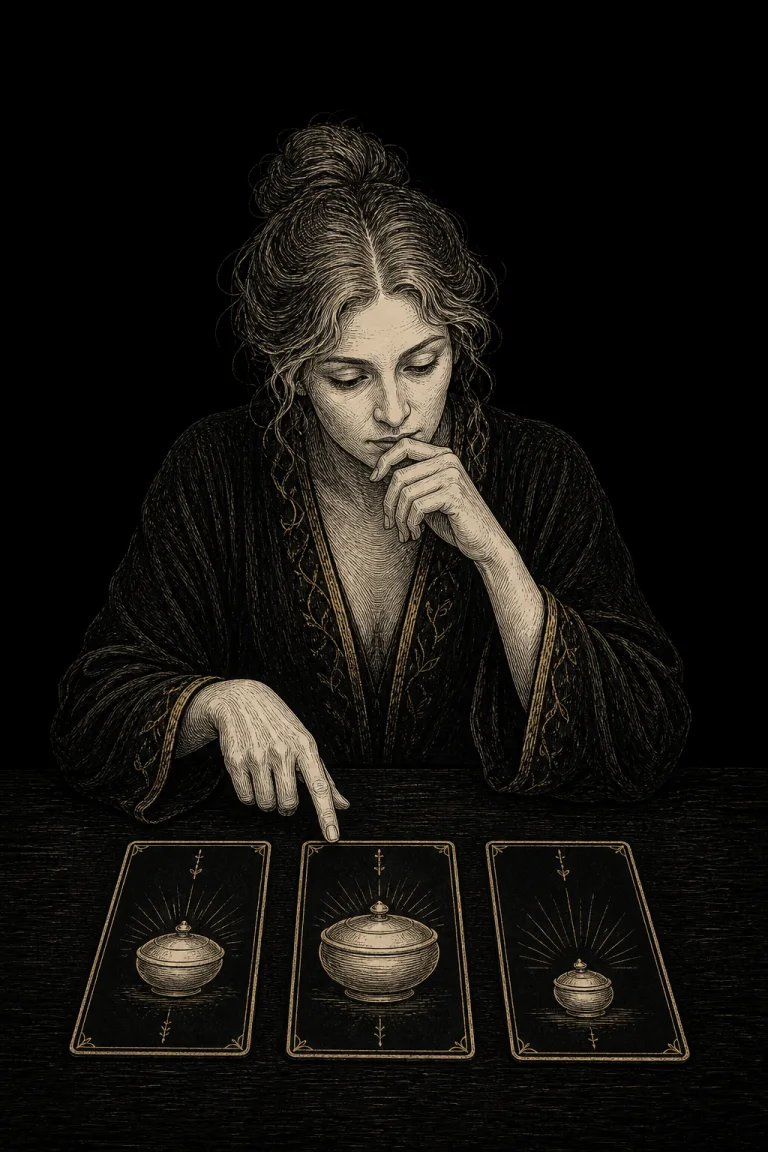
Repetition in Tarot can appear inside one card, across several cards in a spread, or throughout an entire deck. Cups may recur in a row, hands may repeat the same action, circles may appear at regular intervals, or one color may link otherwise different scenes. A repeated feature can create rhythm, emphasis, comparison, accumulation, or continuity. It does not carry one universal message.
Begin with a count, location, and description of every instance. Separate exact repeats from related variations, then compare ordinary cards from the same edition. A motif that appears on most cards is a deck convention, while an unusual cluster may deserve closer attention. Neither kind of recurrence proves fate, synchronicity, another person's thoughts, or a future event.
Take the next insight with you
Explore personalized Tarot guidance in Veritas, available for iOS and Android.
 Scan with your phone
Tarot repetition symbolism at a glance
What counts as repetition in a Tarot image
A repeat requires a feature that can be identified consistently: the same object type, color relationship, gesture, shape, texture, direction, number, or compositional placement. Write the inclusion rule before interpreting. If one card shows a round shield and another shows a full moon, they share circular form but not object identity. The Tarot card symbolism guide helps inventory each scene before grouping details.
Exact repetition and varied repetition
Exact repeats match on the feature being studied, such as three identical vessels. Varied repeats retain a family resemblance while changing size, condition, direction, or use. Variation may create development, contrast, hierarchy, or competing functions. State the stable feature and the changing feature separately. Similarity does not automatically mean progression.
Count before assigning significance
Record one instance at a time and check partially hidden elements. A row of five visible posts is different from four posts and one tree. If the illustration is ambiguous, preserve a range rather than forcing certainty. Number symbolism can be considered later, but the visible count must remain distinct from a card number, spread position, or calculated total.
Spacing, rhythm, and interruption
Even spacing can create order or visual rhythm. Crowding can create density. A large gap, missing instance, rotated element, or contrasting item can interrupt the series and direct attention. Describe the interruption without declaring it a warning. Composition owns the whole-frame arrangement; repetition analysis asks how recurring units and their intervals relate.
A six-pass repetition method
- Define the motif
Write a rule precise enough that another reader could decide which instances count.
- Count and locate
Record every instance by card, spread position, foreground or background, and visible order.
- Compare variations
Note changes in size, color, orientation, condition, contact, action, and obstruction.
- Check the baseline
Review several unrelated cards from the same edition for standard ornament and recurring style.
- State two functions
Offer a primary scene function and one plausible alternative before choosing a synthesis.
- Test the reading
Connect the pattern to the named question and record what evidence would weaken the interpretation.
Worked example: three vessels with one closed lid
Imagine three cards in a spread, each showing a vessel. Two are open and one is lidded. The stable feature is containment; the variation is access. A grounded synthesis might compare what is available, protected, unfinished, or deliberately closed in the three spread positions. It cannot prove secrecy. Object function and the position question must support the claim.
Worked example: a repeated diagonal changes direction
Suppose two cards contain rising diagonals and the third contains a descending one. The visible pattern is directional contrast, not a guaranteed rise and fall in events. Check whether the diagonals come from roads, bodies, tools, or decorative hatching. The line symbolism guide owns line source and quality, while repetition connects the instances across the spread.
Repeated motifs across a spread
Across cards, repetition can link spread positions that otherwise appear separate. First read each position independently. Then compare the recurring motif, its transformations, and any position where it disappears. The card combinations guide helps preserve position and sequence instead of flattening the spread into one symbol.
Three levels of repetition
Keep repetition inside one card, across one spread, and across the deck as three separate levels. Inside a card, repeated elements contribute to that scene. Across a spread, a motif can connect named positions. Across the deck, recurrence may reveal the illustrator's ordinary visual language. A crown appearing on many court cards is a baseline; three crowns clustered in one small spread may still be relevant because of their positions and differences. State which level supports each claim.
Build motif families without losing precision
A motif family can include related but nonidentical instances, such as containers, thresholds, climbing forms, or tools for measurement. Broad families help synthesis, but they also increase the chance of seeing a pattern everywhere. Start with the narrowest defensible rule. Report exact repeats first, then add a broader family only if the shared function is visible. A cup, lake, and falling rain all involve water, but they differ in scale, access, movement, and use.
Repetition in scenic and pip-style decks
Scenic decks often repeat characters, gestures, landscapes, and narrative objects. Pip-style decks make number, suit emblem, spacing, symmetry, floral links, and interruptions more prominent. Neither system is automatically easier or more symbolic. In Marseille-style pips, compare how emblems are grouped and connected rather than importing a scene that is not drawn. The Rider-Waite-Smith and Marseille comparison explains the structural difference.
Questions that keep a repeated motif grounded
Ask what each instance is doing, who can access it, what changes from one occurrence to the next, and which spread position contains the exception. Then ask whether the same conclusion would survive if one instance were removed. A useful pattern clarifies a relationship already supported by card meanings and positions. If the entire interpretation collapses when an ambiguous detail is excluded, preserve uncertainty instead of strengthening the claim.
Record the pattern before the story
Use Veritas to save the motif rule, count, locations, variations, deck baseline, spread positions, two competing functions, limits, and the evidence that would change your reading.
Repetition is not the same as a stalker card
This guide concerns visual features repeating inside one image or one defined spread. The stalker card guide concerns the same named card recurring across separate draws or readings and includes shuffle, deck, and logging checks. A repeated cup motif is not automatically a recurring card, and a recurring card may not share its visual motifs with surrounding cards.
Shapes, editions, reversals, and accessibility
The shape guide examines the form and function of circles, triangles, open shapes, and negative spaces. This article owns recurrence, count, interval, and variation among instances. Reversal changes orientation but not the number of printed elements. Crops, recolors, border removal, small screens, and color-vision differences can hide or manufacture a pattern, so compare a reliable edition and describe more than color alone.
Common mistakes and responsible limits
Common mistakes include counting unlike objects as identical, ignoring deck-wide ornament, choosing the inclusion rule after seeing a preferred total, treating one interruption as danger, and reading frequency as supernatural confirmation. Tarot is a reflective practice, not scientific prediction or surveillance. Repetition cannot replace consent, direct communication, medical care, legal advice, financial evidence, or safety planning. Keep observations in a Tarot journal and visit the <a href="/tarot">Tarot journal hub</a> for related methods.