Tarot Journal
Tarot Sound Symbolism: An Evidence-First Guide
Tarot sound symbolism begins with visible evidence of a sound source, listener, distance, rhythm, interruption, or silence, then tests what that acoustic relation does in the scene.
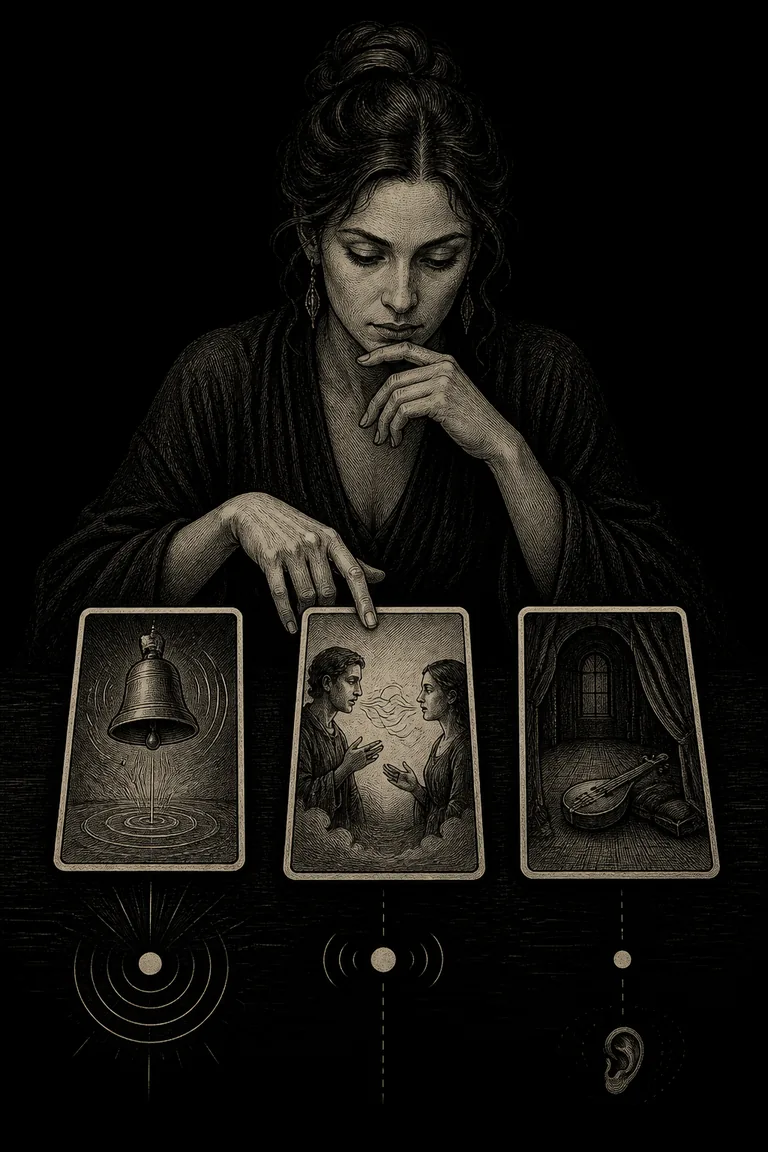
Sound symbolism in Tarot concerns sounds that the picture implies rather than sounds the card literally makes. A bell may be swinging, two figures may be speaking, a trumpet may summon a crowd, water may strike stone, or a closed room may make silence conspicuous. These details can organize attention, contact, warning, ceremony, memory, pace, or withheld communication. They do not reveal an unheard message or predict what someone will say.
Begin with the visible source and the evidence that it is active. Then identify who could hear it, what might block it, and whether the deck repeats the motif elsewhere. Separate observation from imagination: a pictured instrument is not necessarily being played, an open mouth does not provide exact words, and quiet space does not prove secrecy. The useful reading stays proportionate to what the image supports.
Take the next insight with you
Explore personalized Tarot guidance in Veritas, available for iOS and Android.
 Scan with your phone
Tarot sound symbolism at a glance
What counts as sound evidence in a Tarot card
Direct evidence includes an active mouth, struck surface, moving clapper, vibrating string, raised trumpet, splashing water, barking animal, or impact lines placed at a plausible source. Indirect evidence can include covered ears, several heads turning toward one point, startled birds, or a figure leaning close to listen. First write what is drawn. The Tarot card symbolism guide provides the wider evidence-first inventory.
Separate a sound object from an active sound
A bell hanging still is an object with a possible acoustic use. A bell tilted with its clapper displaced is stronger evidence of ringing. A lute on the floor may indicate rest, storage, memory, or unavailable music rather than performance. Use the object symbolism guide for function and affordance, then add a sound claim only when posture, contact, motion, or response makes activity visible.
Voice, speech, and the limit of lip-reading
A pictured exchange may support speaking, calling, singing, whispering, or listening as competing possibilities. Distance, hand position, audience, and other figures can narrow the options. The image still cannot provide a transcript, tone of voice, honesty, or consent. Do not turn an open mouth into a confession, proposal, argument, diagnosis, or promise. Ask what communication role the scene establishes, not what sentence you want it to contain.
Listener, audience, and access
Sound is relational. Note whether a source addresses one person, a crowd, an absent space, or nobody visible. Check who faces the source, who is distant, who is behind a wall, and who controls the signal. A public trumpet and a private conversation create different access structures even if both imply communication. Hearing range in a stylized image is uncertain, so describe likely access rather than claiming that every figure receives the message.
Distance, barriers, and direction
Walls, doors, curtains, water, elevation, wind, and crowding may change how a sound could travel. A figure calling across a gap can organize separation or effort, while two figures leaning together can organize privacy or concentration. Direction lines may be decorative or may indicate movement rather than sound. Compare their source, endpoints, and use elsewhere in the deck before deciding. The line symbolism guide helps keep that distinction visible.
Rhythm, repetition, and interruption
Repeated clappers, drum strokes, marching feet, waves, or birds can imply cadence, but count only units actually drawn. One broken sequence may support interruption or changed pace if the pattern is established first. The repetition guide owns count and variation. Sound analysis adds the possible acoustic relation, such as a regular signal becoming uneven, without assigning a universal meaning to fast or slow rhythm.
Silence as visible absence
Silence is harder to establish because every still image is physically silent. It becomes a useful comparison only when the scene supplies a reason to expect sound: an unused instrument, a stopped bell, an empty hall after activity, a speaker facing an absent audience, or figures deliberately separated. Call this implied quiet, pause, or unavailable sound rather than proof that someone is withholding truth.
A seven-question sound method
- Locate the source
Name the visible person, object, animal, element, or impact that could produce the sound.
- Check activation
Find contact, motion, vibration, breath, response, or another cue that distinguishes active sound from potential.
- Map the listeners
Identify who appears able to hear, who responds, and who may be outside the acoustic relation.
- Trace the path
Record distance, direction, barriers, enclosure, and competing sources without pretending to calculate volume.
- Describe the pattern
Note repetition, overlap, pause, pace, or interruption only when a visible sequence supports it.
- Check the deck
Compare the same source and response cues across unrelated cards in the exact edition.
- Test two functions
Offer two plausible scene functions and choose only what fits the card, position, question, and neighbors.
Worked example: a bell above moving water
Imagine a bell with a displaced clapper above a basin where concentric ripples spread. The bell is the likely source, while the ripples visually echo propagation without proving literal acoustics. A grounded reading might examine a signal whose effects continue after the initial action. An alternative is ritual timing or a visual link between air and water. The card cannot promise news, an alarm, or spiritual contact.
Worked example: two speakers and one turned figure
Two figures face each other with active gestures while a third stands farther away and looks elsewhere. The scene may distinguish direct exchange from limited access or competing attention. Before calling the third person excluded, check distance, posture, task, and the spread question. They may be waiting, guarding, working, or choosing privacy. The picture supports a communication structure, not a verdict about motive.
Sound across a spread
Read each card in its assigned position first. Then compare sources, listeners, barriers, and response. A spread may move from one public signal to a private exchange and then an unused instrument. That sequence can support reflection on changing communication conditions only when the positions establish an order. The card combinations guide prevents visual similarities from erasing positional meaning.
Sound and movement are related but distinct
The movement guide examines pictured change of position, route, pace, and control. Movement can activate a sound source, but not every moving object is noisy and not every implied sound requires visible travel. A raised hammer may precede impact rather than show it. Preserve that temporal uncertainty instead of converting preparation into a completed event.
Deck tradition and edition matter
Scenic decks may show musicians, speakers, animals, weather, and ceremonial instruments in narrative settings. Pip-style decks may suggest rhythm through repeated emblems and floral structures without depicting a literal source. Modern decks may add graphic wave lines or remove them. Compare the exact edition, crop, and guidebook. Do not import a trumpet, voice, or soundtrack from a familiar deck when the card in front of you does not contain it.
Accessibility and careful description
Describe the source, activation cue, listener, and barrier in plain visual terms rather than relying on sound-effect words alone. A reader who is Deaf or hard of hearing can interpret acoustic relations from the same visible evidence without treating hearing as a measure of awareness. Avoid claims that silence equals deficiency or that loudness equals authority. Social power, access, and consent need separate evidence.
Record the acoustic relation before the message
Use Veritas to save the source, activation cue, possible listeners, distance, barrier, rhythm, deck baseline, two scene functions, spread position, question fit, and evidence that would change the reading.
Questions that keep sound symbolism grounded
Ask what could physically make the sound, whether activity is shown, who responds, and what remains outside the scene. Ask whether the artwork establishes repetition or only one moment. Check whether a barrier changes access and whether the same motif behaves differently elsewhere. Finally, state what the image cannot tell you: exact words, sincerity, volume, future timing, and another person's private thought.
Common mistakes and responsible limits
Common mistakes include treating every instrument as active, inventing dialogue, reading decorative lines as sound waves, equating quiet with secrecy, and calling a prominent signal a prophecy. Tarot is a reflective practice, not surveillance, scientific prediction, or communication with an absent person by default. Sound symbolism cannot replace direct conversation, consent, medical care, legal advice, safety planning, or emergency help. Keep tests in a Tarot journal, use Tarot storytelling to connect evidence without inventing a script, and browse the <a href="/tarot">Tarot journal hub</a>.