Tarot Journal
Tarot Viewpoint Symbolism: An Evidence-First Guide
Tarot viewpoint symbolism asks where the implied observer stands, what that position reveals or hides, and how the deck normally frames a scene before assigning meaning.
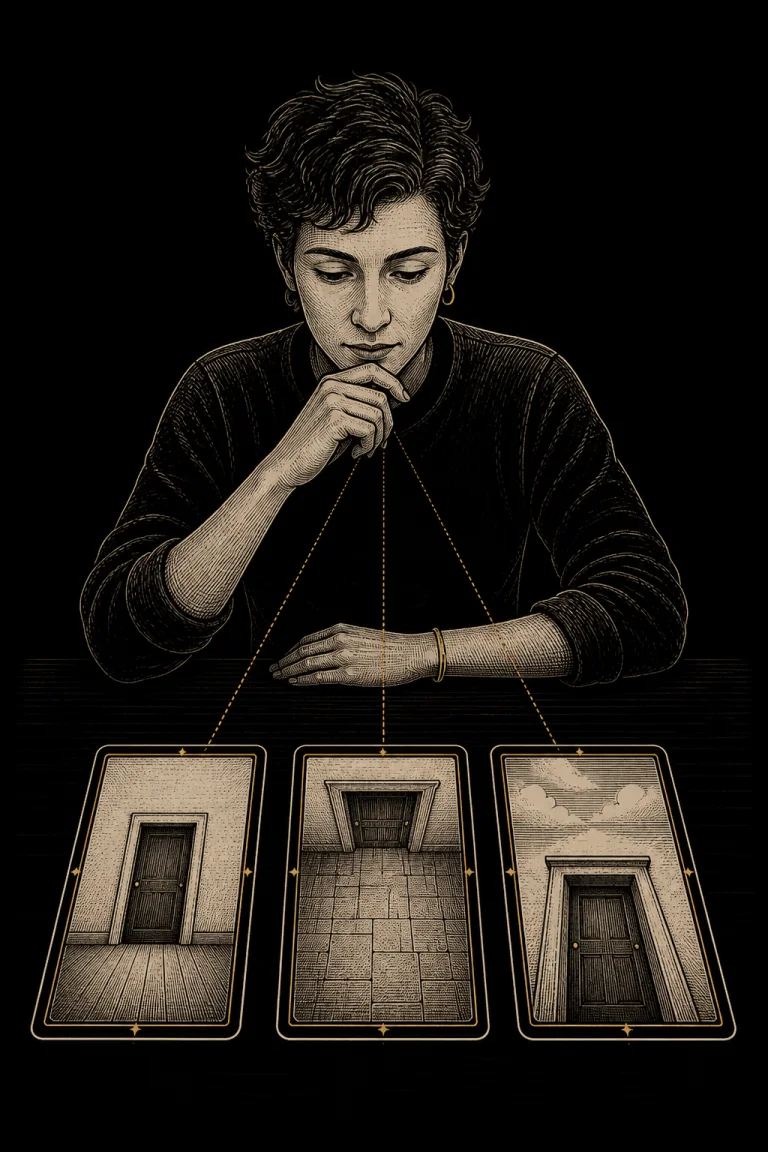
Tarot viewpoint symbolism concerns the position from which a card lets you see its scene. An image may meet a figure at eye level, look down from above, look upward from below, stand inside a room, watch through an opening, or crop the action so that the observer knows only part of what is happening. Viewpoint changes access to information. It does not automatically prove superiority, danger, intimacy, truth, or a future outcome.
Begin with a neutral camera-style description even when the artwork is not realistic. Name the implied observer position, record what is visible and concealed, compare the choice with other cards in the same deck, and test at least two scene functions. This separates a useful visual observation from a story about status, motive, or destiny that the image cannot establish.
Take the next insight with you
Explore personalized Tarot guidance in Veritas, available for iOS and Android.
 Scan with your phone
Tarot viewpoint symbolism at a glance
Viewpoint is not the same as composition, distance, or gaze
Viewpoint asks where the implied observer is located. Composition asks how the whole frame arranges attention. Distance symbolism compares gaps and access between endpoints inside the picture. Gaze symbolism follows where depicted eyes or faces orient. These layers interact, but keeping their questions separate prevents one dramatic feature from explaining everything.
Build an observer inventory
- Locate the observer
Estimate whether the view is level, elevated, low, close, remote, inside, outside, behind, beside, or looking through an opening.
- Name the frame
Record what the card includes, crops, overlaps, blocks, enlarges, or leaves beyond the visible edge.
- Separate fact from effect
Write one checkable description, then note the visual effect it creates without converting that effect into an event claim.
- Test alternatives
Compare practical access, artistic convention, symbolic hierarchy, reproduction crop, and at least one rival scene reading.
- Check the deck
Compare several cards from the same edition to learn its normal eye level, horizon, distortion, and framing habits.
- Return to context
Use the title, spread position, question, neighboring cards, guidebook, and ordinary evidence to decide whether viewpoint matters.
Eye-level views can create parity without proving equality
An eye-level scene often lets the observer meet figures and objects without obvious vertical emphasis. It may support direct encounter, practical inspection, ordinary participation, or documentary clarity. Yet a level camera does not make the relationship equal. Clothing, access, scale, posture, tools, barriers, and actions may show very different roles. Treat apparent parity as one compositional effect, then check the rest of the evidence.
High viewpoints reveal patterns and hide lived detail
A view from above may reveal routes, groupings, boundaries, repetition, or the relationship between several objects. It can support overview, planning, exposure, detachment, mapping, or simple economy of space. It may also hide faces, texture, eye contact, and obstacles visible only at ground level. Looking down does not automatically mean control, judgment, divine knowledge, or success. Ask what the overview gains and what it loses.
Low viewpoints can enlarge a subject without proving authority
Looking upward can make a figure, wall, tree, tool, or doorway occupy more of the frame. The effect may emphasize scale, effort, shelter, obstruction, aspiration, vulnerability, or architectural height. Perspective enlargement is not evidence that the subject is powerful, virtuous, dangerous, or destined to prevail. Use the scale and proportion guide to distinguish depicted prominence from real-world rank or value.
Inside and outside positions change access
A scene viewed from inside a room may place the observer among tools, duties, protections, or restrictions. A view from outside may show the boundary and destination while withholding what occurs within. Looking through a window, arch, curtain, foliage, or doorway creates layered access: something is visible, but approach, permission, ownership, and context may remain uncertain. Architecture regulates access; it does not prove exclusion or invitation by itself.
Over-the-shoulder and partial views
An over-the-shoulder image may align the observer with one figure's task without granting that figure's thoughts. A cropped hand may show action while hiding the actor. A foreground object may block a face but reveal the tool being used. List what can be verified and what cannot. Partial knowledge can be the scene function, an ordinary crop, or an artistic device. Do not fill every hidden area with secrecy, deception, or threat.
Worked example: one doorway from three angles
Imagine three cards showing the same plain doorway. At eye level, the handle and threshold are easy to inspect. From above, the route on both sides is visible but the lintel condition is unclear. From below, the door feels tall while the floor plan disappears. One reading compares direct access, strategic overview, and the effort or uncertainty of approach. Another reading is simply that the artist uses angle to vary visual interest. Check whether the cards truly repeat the doorway, what each spread position asks, and whether any figure can act.
Worked spread: changing information access
Suppose a three-card spread moves from a view through a narrow window, to an eye-level table, to an overhead map. A coherent connector could be increasing access to evidence: partial observation, direct examination, then wider planning. A rival explanation is that the scenes are unrelated. Use the card combination method to require repeated objects, directions, positions, or actions before claiming one visual sequence.
Reversals change orientation, not the original camera position
Turning a card upside down changes the viewer's orientation to the artwork. It does not retroactively move the implied observer from above to below or turn every entrance into an exit. Decide before shuffling how reversals affect your method. Compare the printed scene upright first, then describe what inversion changes in balance, access, or attention. The reversed Tarot guide offers several consistent approaches without forcing a literal opposite.
Deck baselines and reproduction changes
Marseille pip cards, staged Rider-Waite-Smith scenes, geometric Thoth-derived decks, collage, photography, and borderless editions use viewpoint differently. Mobile crops can remove a threshold or foreground witness. A reprint can enlarge art, alter borders, or mirror an image. Compare the complete card and several deck examples before calling one angle exceptional. When artist notes or guidebooks name a source image, that evidence deserves more weight than a universal viewpoint dictionary.
Accessibility when perspective is hard to read
If fine perspective cues are unclear, use large overlaps, horizon placement, visible tops or undersides, door and floor geometry, figure scale, and reliable image descriptions. You may state that the angle is uncertain. A useful reading can focus on objects, actions, positions, and card title instead. Enlarging a high-quality image may help, but inventing an exact observer position does not improve interpretation.
Save a viewpoint evidence record
Use Veritas to log observer position, angle, frame, visible and hidden evidence, access, deck baseline, two possible functions, uncertainty, and what later supported or challenged the interpretation.
A practical journal protocol
Choose one card with a clear scene and sketch a small eye outside its frame where the observer seems to stand. Write three columns: visible, concealed, and uncertain. Add the practical effect of the angle, one symbolic possibility, and one ordinary artistic explanation. Compare two cards from the same deck with different viewpoints. Revisit the entry after reading the guidebook. A Tarot journal makes deck-wide visual grammar easier to distinguish from a one-card exception.
Common mistakes and responsible limits
Common mistakes include treating high angle as weakness, low angle as power, eye level as equality, an outside view as rejection, a hidden area as deception, or a close view as intimacy. Tarot viewpoint symbolism is an interpretive visual method, not surveillance, mind reading, diagnosis, proof of consent, or a way to predict rank, safety, timing, or behavior. Use direct communication, documented evidence, qualified advice, and appropriate safety procedures for consequential decisions. Visit the <a href="/tarot">Tarot journal hub</a> for related methods.