Tarot Journal
Earth Symbolism in Tarot: A Visual Reading Guide
Earth symbolism in Tarot begins with visible ground: soil, stone, sand, clay, slope, depth, boundaries, routes, weight, support, and the figures who cultivate or cross it.
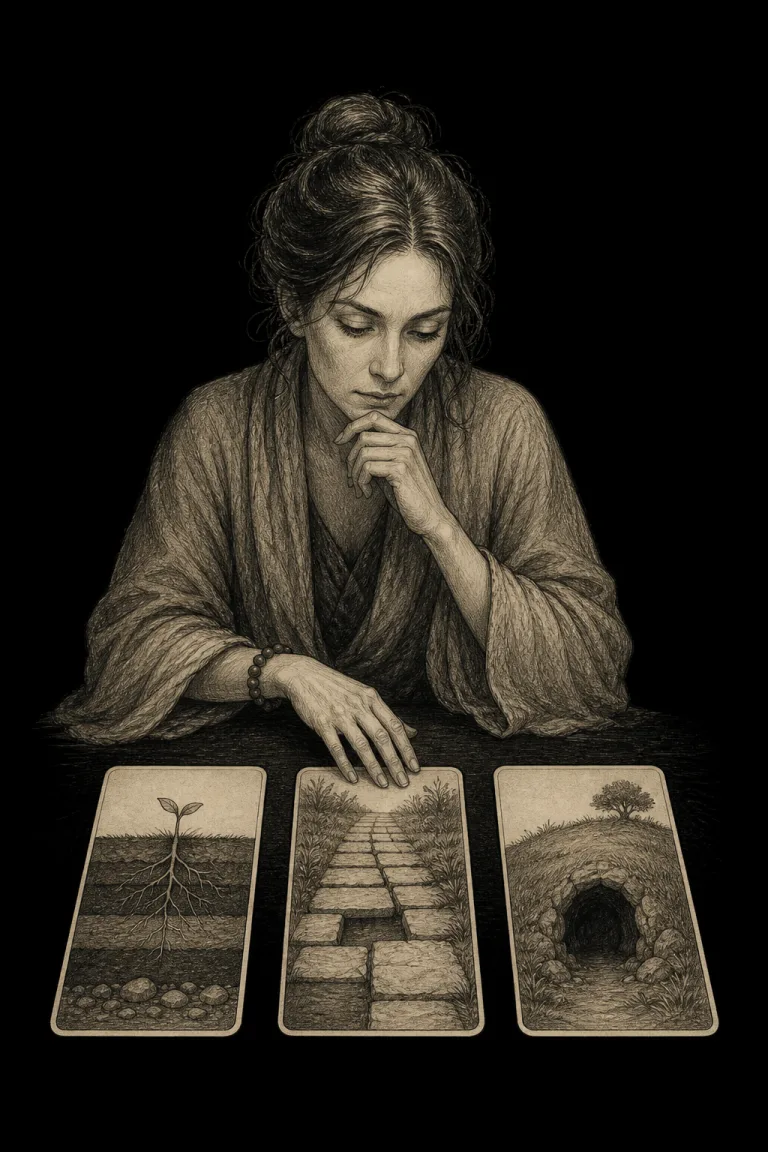
Earth symbolism in Tarot describes how ground and mineral material function inside a card. A planted field, bare rock, loose sand, paved road, cave, and distant mountain create different visual facts. A useful reading starts with material, condition, surface, depth, support, boundaries, routes, and access before adding ideas such as stability, money, fertility, grounding, or permanence.
Earth is not automatically the suit of Pentacles, and it does not independently predict wealth, property, health, pregnancy, safety, delay, or a lasting outcome. Read the printed terrain, compare the deck's visual habits, connect one supported observation to the spread position, and use direct evidence for consequential decisions.
Take the next insight with you
Explore personalized Tarot guidance in Veritas, available for iOS and Android.
 Scan with your phone
Earth symbolism in Tarot at a glance
First name the visible material
Soil, clay, gravel, bedrock, sand, ash, and a paved surface do not behave alike. Name only what the illustration supports. If the surface is stylized or unclear, use a neutral description such as dark ground or pale loose material. The card symbolism guide provides the broader evidence-first method.
Surface and depth answer different questions
A smooth top layer may hide roots, buried objects, water, foundations, or nothing identifiable. A cut bank or cave can reveal depth, while an overhead view may show only surface pattern. Do not infer what is underground unless the card exposes it. Record visible layers, openings, and interruptions before assigning hidden meaning.
Support depends on material and condition
Firm stone under a figure, a cracked ledge, churned mud, and shifting sand provide different support. Check the contact point between body, object, and ground. A standing figure does not prove the terrain is safe beyond that point. A crack does not guarantee collapse. Describe current support and visible risk separately.
Weight and load need a visible relationship
A cart pressing into soft soil, a building anchored in rock, and a small seed beneath a thin layer each show a relation between material and load. Relative size, compression, bending, footprints, and displaced earth can support an observation. They cannot calculate real capacity, legal ownership, or future durability.
Boundaries and routes shape access
Walls, ridges, trenches, field edges, cliffs, paths, steps, bridges, and open slopes organize movement across the ground. Trace where a route begins, where it ends, and whether a barrier has an opening. The distance guide helps separate a route from the gap it crosses.
Cultivation is visible work, not automatic abundance
Rows, furrows, tools, irrigation, pruning, planting, and harvesting show intervention. Bare ground may be resting, neglected, newly cleared, or simply outside a growing season; the picture must decide what can be said. A seed does not promise a harvest, and a full field does not reveal who owns or benefits from it.
Earth is not the same as the suit of Pentacles
The Tarot suits guide explains Pentacles as one Minor Arcana system. Visible ground appears across every suit and the Major Arcana, while many Pentacles cards emphasize people, exchange, craft, or objects rather than soil. Keep the suit structure and illustrated terrain separate, then note whether they reinforce or complicate each other.
A six-step earth reading method
- Name the material
Identify soil, stone, sand, clay, gravel, dust, pavement, or uncertain ground without interpreting it.
- Record condition
Note dry, wet, compact, loose, cracked, layered, cultivated, excavated, covered, or interrupted surfaces.
- Map support and load
Mark what rests on the ground, where contact occurs, and what strain or stability is actually visible.
- Trace boundaries and routes
Locate edges, ridges, walls, holes, paths, steps, crossings, entrances, and inaccessible areas.
- Check intervention
Identify who digs, plants, builds, carries, crosses, repairs, extracts, avoids, or cannot reach the material.
- Write a bounded meaning
Connect one supported relation to the spread position and state what the image cannot establish.
Worked example: a path with one missing stone
Imagine a paved path crossing soft ground, with one slab missing and an alternate step visible at the side. The evidence supports a mostly prepared route, one interruption, and a possible adjustment. In an advice position, it may prompt checking the specific gap before proceeding. It does not predict failure, prove instability in every area, or say the destination is wrong.
Worked example: roots exposed in a cut bank
Suppose a tree stands above a cut slope and several roots are visible, while others remain embedded. A grounded reading can compare exposed support with the material still holding it and ask what changed at the boundary. It cannot diagnose the tree, prove family history, reveal a secret, or predict collapse.
Landscape, material, and architecture retain their own scopes
The landscape method reads the whole setting and routes through it. The texture and material guide compares how surfaces look and might behave. The architecture guide examines constructed spaces. Earth symbolism focuses the ground or mineral material supporting, separating, covering, or being changed by those elements.
Weather changes the condition of ground
Rain can darken soil or produce mud, wind can move sand or dust, and frost can harden a surface. Use only effects visible in the card. The weather guide owns atmospheric evidence; earth analysis records what has happened to the ground. Neither method turns a visual cue into a literal forecast.
Reversals do not mechanically invert earth
If you read reversals, do not automatically translate firm ground into instability or buried material into exposure. Begin with the same printed evidence, then use the reversal method to test blocked access, changed orientation, internal emphasis, or excess. State which convention you used.
Compare the deck baseline
Some decks place nearly every scene on detailed terrain; others float figures against flat backgrounds. Count how often soil, stone, paths, roots, caves, and mountains appear before treating one instance as unusual. Compare color, line, and placement within the same deck rather than importing another deck's visual grammar.
Accessibility and uncertain detail
Small prints, low contrast, color-vision differences, and stylized textures can make material hard to identify. Use a larger licensed image, guidebook description, or tactile edition where available. If detail remains uncertain, record the larger relation, such as figure on uneven ground, without inventing soil type or hidden layers.
Compare earth across a spread
Use the card combinations method to compare repeated materials only after reading each card. One card may show compact ground, another excavation, and another a repaired path. Ask whether the sequence changes support, access, or intervention. Do not force a story if positions answer separate questions.
Build an earth-evidence map
Use Veritas to record material, condition, layers, support, load, boundaries, routes, access, intervention, deck baseline, spread position, and one bounded interpretation.
A practical journal exercise
Choose one card with visible ground. In your Tarot journal, write a description without symbolic nouns. Draw the surface edge and any route, mark contact points and openings, then list what is visible, inferred, and unknown. Finish with one question that could be checked outside the reading.
Responsible limits
Earth symbolism in Tarot is an interpretive visual method, not evidence of wealth, property rights, health, fertility, pregnancy, safety, permanence, hidden objects, geology, or future events. Do not use it to choose medical care, construction, excavation, investments, contracts, or emergency actions. Visit the <a href="/tarot">Tarot journal hub</a> and use qualified advice, direct inspection, consent, and ordinary safety checks for consequential choices.