Tarot Journal
Fire Symbolism in Tarot: A Visual Reading Guide
Fire symbolism in Tarot begins with visible evidence: source, fuel, heat, light, smoke, containment, direction, distance, and the figures who approach or manage it.
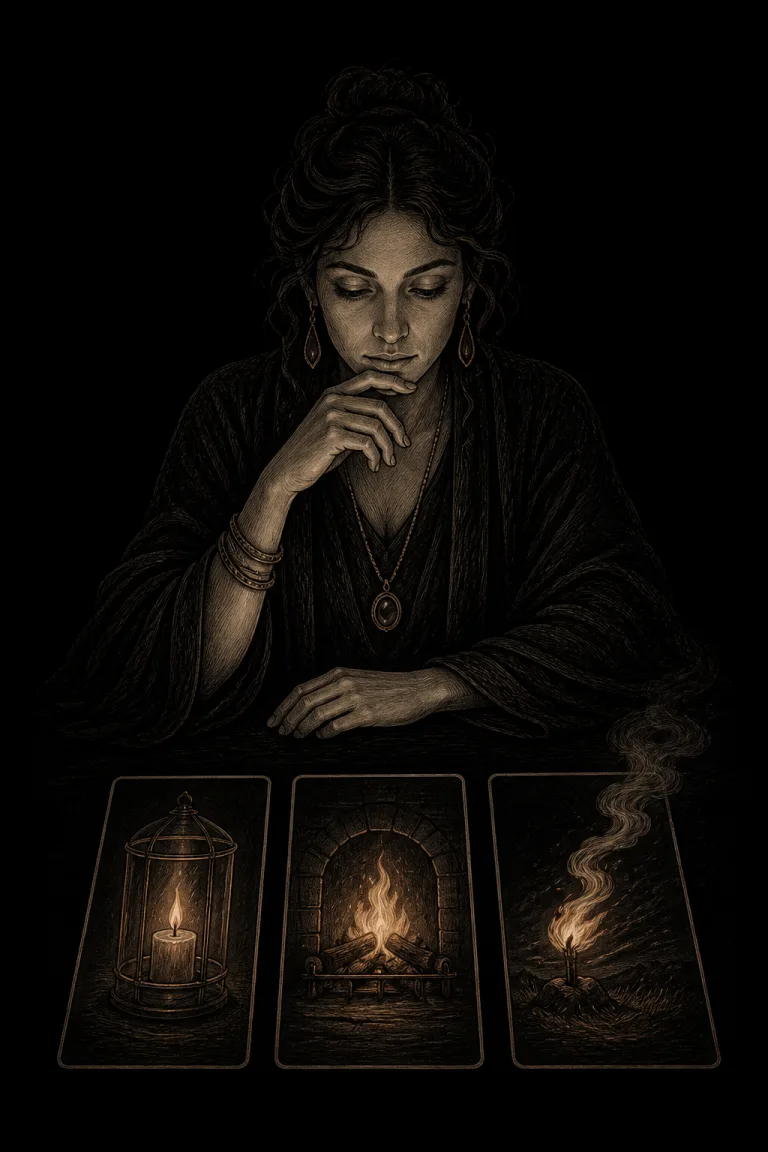
Fire symbolism in Tarot describes what a depicted flame is doing inside a card. A candle, hearth, torch, ember, lightning-struck tree, and distant blaze create different visual facts. A useful reading starts with source, fuel, scale, containment, movement, smoke, and access before adding ideas such as energy, desire, anger, purification, or danger.
Fire is not automatically the suit of Wands, and it does not independently predict conflict, attraction, success, destruction, spiritual awakening, or a sudden event. Read the printed scene, compare the deck's visual habits, connect one supported observation to the spread position, and leave consequential decisions to direct evidence.
Take the next insight with you
Explore personalized Tarot guidance in Veritas, available for iOS and Android.
 Scan with your phone
Fire symbolism in Tarot at a glance
First identify the fire source
A candle concentrates one small flame around a wick. A hearth contains burning fuel for warmth or work. A torch can be carried. A wildfire covers terrain, while a glow behind a window may hide its exact source. Name what is visibly producing the flame. If the source is outside the frame, say it is unknown rather than inventing a cause. The card symbolism guide provides the broader evidence-first method.
Fuel makes duration and maintenance visible
Wax, oil, wood, charcoal, paper, and an unseen fuel supply create different relationships to maintenance. A nearly spent candle shows limited visible material, but it does not tell you exactly when the flame will go out. A stocked hearth shows available fuel, not guaranteed comfort. Record what feeds the fire, who tends it, and whether replenishment is shown.
Flame, ember, smoke, and reflected light are different evidence
A flame shows active combustion. An ember may retain heat with little light. Smoke indicates material moving away from a source, but its cause and effect must still be observed. Reflected orange light may reveal a fire that is hidden outside the frame. The light and shadow guide owns visibility and contrast; this method asks what the fire itself is doing.
Containment changes the reading
A lantern, brazier, stove, ring of stones, fireplace, or vessel sets a boundary around flame. Check whether the boundary is intact, open, cracked, carried, guarded, or unattended. Containment can support controlled use, but it does not automatically mean emotional control or safety. The object method can examine the container as a tool.
Direction and spread require visible cues
Wind-bent flame, drifting sparks, smoke direction, dry fuel, and contact with nearby material can imply movement. Do not call a fire spreading only because the flame points sideways. Trace the actual route and obstacles. The movement guide helps separate a directional line from completed action.
Distance determines access and exposure
A person warming both hands at a hearth, carrying a torch, watching a beacon, and standing behind a wall have different access. Record who can approach, add fuel, extinguish, avoid, or use the fire. Distance alone does not prove fear, desire, exclusion, or future movement. A route must be shown or supplied by the spread question.
Fire is not the same as the suit of Wands
The Tarot suits guide explains Wands as one part of the Minor Arcana system. Visible fire may appear in any suit or Major Arcana card, and many Wands cards show no literal flame. Keep the suit structure and the illustrated scene separate. They may reinforce one another, create tension, or address different layers of the question.
A six-step fire reading method
- Name the source
Identify candle, lamp, hearth, torch, ember, lightning, burning structure, or another visible source without interpreting it.
- Record fuel and scale
Note what feeds the fire, how much is visible, and how the flame compares with nearby figures and objects.
- Map containment
Mark walls, rims, doors, screens, gaps, combustible material, and possible routes.
- Trace effects
Observe smoke, light, heat cues, melting, charring, sparks, and changes already visible in the scene.
- Check access
Identify who tends, carries, uses, approaches, avoids, watches, or cannot reach the fire.
- Write a bounded meaning
Connect one supported relation to the spread position and name what the image cannot establish.
Worked example: a candle inside a lantern
Imagine a small candle protected by a metal lantern while a figure carries it along a dark path. The visible evidence supports portable light, limited fuel, a protective frame, and active stewardship. In an advice position, this may prompt a modest plan that preserves visibility under uncertain conditions. It does not promise protection, reveal a spirit guide, or predict that the path is safe.
Worked example: an unattended hearth
Suppose a hearth contains bright logs, but no figure is nearby and sparks reach toward stacked cloth. A grounded reading can compare useful heat with unattended consequence and ask who owns maintenance. It cannot prove negligence, conflict, a house fire, burnout, or betrayal. Check the full card, question, and spread position before drawing any conclusion.
Weather and water can alter the fire evidence
Wind can bend flame and carry sparks. Rain can reduce or obscure combustion. Dry terrain can provide fuel. Use the weather guide for atmospheric conditions and water symbolism for visible water form and access. Do not force elemental opposition when the image shows a more specific physical relationship.
Compare fire across a spread
Across several cards, compare source, fuel, scale, containment, and access one feature at a time. A guarded candle, working hearth, and distant beacon may show increasing scale while direct control decreases. If the positions establish a sequence, describe the change without treating it as a timed prediction. The card combinations guide helps preserve both repetition and difference.
Reversals do not rewrite physical laws
A reversed flame does not literally burn downward, and smoke does not prove a hidden disaster. Keep the printed scene as evidence, then apply your chosen reversal method to access, emphasis, expression, or reading direction. State the convention you used so the interpretation can be reviewed.
Deck baselines and accessibility
Review five to ten cards from one deck and record every visible flame, glow, ember, and smoke trail. This reveals whether fire is rare, decorative, tied to one color, or consistently connected with particular actions. On small or low-contrast art, use an official scan, guidebook description, magnification, or neutral assistance. Alt text should describe source, containment, and interaction before meaning.
Save a fire evidence map
Use Veritas to record fire source, fuel, scale, containment, spread direction, smoke, light, distance, access, interaction, deck baseline, alternatives, and what later evidence changed.
A practical Tarot journal exercise
Choose six cards from one deck that show fire or its effects. For each card, write one sentence about source, fuel, and containment, then one about access and visible consequence. Add a conventional association only after the record is complete. A Tarot journal makes the deck's fire vocabulary testable rather than automatic.
Responsible limits
Fire symbolism in Tarot is a visual interpretation method, not evidence of attraction, anger, purification, illness, violence, arson, destruction, spiritual power, success, or a future emergency. Visit the <a href="/tarot">Tarot journal hub</a>, compare the full deck, and let direct communication, qualified advice, reliable records, and immediate safety needs lead consequential choices.