Tarot Journal
Tarot Symmetry Symbolism: An Evidence-First Guide
Tarot symmetry symbolism compares forms across a clear axis or center, then studies what matches, what differs, and what the scene does with that relationship.
Tarot symmetry symbolism begins with a testable visual question: which features correspond across a stated axis, center, or pair? A card may place two figures beside one lamp, repeat two towers around a path, balance vessels on opposite sides, or interrupt an otherwise regular arrangement. Symmetry can stabilize a scene and make comparison easy, but it does not automatically mean harmony, fairness, or a favorable outcome.
Describe the axis before interpreting the pattern. Name the matching elements, measure how close the correspondence is, and record the exceptions. Then compare several cards from the same deck and test at least two scene functions. This method keeps a memorable balanced design from becoming a fixed prediction about relationships, decisions, health, money, or destiny.
Take the next insight with you
Explore personalized Tarot guidance in Veritas, available for iOS and Android.
 Scan with your phone
Tarot symmetry symbolism at a glance
Symmetry needs a named axis
Two similar objects do not become symmetrical merely because both appear in one card. Reflection symmetry requires correspondence across an axis. Rotational symmetry requires a form that remains related around a center. Approximate symmetry can organize similar visual weight without matching every contour. State whether the axis is vertical, horizontal, diagonal, radial, or only implied. If no stable axis can be named, the pattern may be repetition or general balance instead.
Keep symmetry separate from composition and repetition
Composition symbolism examines the whole frame, including focal path, grouping, depth, and negative space. Repetition symbolism tracks a motif, count, interval, and variation. Symmetry asks whether elements correspond across an axis or center. Three cups in a row repeat, but they may not be symmetrical. A centered figure between unequal cliffs may create compositional balance without a mirrored landscape. Record each layer separately before combining them.
Build a symmetry inventory
- Draw the axis
Identify the line or center across which a correspondence could be tested. Do not move the axis after seeing which interpretation you prefer.
- Pair visible elements
Match figures, objects, openings, colors, lines, gestures, spaces, and distances on opposite sides only when their positions support a real comparison.
- Grade the match
Call it exact, approximate, weighted, or uncertain. Note differences in scale, direction, condition, access, and visual emphasis.
- Name the exception
Record any missing, displaced, damaged, brighter, darker, open, closed, active, or inaccessible element that interrupts the pattern.
- Compare the deck
Check other cards for the artist's normal centered layouts, paired ornaments, border rules, and asymmetrical storytelling habits.
- Test two functions
Write one practical design function and one symbolic possibility, then use the card action, spread question, and ordinary evidence to evaluate both.
Exact and approximate symmetry do different work
Exact reflection can make a seal, doorway, mask, wheel, or formal portrait easy to scan. It may indicate ritual design, heraldry, architectural structure, or the artist's preference for clarity. Approximate symmetry preserves a shared arrangement while allowing human bodies, plants, folds, flames, or clouds to vary. That variation can create life and movement. Do not treat a hand-drawn mismatch as a secret message until its placement, scale, and function distinguish it from normal illustration variation.
Paired figures are not automatically equal partners
Two figures placed around a central object invite comparison, yet placement alone does not establish equal power or mutual feeling. Compare posture, gaze, tools, clothing, height, access, and who can touch or control the center. A shared lamp may illuminate both people while only one holds the fuel. Two people may mirror gestures while facing different exits. Symmetry makes the relation visible; the scene supplies its terms.
Broken symmetry directs attention
An interrupted pattern often becomes a focal cue because the eye predicts the missing match. One tilted cup among upright cups, one open window opposite a closed window, or one figure stepping beyond a paired group may deserve inspection. First identify the ordinary function. The tilted cup could be in use, unstable, emptying, or drawn to reveal its interior. The open window could provide ventilation or a route. Broken symmetry marks difference, not its cause or consequence.
Negative space can carry the comparison
Symmetry may appear in gaps rather than objects. Equal margins, matching openings, a centered empty road, or two dark spaces around a lit figure can organize the card. Unequal negative space can leave room for movement, direct the eye, or isolate a subject. The shape symbolism guide helps name bounded and open forms, while the contrast guide tests whether light, color, or texture makes one side more prominent.
Worked example: lamp, doorway, and vessel
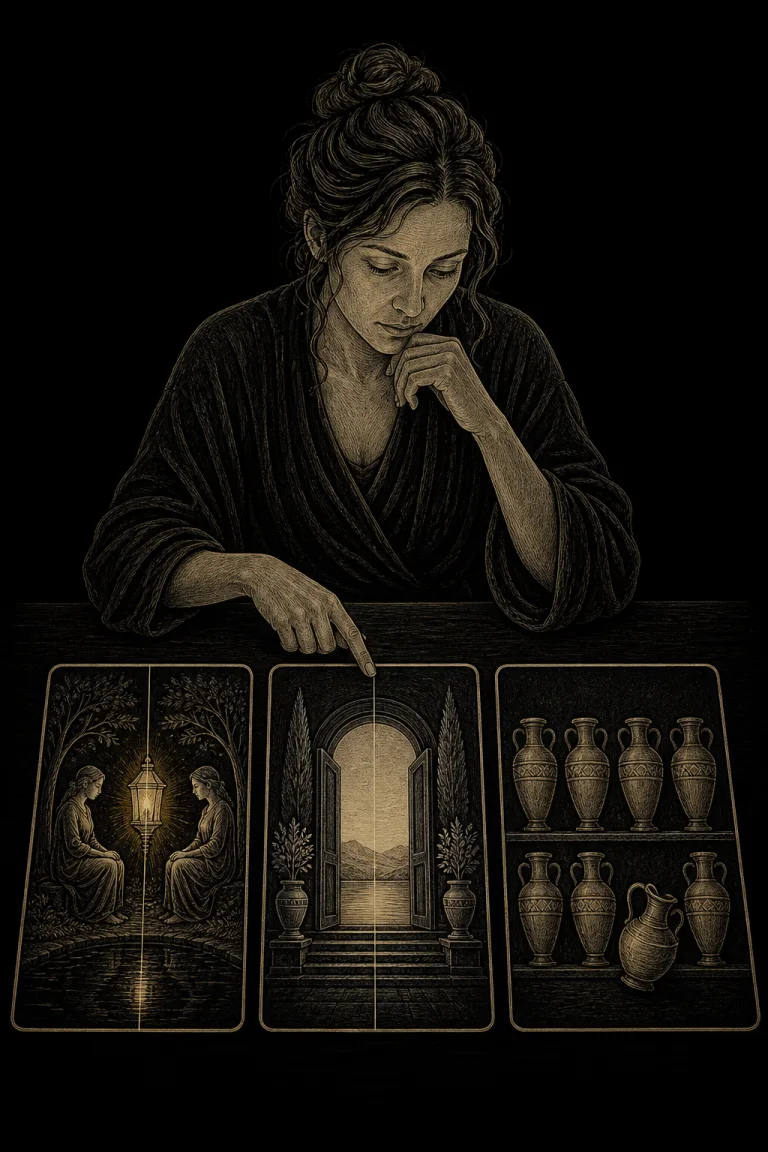
Imagine three cards from one deck. The first places two seated figures at equal distance from a central lamp, but only the left figure reaches toward it. The second centers an open doorway between matching plants, while a path bends away after the threshold. The third repeats six vessels in two rows, with one lower vessel displaced. A careful reading notes shared access with unequal action, a formal invitation followed by an uncertain route, and a regular system with one active exception. Rival explanations include portrait convention, perspective, and the practical use of the displaced vessel. None of the patterns proves reconciliation, betrayal, fairness, or a deadline.
Symmetry across a Tarot spread
A spread can create its own axis. In a five-card line, cards one and five or two and four may be assigned paired positions before the draw. Compare those positions through the stated spread logic, not merely because their pictures look alike. If two outer cards contain matching towers, check whether the inner cards repeat access, material, direction, or action. The card combination method prevents one striking visual echo from overriding the question and position meanings.
Reversals change some axes, not every relation
Reversing a card exchanges top and bottom but usually preserves left and right from the viewer's perspective. A vertically mirrored design may therefore look similar when reversed, while a figure's action or gravity changes. Decide how reversals work before shuffling and describe the upright structure first. The reversed Tarot guide offers consistent reading options. Do not invent a broken symmetry simply because the card is upside down.
Deck baselines prevent selective noticing
Some decks center nearly every figure, repeat decorative pillars, or use mirrored borders. In those decks, symmetry is part of the visual grammar and needs additional evidence before it carries special weight. Other decks favor collage, irregular cropping, or shifting horizons, so a rare formal axis may be more noticeable. Sample at least ten cards, including quiet scenes and action scenes, before declaring a pattern unusual. The direction guide can then test whether the paired elements face, approach, or block the same target.
Accessibility when fine matching is difficult
Use large landmarks: central figures, doorways, towers, borders, repeated vessels, horizon lines, and strong light-dark divisions. Magnification or a reliable image description can help, but exact ornament counts are optional. If the axis remains uncertain, read through title, action, object, color, and spread position. A useful method should allow uncertainty instead of rewarding invented precision.
Save an axis and exception record
Use Veritas to log the proposed axis, matching elements, degree of correspondence, exceptions, deck baseline, two possible functions, uncertainty, and what later evidence supported or challenged the reading.
A practical journal protocol
Choose one card that looks symmetrical and draw its axis outside the artwork. List paired elements in neutral language, then list every difference without ranking it as positive or negative. Compare two other cards from the deck to learn whether the design is ordinary. Finally, write one practical function and one symbolic possibility for the strongest exception. A Tarot journal makes it easier to separate a deck convention from a pattern that genuinely helps interpretation.
Common mistakes and responsible limits
Common mistakes include calling any balanced image symmetrical, treating symmetry as harmony, treating asymmetry as damage, ignoring perspective, moving the axis to fit a theory, and assuming paired figures have equal intent. Tarot symmetry symbolism is an interpretive visual method, not proof of compatibility, consent, fairness, diagnosis, structural safety, financial balance, or another person's thoughts. Use direct communication, records, qualified advice, and appropriate professional support for consequential decisions. Visit the <a href="/tarot">Tarot journal hub</a> and card symbolism guide for related methods.