
Chiron Return Chart: Timing and Interpretation
A reproducible Chiron return method for the roughly age-50 cycle, preserving exact longitude, retrograde passes, chart settings, uncertainty, and ethical limits.
Read the guideAstrology Journal
Clear, grounded explanations of birth charts, signs, houses, planets, aspects, and the patterns astrologers use to tell a richer personal story.
VERITAS JOURNAL
FIELD NOTES · 00
Journal atlas
Five considered paths through Astrology, plus a search across every published guide.
Complete index
Showing 61–72 of 202 considered guides.
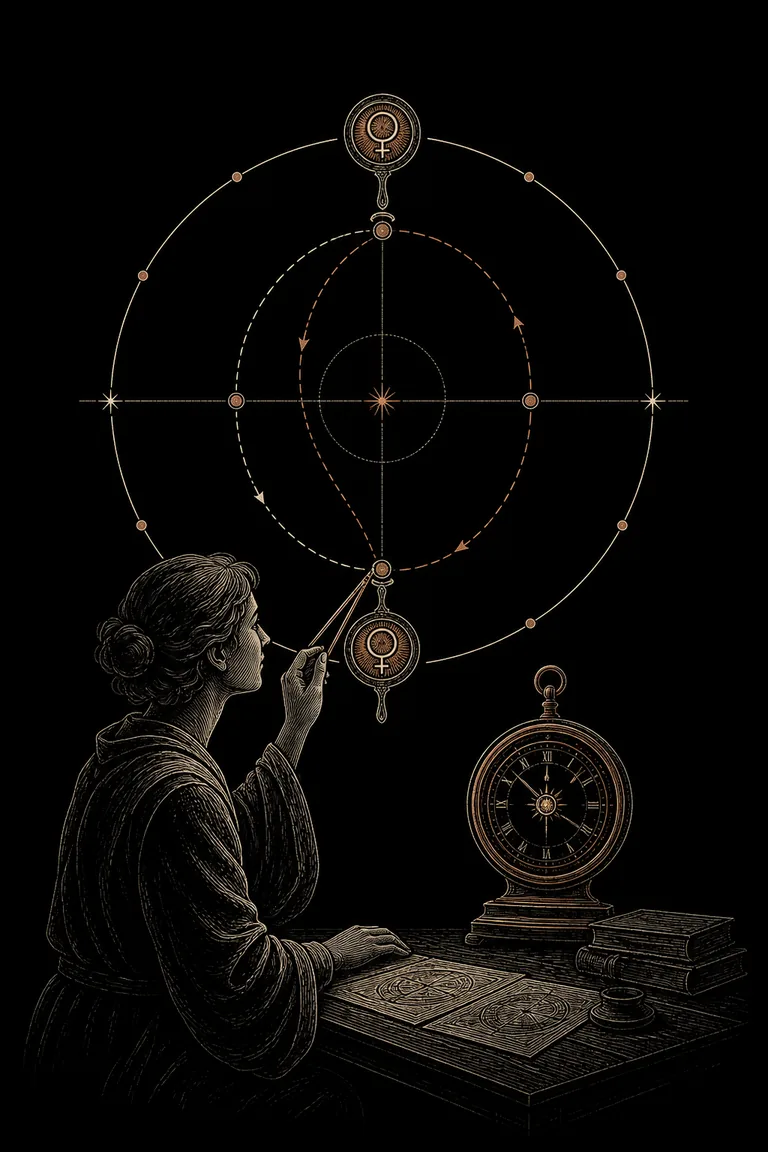
A reproducible Chiron return method for the roughly age-50 cycle, preserving exact longitude, retrograde passes, chart settings, uncertainty, and ethical limits.
Read the guideA reproducible Pluto return method for long-lived charts that separates the orbital estimate from exact geocentric longitude and documented history.
Read the guideA reproducible Neptune return method for long-timescale research that separates the orbital estimate from exact geocentric longitude.
Read the guideA reproducible Uranus return method that treats the eighty-four-year orbit as a search estimate and preserves every exact geocentric crossing.
Read the guideA reproducible Jupiter return method that separates the 11.86-year orbital estimate from exact geocentric longitude and preserves every crossing.
Read the guideA reproducible Mars return method that distinguishes the orbital estimate from exact geocentric longitude and preserves every crossing and setting.
Read the guideA reproducible Venus return method that separates orbit, synodic cycle, and exact geocentric longitude while preserving every crossing and chart setting.
Read the guideA reproducible Mercury return method that separates the 88-day heliocentric orbit from the roughly annual geocentric longitude return and preserves every pass.
Read the guideA lunar return chart begins with an exact natal-lunar-longitude match, then requires a declared place, chart settings, reading order, and honest review.
Read the guideTertiary I maps one ephemeris day to one tropical month of life; Tertiary II maps one tropical month after birth to one year of life.
Read the guideSolar arc directions apply one declared progressed-Sun or mean arc to every natal point, then compare directed positions with natal targets.
Read the guideSecondary progressions map one ephemeris day after birth to one year of life, while preserving the exact progressed timestamp and chart settings.
Read the guideExplore the journal