Tarot Journal
Air Symbolism in Tarot: A Visual Reading Guide
Air symbolism in Tarot begins with visible evidence of a moving or contained medium: bent plants, lifted fabric, smoke drift, breath, open passages, pressure, stillness, and the figures exposed to it.
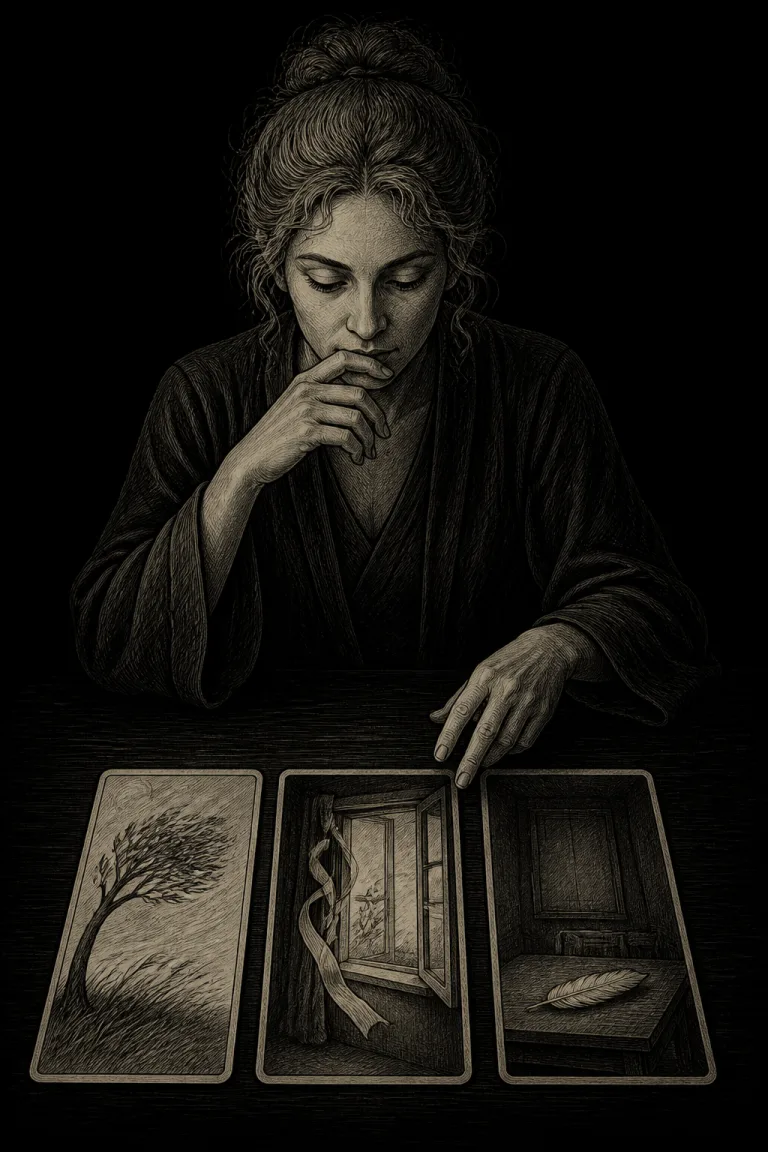
Air symbolism in Tarot describes how an invisible medium becomes legible through its effects. A wind-bent tree, a lifted veil, smoke traveling sideways, a feather at rest, an open window, and a sealed room provide different evidence. A careful reading starts with source, direction, force, duration, pathway, resistance, exposure, and response before adding ideas such as thought, communication, freedom, conflict, or change.
Air is not automatically the suit of Swords, and a breeze does not independently predict news, travel, an argument, relief, danger, or a sudden event. Read what the illustration actually shows, compare it with the deck baseline, connect one supported relation to the spread position, and use direct evidence for consequential choices.
Take the next insight with you
Explore personalized Tarot guidance in Veritas, available for iOS and Android.
 Scan with your phone
Air symbolism in Tarot at a glance
Air is visible through effects, not empty space
Most cards do not draw air itself. They draw a material responding to it. Name the response first: cloth lifts, grass leans, smoke drifts, dust rises, or nothing visibly moves. Empty sky is not enough to establish wind. The card symbolism guide provides the broader evidence-first method.
Separate observation from inference
"The ribbon curves toward the window" is an observation. "Air moves through the opening" is a modest inference. "A message is arriving" is an interpretation that needs the question, position, and other cards. Keep those three levels separate. If several causes could explain the effect, state the uncertainty instead of selecting the most dramatic one.
Source and direction need anchors
Trace the responsive object back toward a plausible source or opening. Hair and clothing may stream in one direction while smoke curls in another because heat, obstacles, and scale differ. One diagonal stroke does not establish a complete route. The direction guide helps define oriented subjects, targets, and deck baselines without converting right or left into a universal meaning.
Force is relative to the object
A feather moves under less force than a heavy branch. Compare like with like within the same image or deck. Slightly lifted fabric, flattened grass, a broken mast, and airborne debris imply different ranges of pressure and resistance, but they cannot measure real wind speed. Describe the visible response rather than assigning a number the card cannot support.
Duration is not the same as timing
Repeated ripples, a sustained lean, accumulated drifts, or a figure bracing may suggest that the depicted effect lasts longer than a single instant. A frozen illustration still cannot reveal hours, days, or a future deadline. Duration belongs to the pictured scene; divinatory timing requires a separate declared method and remains uncertain.
Openings, channels, and barriers shape airflow
Windows, doors, corridors, sails, walls, cliffs, trees, and clothing can admit, redirect, block, or concentrate moving air. Map the opening and the protected zone separately. A closed door may reduce exposure in the scene without proving secrecy or safety. An open passage creates access, not a guarantee that anything will enter.
Exposure and response belong to different subjects
One figure may turn away, another may lean into the wind, and a third may remain sheltered. Record posture, clothing, grip, and location before assigning willingness or fear. The movement guide owns changes of body and object position; air analysis asks what medium may be influencing that movement.
Still air is an evidence claim too
A hanging ribbon, upright flame, settled dust, and undisturbed water can support relative stillness when the deck draws motion clearly elsewhere. Stillness is not absence of atmosphere, thought, or communication. It means the available markers do not show meaningful movement at that pictured moment. Compare the same object across several cards before treating it as unusual.
Air is not the same as the suit of Swords
The Tarot suits guide explains Swords as a Minor Arcana system. Wind appears in every suit and the Major Arcana, while many Swords cards show enclosed rooms, still landscapes, or no clear atmospheric cue. Keep the suit structure and depicted air evidence separate, then note whether they reinforce, complicate, or ignore each other.
A six-step air reading method
- Name the effect
Record the bent, lifted, drifting, disturbed, braced, sheltered, or still material without interpretation.
- Estimate the minimum cause
Infer only enough airflow to explain the effect and list credible alternative causes when the image is ambiguous.
- Trace the path
Mark plausible source, direction, openings, channels, obstacles, sheltered areas, and the limits of the frame.
- Compare force and duration
Use the object response and deck baseline, not imagined wind speed or a divinatory clock.
- Record exposure and response
Identify who or what is affected, protected, resisting, using, or unaffected by the moving medium.
- Write a bounded meaning
Connect one supported relation to the spread position and state what the image cannot establish.
Worked example: a ribbon beside an open window
Imagine a ribbon lifting toward the room while plants outside lean in the same direction. The evidence supports an open path and airflow crossing a boundary. In an advice position, it may prompt checking what information, influence, or interruption has access. It does not prove that news is coming, that the influence is helpful, or that the window should literally remain open.
Worked example: smoke divided by a wall
Suppose smoke rises from a small fire, then splits around a stone partition while a seated figure remains in its lee. A grounded reading can name source, redirection, and relative shelter. It cannot diagnose air quality, predict a fire, identify a hidden person, or prove emotional avoidance. Real smoke requires ordinary fire and ventilation safety.
Weather, sound, and air retain separate scopes
The weather guide reads clouds, precipitation, visibility, and atmospheric conditions. The sound guide reads visible sources and listening relationships. Air symbolism focuses the medium inferred from physical effects. Wind may accompany weather or carry sound, but one does not automatically prove the others.
Reversals do not mechanically turn wind around
If you read reversals, do not automatically reverse the airflow, turn exposure into protection, or interpret stillness as chaos. Begin with the printed relation and use the reversal method to test changed orientation, blocked access, internal emphasis, delay, or excess. State the convention you used.
Compare the deck baseline
Some artists animate nearly every sky, robe, and plant. Others use still silhouettes except in a few cards. Count repeated motion marks, open windows, smoke paths, sails, feathers, and sheltered interiors before treating one cue as exceptional. Compare line weight, angle, and object response within the same deck rather than importing another deck's grammar.
Accessibility and uncertain marks
Small cards, low contrast, visual impairment, and decorative hatching can make motion marks hard to distinguish. Use a larger licensed image, guidebook description, magnification, or tactile edition where available. If the detail remains uncertain, record the larger relation, such as figure near an open window, without inventing wind direction or strength.
Compare air across a spread
Use the card combinations method after reading each card independently. One position may show exposure, another redirection, and another still shelter. Ask whether access, resistance, or response changes across the positions. Do not force one weather story when the cards answer different questions.
Build an air-evidence map
Use Veritas to record visible effects, minimum cause, direction, force, duration, openings, barriers, exposure, response, deck baseline, spread position, uncertainty, and one bounded interpretation.
A practical journal exercise
Choose one card with a possible air cue. In your Tarot journal, make three columns: observed, inferred, and interpreted. Draw arrows only where the image supports direction, mark openings and sheltered zones, then write one counterexplanation. Finish with a question that can be checked outside the reading.
Responsible limits
Air symbolism in Tarot is an interpretive visual method, not evidence of thoughts, messages, arguments, travel, weather, air quality, illness, danger, timing, or future events. Do not use it for medical, fire, ventilation, transport, legal, financial, or emergency decisions. Visit the <a href="/tarot">Tarot journal hub</a> and use forecasts, measurements, qualified advice, consent, and ordinary safety checks for consequential choices.