Tarot Journal
Tarot Overlap Symbolism: An Evidence-First Guide
Tarot overlap symbolism begins where one visible form interrupts another. The useful evidence is the shared edge, the front-to-back order, and exactly what the image leaves visible.
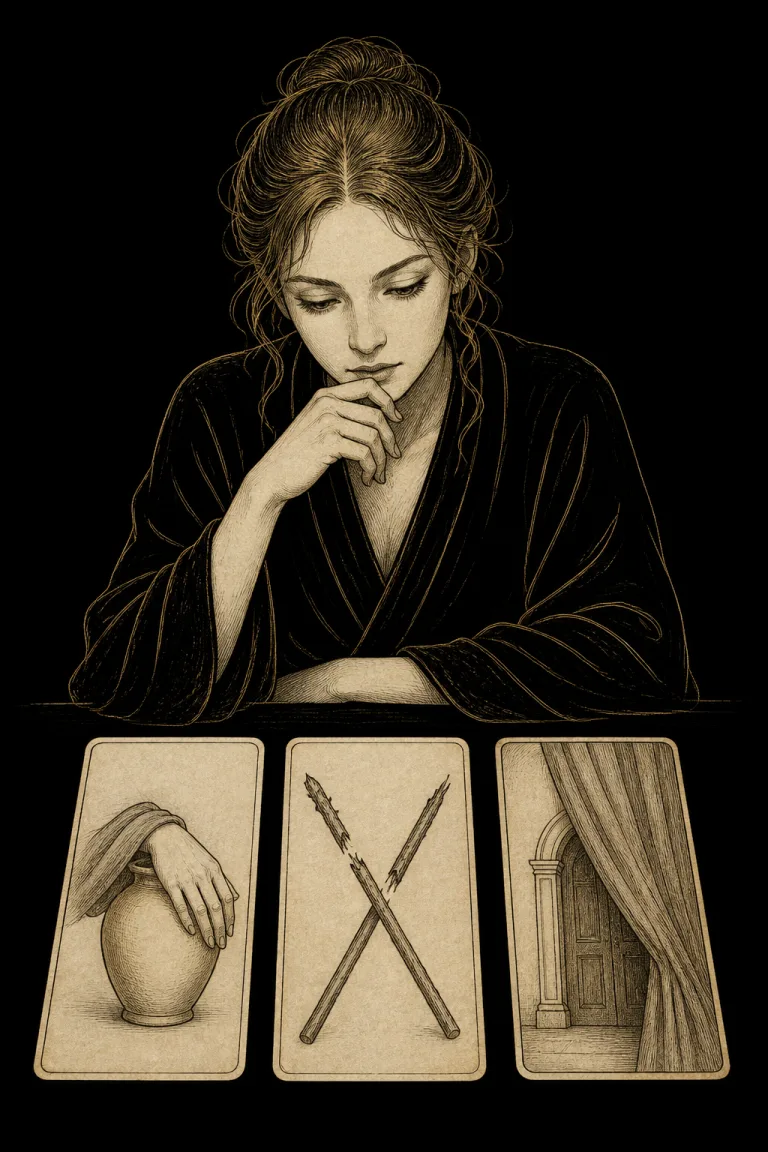
Overlap occurs when one figure, object, border, or environmental feature covers part of another. It is one of the clearest pictorial cues for depth, but it can also organize contact, obstruction, protection, sequence, or limited information. A hand over a cup, two crossed staffs, and a curtain before a doorway are three different overlap relationships. They should not receive one fixed keyword.
A responsible reading starts with visible edges and stops at the boundary of the evidence. You can say which form is in front, where the hidden contour probably continues, and whether the objects touch. You cannot automatically claim concealment, dishonesty, intimacy, control, or an unseen event. Compare the complete card, the deck baseline, and the spread position before interpreting the layer.
Take the next insight with you
Explore personalized Tarot guidance in Veritas, available for iOS and Android.
 Scan with your phone
Tarot overlap symbolism at a glance
What overlap means in an image
The visual system usually reads an uninterrupted contour as the nearer form and an interrupted contour as continuing behind it. Artists use this economical cue even when perspective, shading, or scale is minimal. Begin by tracing the actual boundary. If a sleeve covers part of a hand, name the sleeve edge and the visible fingers. If a cloud crosses a mountain, distinguish the cloud boundary from the mountain ridge. The Tarot line symbolism guide helps describe contour evidence without turning every break into a message.
Overlap is not the same as contact
Two depicted forms may overlap in the flat picture without touching in the imagined scene. A bird can cross the disk of the sun while remaining far away. A staff can pass in front of a robe without pressing against it. Physical contact needs additional evidence such as a gripping hand, compressed fabric, a shared shadow, or an explicit action. Conversely, touching forms may sit side by side with no overlap. Describe occlusion and contact separately before assigning themes such as support, pressure, conflict, or exchange.
A five-step overlap reading method
- Name both forms
Use neutral nouns before symbolic keywords: hand and vessel, staff and robe, curtain and doorway.
- Trace the interruption
Record the exact edge that disappears and the edge that remains continuous.
- Set the depth order
Identify front, middle, and back only as far as the visible cues support them.
- Test contact and function
Look for grip, pressure, shadow, route, barrier, protection, or an ordinary compositional explanation.
- Compare the deck
Check whether the same overlap device is common, unique, or altered across related cards.
Partial visibility and the ethics of inference
A partly hidden object creates incomplete information, not permission to invent the missing part. The safest description states what is visible, what is inferred from continuity, and what remains unknown. A round rim behind a hand may support the inference that a vessel continues beneath the fingers. It does not reveal what the vessel contains. In readings about another person, incomplete imagery cannot justify accusations, mind reading, surveillance, or pressure for disclosure.
Foreground layers, barriers, and access
An overlapping foreground form can block access to a background feature, but the function depends on the scene. A curtain may hide a doorway, frame it, soften its light, or simply establish an interior. A wall may interrupt a road and create a real barrier. A passing figure may cover the route only from the viewer's angle. Use the distance guide to map the interval and the viewpoint guide to ask whether the blockage belongs to the observer rather than the depicted traveler.
Crossed objects need object evidence
Crossed swords, staffs, keys, branches, or tools create an overlap at their intersection. The X-shaped arrangement may organize defense, exchange, closure, comparison, or visual balance. First identify which object passes in front and whether hands actively hold them. Then consult the object's depicted use and the deck guide. Crossing alone does not guarantee conflict, refusal, cancellation, or protection. The object symbolism method keeps material function in view.
Worked example: a hand over a vessel
Imagine a card in which an open hand covers the upper third of a plain vessel. The visible facts are a hand in front, a vessel behind, no obvious grip, and an uncovered opening. One reading may emphasize temporary stewardship or inspection because the hand controls attention without sealing the vessel. Another may see protection because the hand shields the rim. An ordinary explanation is that the overlap creates depth and connects figure to object. A clenched grip, lid, spill, or second person would materially change the evidence.
Worked example: a curtain and doorway
Suppose a curtain covers half of an open doorway while the threshold and a strip of light remain visible. The scene supports partial access and incomplete view. It does not establish that someone is hiding behind the fabric. Check whether the curtain can move, whether a figure approaches, and whether the path reaches the threshold. The negative space guide can clarify the open passage, while overlap explains why only part of it is available to the observer.
Deck baselines prevent false exceptions
Some decks layer collage fragments on nearly every card. Others use dense medieval scenes, transparent washes, flat Marseille patterns, or borderless photography. Count comparable overlaps across at least five cards. Ask whether the device changes card by card, belongs to the artist's standard construction, or results from a crop or reprint. A common layer can still contribute meaning, but it deserves less emphasis than a deliberate exception within the same visual grammar.
Overlap across a Tarot spread
Across several cards, repeated overlap can become a useful connector if the relationships are genuinely comparable. Record the front form, hidden form, contact evidence, and spread position for each card. A hand covering a tool and a cloud covering a destination may share limited visibility, but not necessarily the same cause. Use Tarot card combinations to propose one connector, then list the differences it must not erase.
Reversals and mirrored images
Turning a card upside down preserves which drawn form covers the other. It changes orientation, gravity cues, and the route through the composition, not the printed layer order. A mirrored app image can reverse left and right while keeping occlusion intact. Establish your reversal method before deciding that an overlap has loosened, intensified, or become hidden. The image alone does not support those claims.
Accessibility and source quality
Fine contours, dark printing, textured collage, and small phone displays can make overlap order ambiguous. Use an official high-resolution image, neutral alt text, a guidebook description, tactile materials, or a trusted reader's plain account. Good alt text names the relation without embedding a verdict: a hand covers the upper edge of a vessel while its opening remains visible. If the order cannot be established, record it as uncertain rather than forcing depth.
Save an overlap evidence map
Use Veritas to record both forms, the interrupted edge, front-to-back order, contact evidence, hidden area, deck baseline, two possible functions, spread position, and what later comparison changed.
A practical journal exercise
Choose three cards from one deck: one with a hand and object, one with crossed forms, and one with an environmental layer. Sketch only the overlapping contours. Mark continuous edges with a solid line and hidden continuations with a dotted line. Write one spatial explanation, one symbolic possibility, and one limit for each card. Revisit the notes after reading the guidebook. A Tarot journal reveals whether your overlap rules remain consistent across questions.
Responsible limits
Tarot overlap symbolism is an interpretive visual method, not evidence of secrecy, abuse, betrayal, intimacy, surveillance, suppression, timing, diagnosis, or another person's thoughts. Do not use a partly hidden figure or object to accuse someone, override consent, avoid direct questions, or make a high-stakes decision. Visit the <a href="/tarot">Tarot journal hub</a>, compare the complete image and deck, and let observable conduct, reliable records, qualified advice, and immediate safety needs lead consequential choices.