Tarot Journal
Tarot Foreground and Background Symbolism: An Evidence-First Guide
Tarot foreground and background symbolism separates the near, middle, and far planes of a card so prominence, context, and distant counterevidence can be read without flattening the scene.
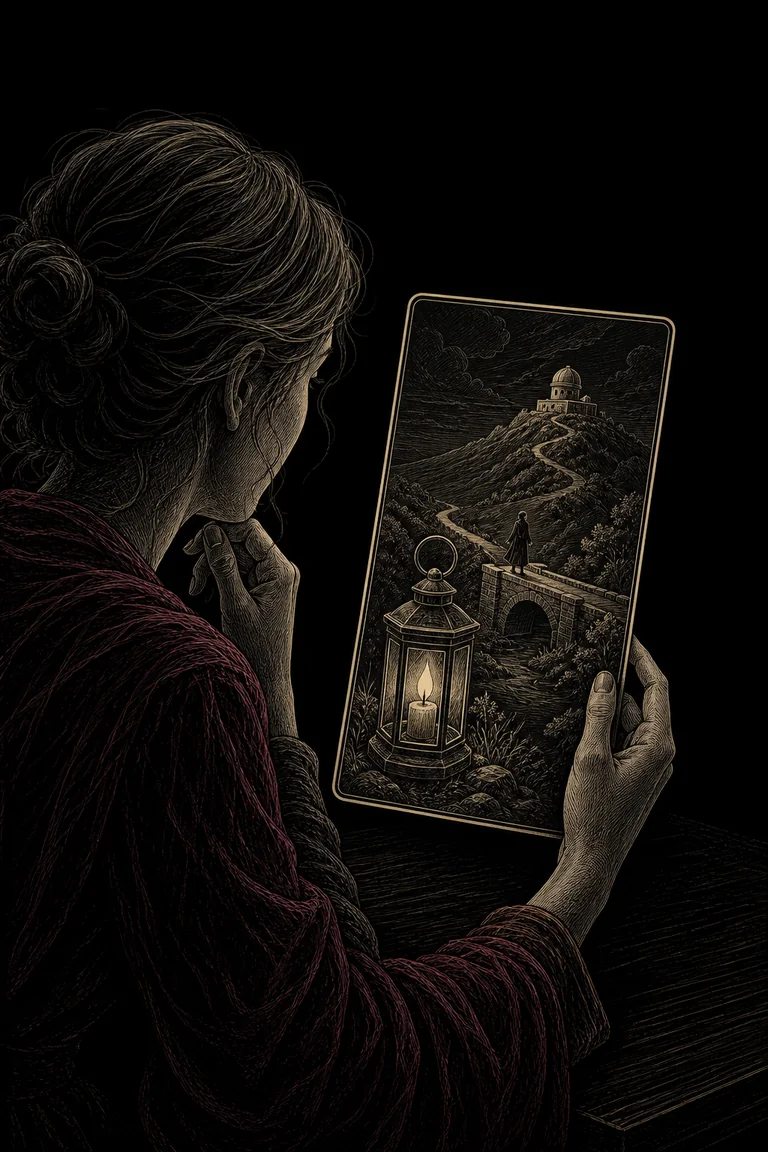
Foreground and background describe where depicted forms sit within the apparent depth of a Tarot image. A lantern close to the viewer, a bridge in the middle ground, and a tower on a distant hill do not carry equal visual access. Their placement can organize immediate attention, the route through a scene, and the wider conditions surrounding a figure.
Depth does not create a fixed dictionary. A foreground object is not automatically urgent, and a distant object is not automatically a future event. First identify the visual cues, compare the deck's normal construction, and ask how the planes relate. Keep overlap, distance, viewpoint, and whole-frame composition as separate checks rather than treating them as synonyms.
Take the next insight with you
Explore personalized Tarot guidance in Veritas, available for iOS and Android.
 Scan with your phone
Tarot foreground and background symbolism at a glance
How an image creates depth planes
Artists can establish depth through several converging cues. Near forms often appear larger, lower, sharper, or more detailed. Far forms may appear smaller, higher, lighter, softer, or partly hidden behind nearer forms. Parallel edges can converge toward a horizon, while a path can shrink as it recedes. Name the cue you actually see. Use overlap evidence for interrupted edges, while the composition guide places those cues inside the complete frame.
Foreground prominence is not automatic importance
A foreground form often receives attention because it occupies more visual area or interrupts the viewer's route into the card. That prominence may make it an entry point, obstacle, tool, witness, or framing device. It does not guarantee that the form is the central subject. A large branch may simply frame a smaller figure whose action organizes the scene. Compare size with contrast, isolation, gesture, and narrative function using the visual weight method.
Background details provide conditions and counterpoints
Background features often establish weather, terrain, settlement, horizon, destination, history, or an alternative focus. A distant tower can define where a road leads. A small boat can complicate an otherwise landlocked scene. A storm behind a calm figure can create contrast without predicting disaster. Read the background as observable context, then ask whether it supports, limits, or contradicts the foreground action. Do not dismiss it merely because it is small.
The middle ground explains the transition
Readers often jump from a near figure to a far destination and miss the middle ground. Bridges, gates, slopes, water, companions, tools, and paths can show how the planes connect. A clear route may make the background accessible. A broken bridge may interrupt that route. An empty middle ground may emphasize separation. Use the distance guide to describe intervals without converting them into days, months, emotional closeness, or mileage.
A five-step depth-plane method
- Divide the scene
Mark the near foreground, middle ground, and far background only where visible cues support those planes.
- Name the cues
Record scale, overlap, perspective, vertical position, focus, detail, color, or atmospheric change.
- Find the entry point
Notice where the eye begins and whether that first form acts as subject, tool, obstacle, witness, or frame.
- Trace the transition
Follow paths, gaze, gesture, architecture, light, or repeated shapes between planes.
- Test the far detail
Ask which background fact confirms, limits, or changes the initial foreground interpretation.
Worked example: lantern, bridge, and observatory
Imagine a card with a large lit lantern near the lower edge, a traveler on a middle-distance bridge, and a small observatory on a hill. The lantern is the visual entry point, the bridge carries movement between planes, and the observatory supplies a possible destination or context of study. One grounded reading might contrast immediate illumination with a longer process of inquiry. It would not claim that the traveler will reach a literal building, that the event is imminent, or that the lantern is more important solely because it is larger.
Worked example: a distant figure changes the scene
Suppose a foreground figure presents a cup while a small person walks away near the horizon. If the distant figure is clearly part of the same route, the scene may contain both offering and departure. If the figure belongs to a decorative landscape repeated across the deck, it may carry less individual weight. Check direction, scale, gesture, and barriers before connecting the two. The direction guide can clarify whether their orientations actually meet.
Foreground framing can alter the observer's access
Curtains, branches, arches, windows, and shoulders can frame a background scene. Some frames guide attention; others restrict the visible field. Ask whether the foreground element blocks a depicted traveler or only the observer's view. That distinction belongs to viewpoint symbolism. A doorway seen through leaves may remain physically open even when the reader has incomplete visual access.
Landscape and architecture keep their own functions
Depth location does not replace object-specific evidence. A mountain remains terrain, and a wall remains architecture, whether near or far. Consult the landscape guide for routes and terrain, or the architecture guide for enclosure, support, thresholds, and access. Then add the plane relationship. This prevents a generic background keyword from erasing what the feature actually does.
Deck baselines reveal real exceptions
Some decks use flat pattern with almost no deep space. Others place a horizon behind nearly every figure or use photographic blur as a standard effect. Compare at least five cards from the same deck. Count recurring horizons, foreground frames, routes, and degrees of detail. An unusual empty background may deserve more attention in a dense deck, while a distant castle repeated on every suit card may function as visual grammar rather than a unique prediction.
Depth patterns across a spread
Across a spread, record the dominant plane in each card and the route between planes. One card may keep action close to the viewer, another may open a long horizon, and a third may block the middle ground. This can support a sequence about attention and access if the spread positions agree. Use Tarot card combinations to state one connector and one difference, rather than forcing every background feature into a single story.
Reversals preserve printed depth
Turning a card upside down changes orientation and the visual route, but it does not make the printed background physically move in front of the foreground. A reversed road may now rise from the upper edge, yet its perspective cues remain part of the same drawing. Establish a consistent reversal method before interpreting changed access, emphasis, or flow.
Accessibility and source quality
Small screens, low contrast, dark printing, visual impairment, and cropped reproductions can hide distant details. Use an official high-resolution image, neutral alt text, a guidebook description, tactile scene mapping, or a trusted reader's plain account. Good alt text names spatial relations without a verdict: a lantern stands near the viewer, a figure crosses a middle bridge, and an observatory sits on a distant hill.
Save a three-plane scene map
Use Veritas to record foreground, middle ground, background, depth cues, visual entry point, routes, barriers, deck baseline, a distant counterpoint, spread position, and what later comparison changed.
A practical Tarot journal exercise
Choose three cards from one deck. Draw three horizontal fields for near, middle, and far, then list each visible form in its supported plane. Underline the first place your eye lands. Circle the feature that connects planes, and box one distant detail that complicates the first impression. Add one alternative explanation based on the artist's normal style. A Tarot journal makes these depth rules testable across readings.
Responsible limits
Tarot foreground and background symbolism is a visual interpretation method, not evidence of future timing, emotional priority, secrecy, surveillance, diagnosis, danger, or another person's thoughts. Do not treat a large foreground form as proof of urgency or a distant figure as a guaranteed event. Visit the <a href="/tarot">Tarot journal hub</a>, compare the full card and deck, and let direct communication, reliable records, qualified advice, and immediate safety needs lead consequential choices.