Tarot Journal
Tarot Horizon Symbolism: An Evidence-First Guide
Tarot horizon symbolism examines the visible or implied division between ground and sky, including its height, clarity, interruptions, and relationship to routes and figures.
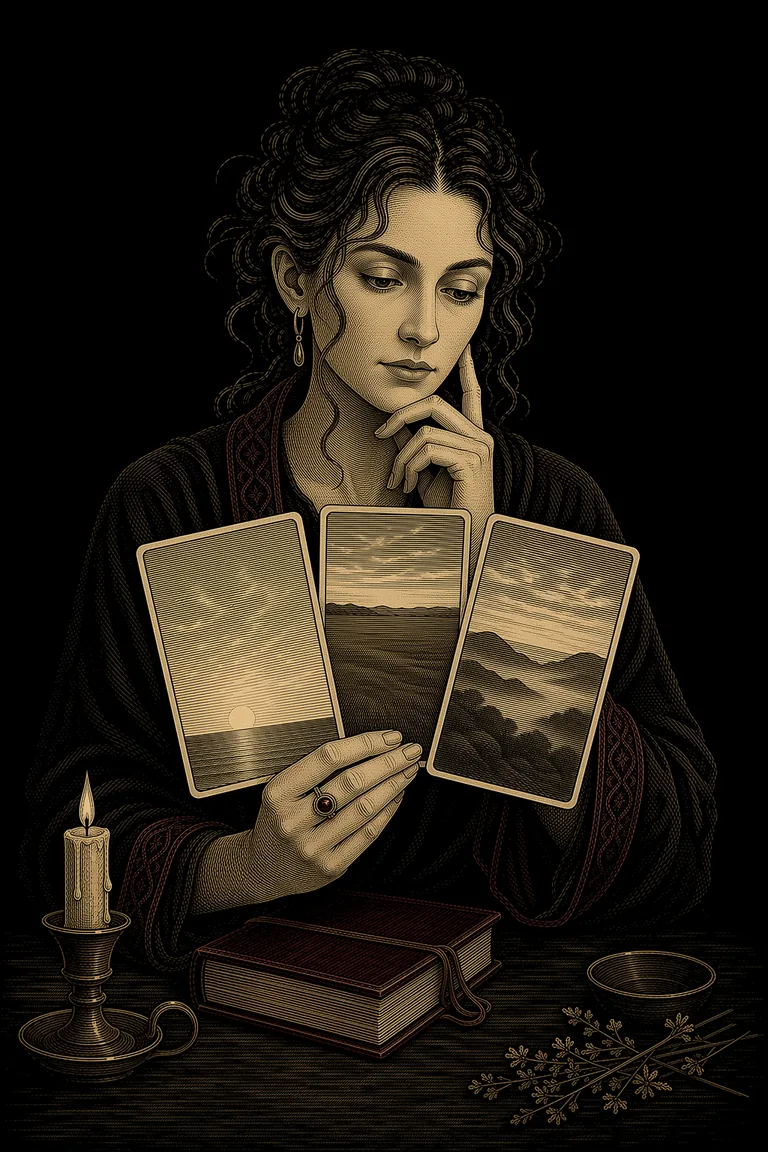
A horizon is the visible or implied boundary where land or water meets the sky. In a Tarot image, it can open a broad distant field, compress the scene behind a figure, disappear behind terrain, or guide a road toward one specific crossing. Its useful evidence comes from placement and construction, not from a universal promise about the future.
Begin by locating the horizon and stating how certain you are that it exists. Record its height, continuity, visibility, and intersections before assigning meaning. Then compare the same deck. A low horizon that is unusual in a tightly framed deck may matter more than a dramatic sky repeated on every card.
Take the next insight with you
Explore personalized Tarot guidance in Veritas, available for iOS and Android.
 Scan with your phone
Tarot horizon symbolism at a glance
How to locate a visible or implied horizon
A visible horizon may be a clean edge between sea and sky or an irregular line formed by hills. An implied horizon may be inferred from converging architecture, a road that narrows, or the eye level shared by distant forms. State the evidence and confidence separately. If a cropped card provides no reliable boundary, record no supported horizon instead of inventing one. The foreground and background guide can help establish depth without requiring a horizon.
Low and high horizons change the available field
A low horizon leaves more visible sky, while a high horizon leaves more ground or built environment. This changes what the image gives the observer access to. A low horizon can make weather, light, or open air visually prominent. A high horizon can emphasize terrain, objects, routes, or enclosure. These are spatial facts, not fixed meanings. Compare them with the whole composition before deciding what organizes the card.
A broken horizon records interruption
Mountains, towers, trees, curtains, smoke, figures, and card-edge cropping can interrupt a horizon. Name the interrupting form and whether it blocks the depicted route, the observer's view, or both. A tower crossing the horizon may act as a landmark. A shoulder may simply obscure part of the line from the viewer. The distinction matters because obstruction of sight is not automatically obstruction of movement.
A hidden horizon is not automatically mysterious
Some interiors, forests, fog banks, close portraits, and flat decorative decks contain no visible horizon. That absence may focus attention on immediate forms, but it does not prove secrecy, confusion, or lack of future. Check whether the deck normally omits distant space. If every court card uses a flat backdrop, the missing horizon is part of the visual grammar rather than a special warning.
Routes can meet, avoid, or run along the horizon
A path that narrows toward one horizon point creates a different relation from a wall running parallel to the boundary. First trace the route, then identify whether it reaches, crosses, follows, or stops before the horizon. Use the direction method to describe an actual target and barrier. Do not convert the length of a drawn road into days, months, mileage, or guaranteed travel.
Light and weather can clarify or erase the line
Dawn, sunset, haze, rain, darkness, and backlighting can make a horizon sharp, luminous, softened, or invisible. Separate the boundary from the atmospheric condition affecting it. The light and shadow guide covers illumination and visibility, while weather symbolism covers observable atmospheric cues. Neither method establishes a literal forecast.
A six-step horizon reading method
- Locate the boundary
Mark the visible horizon or state the perspective cues supporting an implied one.
- Record its height
Describe it as low, central, high, variable, tilted, or not reliably present.
- Trace continuity
Note clear spans, hidden sections, breaks, curves, and the forms that create them.
- Mark crossings
Identify figures, buildings, routes, light, or weather that meet the horizon.
- Compare the deck
Review at least five cards for the deck's usual horizon height, clarity, and scene depth.
- Write a bounded interpretation
Connect the observed spatial relation to the question without inventing timing, motive, or certainty.
Worked example: a low horizon and open sky
Imagine a card where a seated figure occupies the lower third and a clear horizon sits just above the shoulders. Most of the card is open sky. A grounded observation is that the scene gives atmosphere more area than terrain and keeps the distant boundary visible. If the spread concerns planning, this may prompt a comparison between immediate posture and a wide field of possible attention. It does not guarantee opportunity, freedom, or a positive outcome.
Worked example: hills hide the central boundary
Suppose two hills meet near the center and hide the direct land-sky line, while a path disappears between them. The path provides a route into unavailable visual information. A careful reading might distinguish what is observable now from what requires movement or further evidence. The hills do not prove deception, and the hidden section does not reveal what lies beyond it.
Viewpoint controls the horizon position
The horizon often corresponds to the observer's eye level. Raising or lowering the implied observer can shift the boundary without changing the depicted terrain. Before treating a high horizon as pressure or a low one as openness, consult the viewpoint guide. Ask where the viewer seems to stand and how much of the scene that position permits them to see.
Deck baselines prevent false exceptions
Lay out five to ten cards from one deck and record visible horizon height as a rough fraction of each image. Note cards with no supported horizon and cards where the boundary is interrupted. This small baseline reveals whether a low sky, high ground field, or concealed distance is truly unusual. It also protects against importing landscape conventions from a different deck.
Horizon patterns across a spread
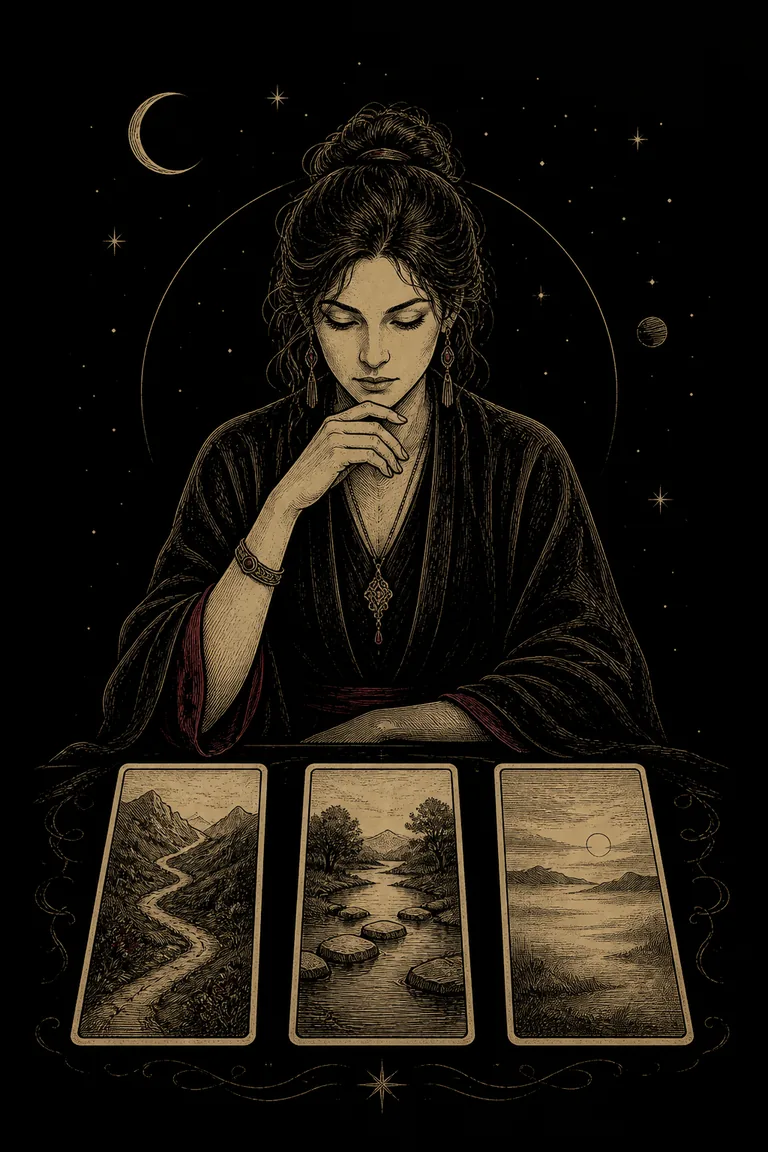
Across a spread, compare horizon visibility before writing a story. One card may offer a clean distant boundary, another may hide it behind architecture, and a third may omit it in a close interior. If the positions support a sequence, you can describe changing access to distant context. Use Tarot card combinations to preserve one shared feature and one important difference.
Reversals rotate the printed boundary
A reversed card places the printed horizon in a new orientation, but it does not make the depicted sky become literal ground. Decide whether your reversal method reads changed visual access, blocked expression, internalization, or another consistent rule. Preserve the original scene construction as evidence and avoid treating an upside-down horizon as a universal disaster sign.
Accessibility and reproduction quality
Small screens, dark printing, low contrast, cropped scans, and visual impairment can hide a faint boundary. Use an official high-resolution image, guidebook description, tactile mapping, or neutral assistance. Good alt text describes the relation without interpretation: a low straight sea horizon remains visible behind a standing figure, while clouds soften its right edge.
Save a horizon evidence map
Use Veritas to record horizon confidence, height, clear spans, interruptions, route crossings, observer position, deck baseline, spread role, alternative explanations, and what later evidence changed.
A practical Tarot journal exercise
Choose six cards from one deck. Sketch only the outer card shape and the visible or implied horizon. Add the main figure, one route, and every form that crosses or hides the boundary. Compare how much sky and ground each card provides. Finish with one sentence about spatial access and one sentence that names what the image cannot establish. A Tarot journal turns these observations into a testable deck vocabulary.
Responsible limits
Tarot horizon symbolism is a visual interpretation method, not evidence of future timing, travel, death, hope, danger, emotional distance, secrecy, or another person's plans. Do not treat sunrise as a guaranteed beginning, sunset as an ending, or a hidden boundary as deception. Visit the <a href="/tarot">Tarot journal hub</a>, compare the full deck, and let direct communication, reliable records, qualified advice, and immediate safety needs lead consequential choices.