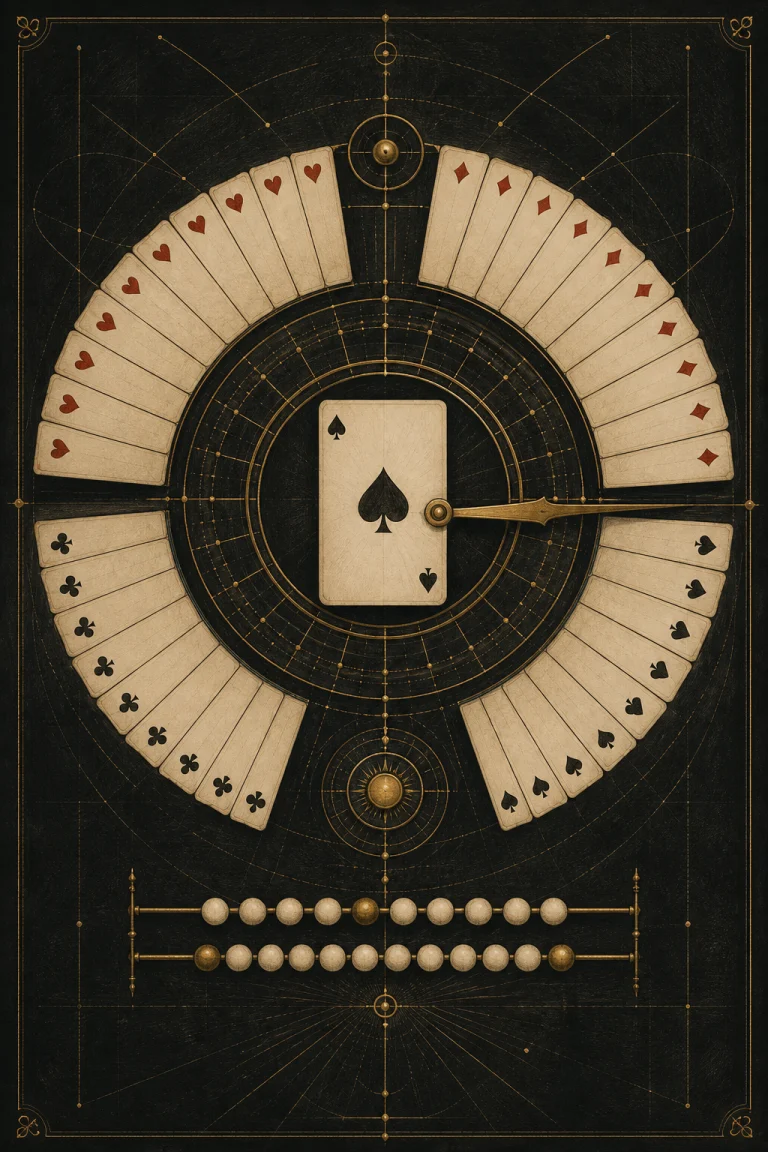
Destiny Card by Birthday: Cardology Calculation and Meaning
A transparent Cardology method that maps month and day to one playing card while keeping formula, deck order, Joker boundary, and symbolic limits visible.
Read the guideTarot Journal · Traditions & comparisons
Deck traditions, historical correspondences, mythology, astrology, alchemy, Qabalah, oracle systems, and comparisons that name their sources and limits.
VERITAS JOURNAL
FIELD NOTES · 05
Journal atlas
Five considered paths through Tarot, plus a search across every published guide.
Inside this cluster
Showing 1–12 of 12 considered guides.
A transparent Cardology method that maps month and day to one playing card while keeping formula, deck order, Joker boundary, and symbolic limits visible.
Read the guideA version-first method for using mythic comparisons without turning Tarot into one ancient universal code or letting a familiar story overrule the cards.
Read the guideA card-first reflection method that separates visual evidence, personal association, a modest hypothesis, a fair alternative, action, and review.
Read the guideA source-aware method for using alchemical transformation language without presenting Tarot as an ancient coded laboratory manual.
Read the guideA card-first method for using repeated ranks, sequences, and number transitions without replacing card imagery, spread positions, or real evidence.
Read the guideA source-aware guide to the Hermetic Qabalah map behind many Golden Dawn, Rider-Waite-Smith, and Thoth Tarot correspondences.
Read the guideA source-aware guide to adding Golden Dawn element, planet, sign, and decan correspondences without overriding the card, position, or evidence.
Read the guideRWS foregrounds narrative scenes, while Thoth foregrounds abstract visual forces and an explicit network of esoteric correspondences.
Read the guideRWS builds numbered-card meaning through scenes, while Marseille makes suit, number, pattern, direction, and card interaction carry more of the reading.
Read the guideTarot uses layered imagery and named spread positions, while Petit Lenormand builds concise statements from 36 stable emblems read in combination.
Read the guideTarot adds Major Arcana and four-card courts to a shared four-suit foundation, while playing cards offer a compact system with its own cartomancy rules.
Read the guideTarot offers a shared 78-card grammar, while each oracle deck defines its own vocabulary, categories, card count, and reading method.
Read the guideExplore the journal