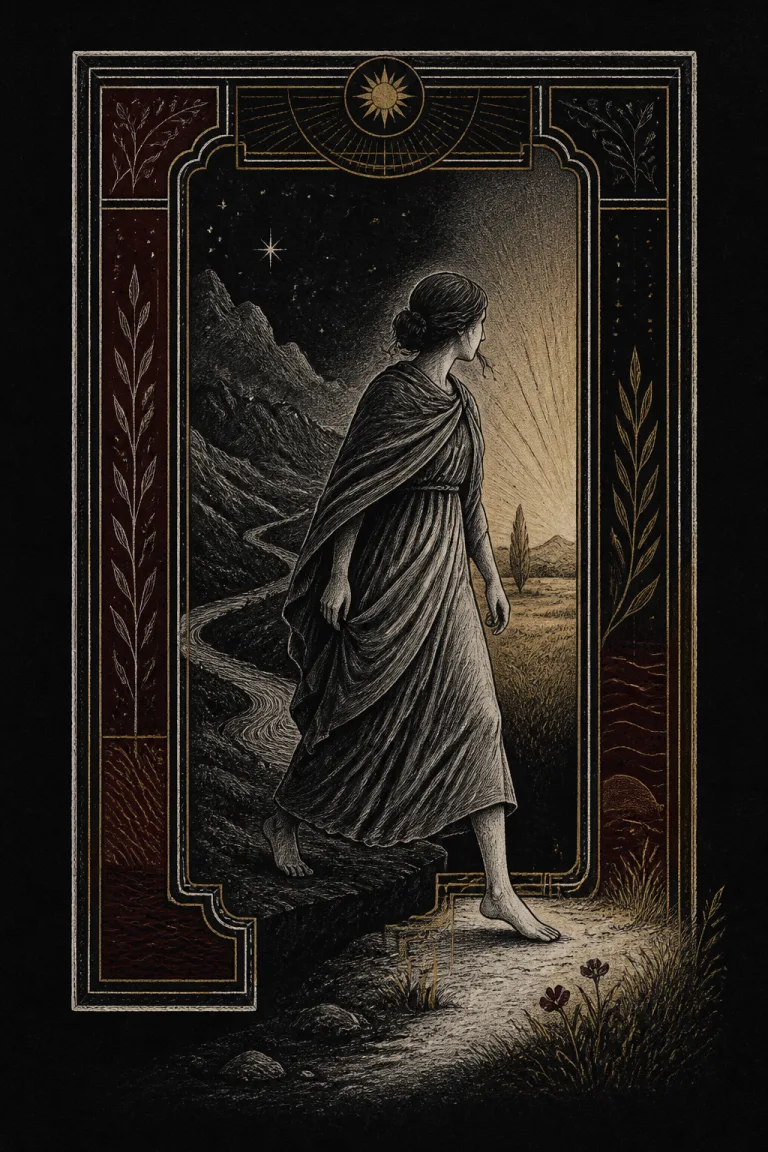


Tarot Sound Symbolism: An Evidence-First Guide
An evidence-first method for reading implied bells, voices, instruments, rhythm, interruption, and silence without inventing exact speech or messages.
Read the guideTarot Journal · Symbols & patterns
Color, direction, gesture, landscape, repetition, card combinations, suit balance, and other observable patterns that make a reading specific.
VERITAS JOURNAL
FIELD NOTES · 03
Journal atlas
Five considered paths through Tarot, plus a search across every published guide.
Inside this cluster
Showing 37–48 of 66 considered guides.
An evidence-first method for reading implied bells, voices, instruments, rhythm, interruption, and silence without inventing exact speech or messages.
Read the guideAn evidence-first method for comparing value, color, scale, edge, texture, direction, spacing, and access without forcing a binary meaning.
Read the guideAn evidence-first method for reading repeated motifs through count, location, interval, variation, interruption, and edition-specific baselines.
Read the guideAn evidence-first method for reading card borders through containment, access, interruption, overlap, crop, and edition-specific visual rules.
Read the guideAn evidence-first method for reading circles, triangles, quadrilaterals, organic forms, and negative shapes through their visible scene function.
Read the guideAn evidence-first method for reading drawn and implied lines through source, quality, endpoints, interruption, contact, repetition, and scene function.
Read the guideAn evidence-first method for mapping the frame, focal point, groups, empty areas, depth, and visual path before interpreting the whole image.
Read the guideAn evidence-first method for reading surface and substance through condition, contact, resistance, permeability, maintenance, and scene function.
Read the guideAn evidence-first method for reading relative size, visual hierarchy, perspective, distance, and distortion without turning prominence into a prediction.
Read the guideAn evidence-first method for reading tools, vessels, barriers, and ordinary objects through function, access, condition, and scene context.
Read the guideAn evidence-first method for reading depicted motion, route, pace, and control without turning visual direction into a fixed timeline or prediction.
Read the guideAn evidence-first method for reading atmospheric conditions and their scene effects without turning illustrated weather into a forecast or fixed emotional code.
Read the guideExplore the journal